Le cerveau qui reprend la parole - Semaine du cerveau 2026
Keywords
Summary
218 words
Critical Evaluation
Value of the Information & Strength of the Argument
The value of the information is high, as it provides a comprehensive overview of current knowledge on aphasia and brain plasticity, supported by clinical examples and research findings. The argumentation is solid, with clear logical progression from historical context to modern neuroimaging and rehabilitation strategies. The speakers present evidence for each claim, such as the effectiveness of intensive therapy and the potential of neuromodulation, while acknowledging uncertainties and ongoing debates.
Scientific Rigor, Source Quality, Title Accuracy
The scientific rigor is high, with references to established research and clinical practice. The sources are not explicitly cited in the video, but the speakers are experts in the field, and the content aligns with peer-reviewed literature. The title accurately reflects the content, focusing on the brain’s ability to recover language. The presentation is well-structured and scientifically sound.
143 words
Title / Content Match
The title accurately reflects the content, focusing on brain recovery of language after injury.
Quality & Reliability
8/10
The presentation is given by established researchers in the field, based on peer-reviewed studies and clinical evidence. The content is accurate and up-to-date, with clear explanations of the scientific method and limitations.
Key Moments
Markers derived by PSI from the transcript: the creator did not define chapters.
- Introduction to the evening and the topic of language disorders.
- Marina Laganaro begins her talk on language disorders and brain networks.
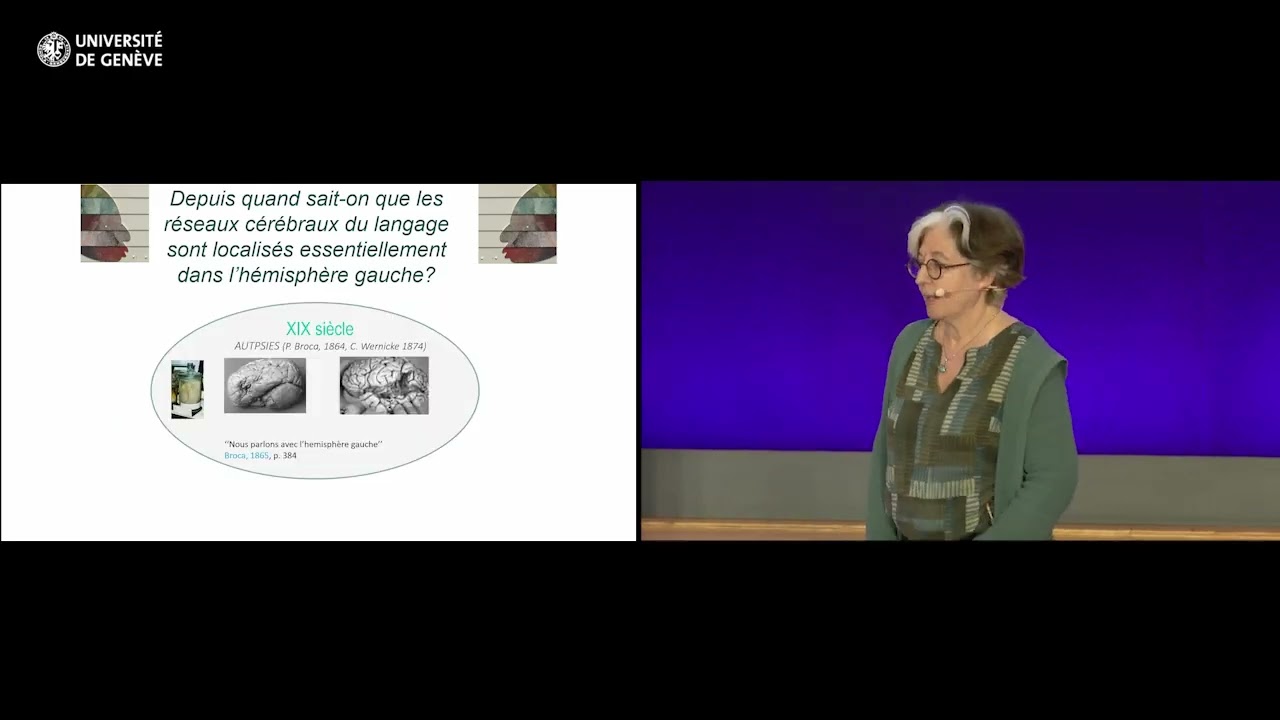
- Historical overview: from ancient beliefs to Broca and Wernicke's discoveries.
- Explanation of the canonical language network and its distributed nature.
- EEG studies showing temporal dynamics of language processes in patients.
- Case study of a patient before and after stroke, illustrating recovery and plasticity.
- Discussion on intensive speech therapy and its effectiveness.
- Adrien Guggisberg introduces brain plasticity and neuromodulation.
- Explanation of non-invasive brain stimulation techniques (TMS, tDCS).
- Evidence for enhancing recovery with neuromodulation and future directions.
Cited Sources
- No explicit sources cited in the video — The speakers did not mention specific references during the talks.
Concurring Sources
- No external sources provided — No additional concordant sources were mentioned in the video.
Dissenting Sources
- No external sources provided — No discordant sources were mentioned in the video.
Contribution & Novelties
This video provides a valuable synthesis of current knowledge on aphasia and brain plasticity, emphasizing the distributed nature of language networks and the potential for recovery through intensive therapy and neuromodulation. It bridges clinical practice and neuroscience research, offering insights into the mechanisms of recovery.
Pour aller plus loin :
- Aphasia - Wikipedia — Overview of aphasia, its causes, and types.
- Neuroplasticity - Wikipedia — General concept of brain plasticity.
- Transcranial magnetic stimulation - Wikipedia — Technique for non-invasive brain stimulation.
- Speech-language pathology - Wikipedia — Role of speech therapy in rehabilitation.
92 words
Radar Profile
The radar profile shows high scores in information quantity, quality, and reliability, with a slightly lower technical level, indicating a well-balanced presentation suitable for a general audience with some scientific depth.