Peut-on sortir de l’Anthropocène ?
Keywords
Summary
169 words
Critical Evaluation
Value of the Information & Strength of the Argument
The lecture provides a valuable philosophical perspective on the Anthropocene, synthesizing scientific, political, and ethical dimensions. Larrère’s argumentation is coherent and well-structured, moving from historical context to conceptual analysis and finally to normative proposals. She effectively critiques the managerial approach, advocating for a more holistic and ethical engagement with the environment. The discussion of controversies, such as the Capitalocene and postcolonial critiques, enriches the analysis, though some points could be further developed.
Scientific Rigor, Source Quality, Title Accuracy
The lecture demonstrates scientific rigor by referencing key scientific and political milestones (e.g., IPCC, Stockholm Conference, planetary boundaries). Larrère cites her own works and those of other scholars, but does not provide detailed citations for all claims. The title is appropriate, though the lecture does not directly answer whether we can ’exit’ the Anthropocene, instead offering philosophical reflections on how to live within it. The content aligns with the title’s promise of exploring the concept and its implications.
165 words
Title / Content Match
The title accurately reflects the content, which explores the concept of the Anthropocene and possibilities for action, though the lecture focuses more on philosophical and political perspectives than on a direct answer to 'exiting' it.
Quality & Reliability
8/10
The speaker is a recognized philosopher specializing in environmental ethics, with a long publication record. The lecture is well-structured, references scientific and political milestones, and acknowledges controversies. However, it is an opinion-based lecture, not peer-reviewed, and some claims (e.g., specific dates) are presented without detailed sourcing.
Key Moments
Markers derived by PSI from the transcript: the creator did not define chapters.
- Introduction by the host, presenting Catherine Larrère and her work.
- Larrère begins her lecture, referencing the recent COP30 and the lack of progress on climate action.
- She outlines the structure of her talk: presenting the Anthropocene, its controversies, and two models of action.
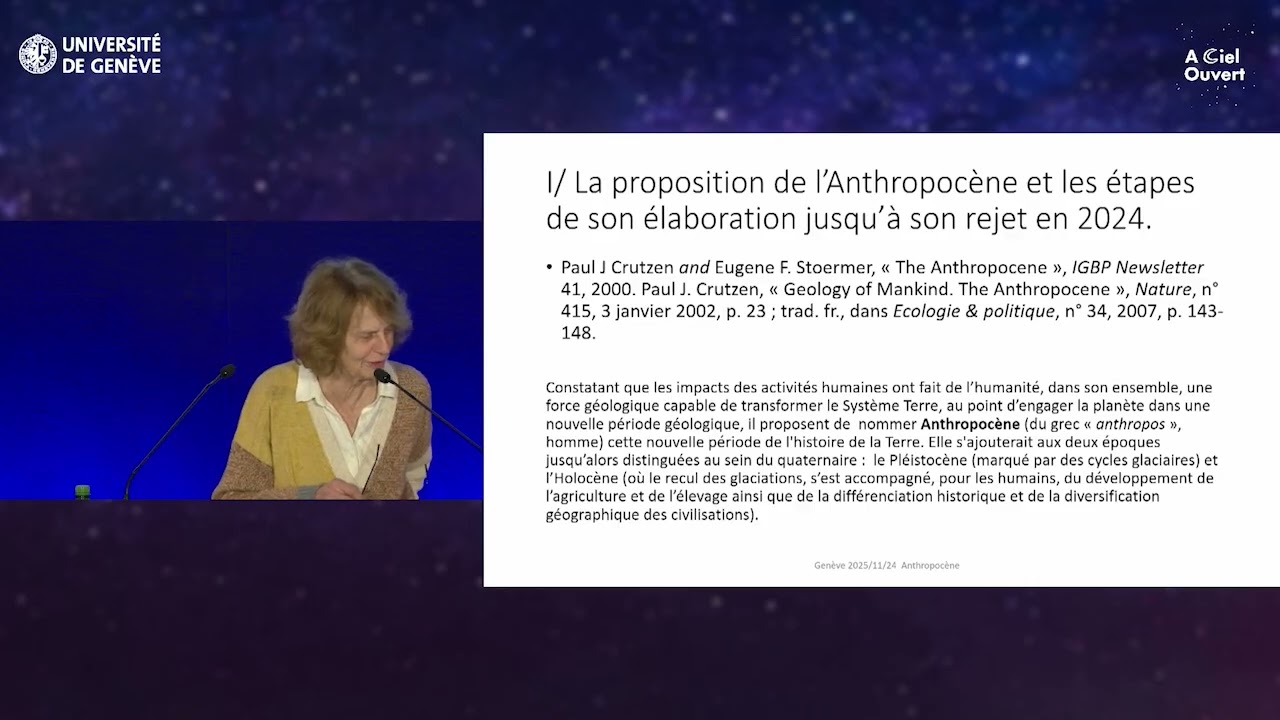
- Discussion of the origin of the Anthropocene concept by Crutzen and Stoermer in 2000.
- Contextualization of the Anthropocene within international environmental governance, mentioning Stockholm, Brundtland, and IPCC.
- Introduction of the Anthropocene Working Group and the controversies, including the Capitalocene and Chakrabarty's critique.
- Discussion of the rejection of the Anthropocene by the geological community in 2024.
- Presentation of the two models of action: managerial (planetary boundaries) and ethical-political (producing vs. inhabiting).
- Conclusion: Larrère argues for the 'inhabiting' approach and the role of philosophy in environmental action.
Cited Sources
- À Ciel Ouvert - Science et Spiritualité — Programme of the conference series in which this lecture was given.
Concurring Sources
- Anthropocene - Wikipedia — Provides background on the concept and its scientific discussion.
- Planetary boundaries - Wikipedia — Relevant to the managerial approach discussed in the lecture.
Dissenting Sources
- Anthropocene Working Group — The lecture mentions the rejection of the Anthropocene by the geological community, which is a point of contention.
Contribution & Novelties
The lecture offers a philosophical synthesis of the Anthropocene debate, emphasizing the distinction between managerial and ethical-political responses. It contributes to the discourse by advocating for a shift from ‘producing’ to ‘inhabiting’ the Earth, integrating insights from environmental philosophy and political ecology.
Pour aller plus loin :
- Anthropocene - Wikipedia — Overview of the concept and its history.
- Planetary boundaries - Wikipedia — Framework for the managerial approach discussed.
- Capitalocene - Wikipedia — Alternative term and critique of the Anthropocene.
- Dipesh Chakrabarty - Wikipedia — Postcolonial historian whose critique is mentioned.
- Paul Crutzen - Wikipedia — Nobel laureate who proposed the Anthropocene.
102 words
Radar Profile
The radar profile shows high scores in quantity and quality of information, reflecting the lecture's comprehensive coverage and philosophical depth. The technical level is moderate, suitable for a general audience. Reliability is high due to the speaker's expertise, though the opinion-based nature slightly lowers it.