À l’intérieur du cerveau qui parle - Semaine du Cerveau 2026
Keywords
Summary
163 words
Critical Evaluation
Value of the Information & Strength of the Argument
The presentation provides valuable insights into the neural basis of language, combining interactive demonstrations with empirical evidence from EEG/MEG studies. The argumentation is solid, building from basic concepts to more complex findings, and effectively uses cross-linguistic comparisons (Korean vs. Russian) to illustrate how the brain adapts to native language phonology. The speaker’s expertise is evident, and she clearly explains the significance of the research for understanding language acquisition and processing. However, some claims could benefit from more explicit references to specific studies, and the discussion of syntax is less detailed than the phonological section.
103 words
Title / Content Match
The title accurately reflects the content, which explores the neural architecture underlying language processing.
Quality & Reliability
8/10
Presentation by a recognized professor and co-director of a national research center, based on established research and methods (EEG/MEG), with clear explanations and references to studies. Minor limitations: no detailed citations of specific studies during the talk, and some simplifications for a general audience.
Key Moments
Markers derived by PSI from the transcript: the creator did not define chapters.
- Introduction to the Brain Week and the topic of language.
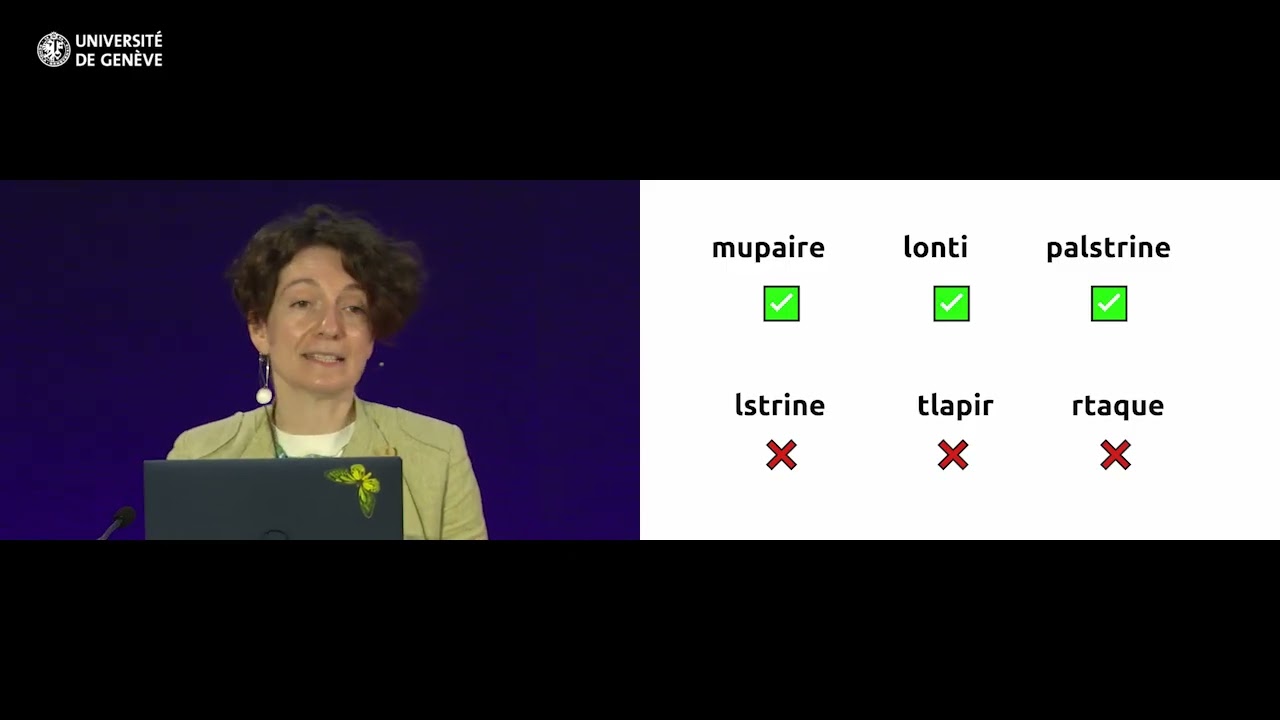
- Interactive demonstration on possible French words, illustrating implicit phonological knowledge.
- Explanation of phonology and the distinction between phonemes and allophones, using Korean and Russian examples.
- Introduction to EEG/MEG methods for studying brain activity during language tasks.
- Discussion of the auditory cortex and its role in processing speech sounds, with evidence from MEG studies.
- Developmental studies on infant speech perception, showing the shift from universal to language-specific perception.
- Transition to syntax, with interactive demonstration on pronoun interpretation.
- Explanation of syntactic structure and its role in coreference, concluding remarks.
Cited Sources
- Janet Werker's research on infant speech perception — Mentioned in the video as a well-known researcher in the field, with a video demonstration of the head-turn procedure.
Concurring Sources
- Werker, J. F., & Tees, R. C. (1984). Cross-language speech perception: Evidence for perceptual reorganization during the first year of life. — Classic study on infant speech perception, consistent with the developmental findings discussed.
Contribution & Novelties
The presentation offers a clear and engaging overview of the neural basis of language, emphasizing the role of the auditory cortex in phonological processing and the importance of early language experience. It integrates interactive demonstrations to illustrate implicit linguistic knowledge, making complex concepts accessible. The speaker’s expertise and the inclusion of recent research from the Evolving Language center add value.
Pour aller plus loin :
- Phoneme perception and language-specific tuning — Overview of phonemes and cross-linguistic variation.
- Electroencephalography (EEG) — Technique used to measure brain activity.
- Magnetoencephalography (MEG) — Another technique mentioned in the talk.
- Critical period hypothesis — Relevant to language acquisition and the window of opportunity.
- Syntax and sentence processing — Basic concepts of syntactic structure.
118 words
Radar Profile
The radar profile shows high scores in information quantity, quality, and reliability, with a slightly lower technical level, reflecting the accessible yet scientifically grounded nature of the presentation.