Histoire du Big-Bang et l’origine de notre Univers - Conférence de Françoise Combes
Keywords
Summary
156 words
Critical Evaluation
Value of the Information & Strength of the Argument
The presentation offers a comprehensive and well-structured overview of the Big Bang theory, supported by historical context and modern observations. The argumentation is solid, relying on established scientific evidence such as the cosmic microwave background and Hubble’s law. The speaker’s expertise adds credibility, and the inclusion of recent James Webb results demonstrates the ongoing evolution of the field. The use of analogies (balloon, sun’s surface) helps convey complex concepts, though some simplifications are made for a general audience.
Scientific Rigor, Source Quality, Title Accuracy
The scientific rigor is high, with accurate explanations of key concepts and proper attribution to historical figures. The speaker references her own publications and the work of others, though specific citations are not detailed in the talk. The title accurately reflects the content, which is a historical and scientific overview. The talk is part of a university program, adding to its reliability. No comments were provided for analysis.
161 words
Title / Content Match
The title accurately reflects the content, which is a historical overview of the Big Bang theory and the origin of the universe, presented by an expert.
Quality & Reliability
9/10
The speaker is a renowned astrophysicist, member of the Académie des Sciences, and the content is based on established scientific knowledge. The presentation is clear, well-structured, and includes recent findings from the James Webb Space Telescope. Minor simplifications for a general audience do not compromise accuracy.
Key Moments
Markers derived by PSI from the transcript: the creator did not define chapters.
- Introduction by the host, presenting Françoise Combes and her credentials.
- Combes begins her talk, referencing the Flammarion engraving and the concept of multiverses.
- Historical overview of the universe's size from ancient times to Copernicus and Newton.
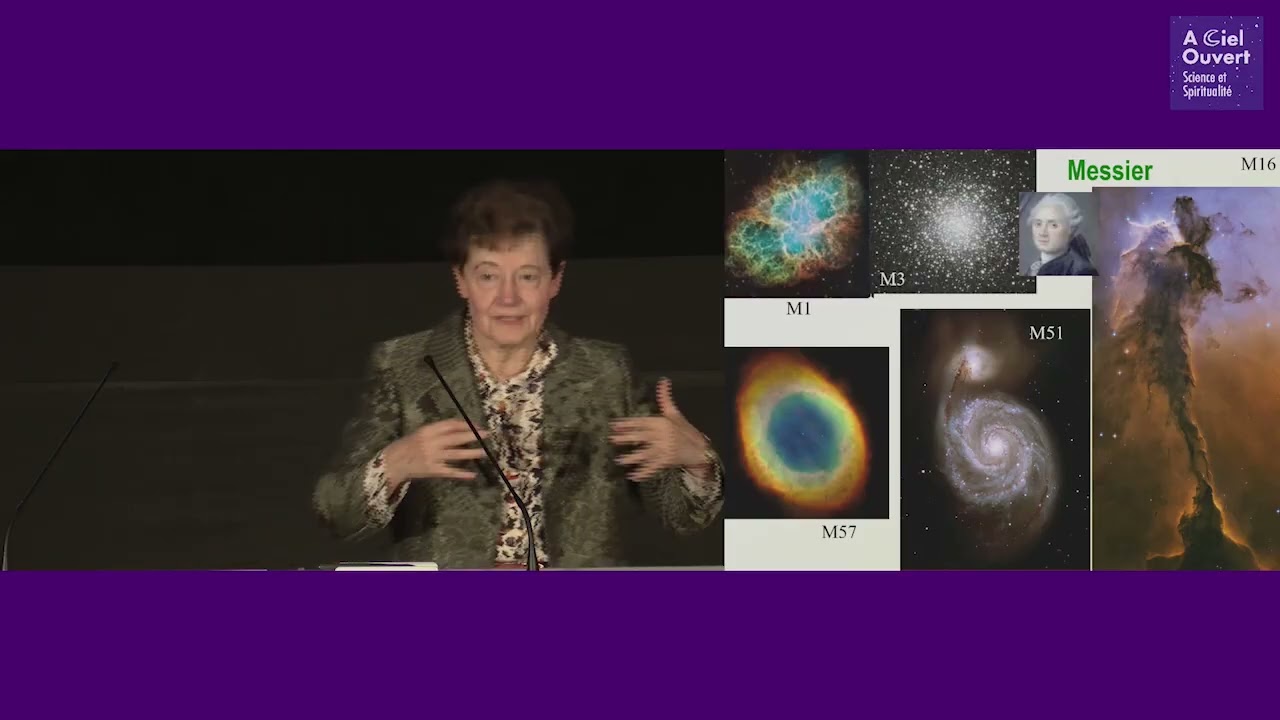
- Discussion of Messier's nebulae and the early classification of astronomical objects.
- The Great Debate between Shapley and Curtis, and the role of Henrietta Leavitt's Cepheid variables.
- Hubble's law and the expansion of the universe, with Lemaître's theoretical contribution.
- Explanation of the cosmic microwave background and its discovery by Penzias and Wilson.
- The balloon analogy for cosmic expansion and the redshift effect.
- General relativity and the cosmological constant, with Einstein's initial static universe.
- Recent results from the James Webb Space Telescope and their implications for early galaxy formation.
Cited Sources
- Programme À Ciel Ouvert - Science et Spiritualité — The conference is part of this program, and the link provides more information about the series.
Concurring Sources
- Big Bang - Wikipedia — General reference for the Big Bang theory.
- Cosmic microwave background - Wikipedia — Reference for the CMB as evidence for the Big Bang.
Contribution & Novelties
The talk provides a clear historical narrative of the Big Bang theory, integrating recent James Webb Space Telescope findings that are reshaping our understanding of early galaxy formation. It emphasizes the role of key scientists and the evolution of cosmological models. The speaker’s expertise adds depth, making it a valuable resource for both general audiences and students.
Pour aller plus loin :
- Big Bang - Wikipedia — Comprehensive overview of the theory.
- Cosmic microwave background - Wikipedia — Detailed explanation of this key evidence.
- James Webb Space Telescope - Wikipedia — Information on the telescope and its discoveries.
98 words
Radar Profile
The radar profile shows high scores in quantity and quality of information, with a slightly lower technical level, reflecting the accessible yet rigorous nature of the talk. The overall reliability is high, consistent with the speaker's expertise and the scientific consensus.