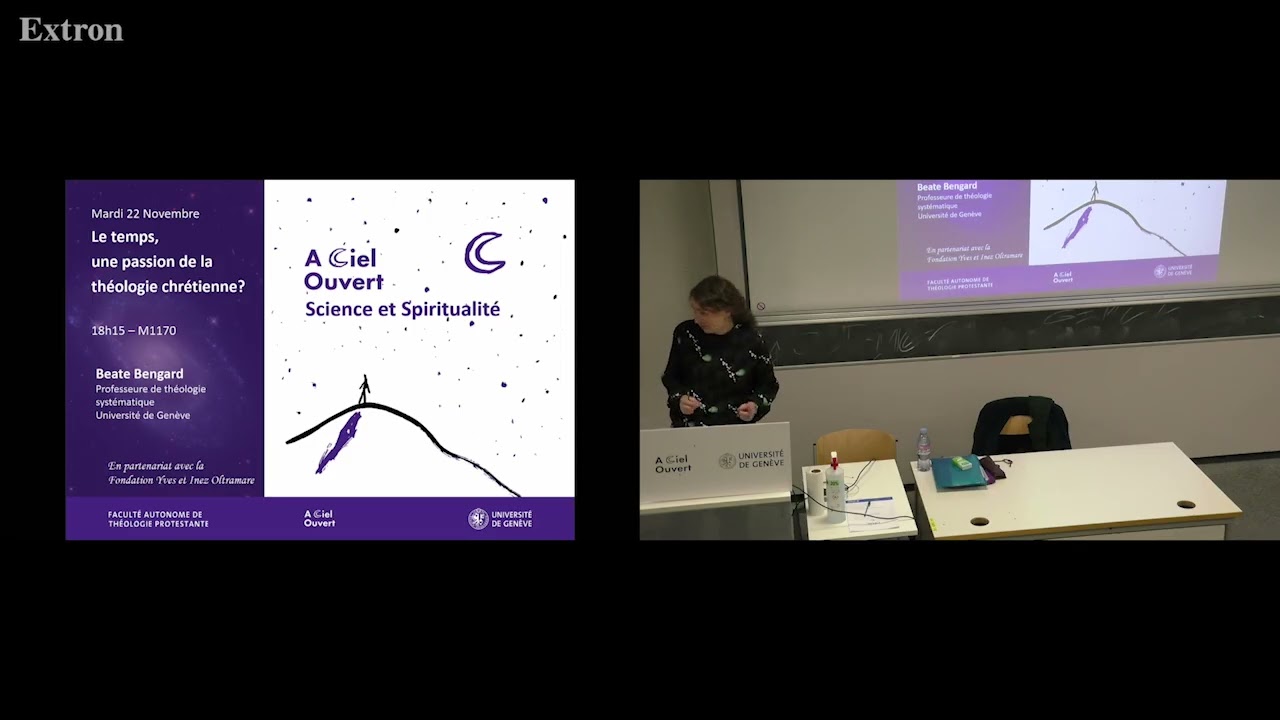
Le temps, une passion de la théologie chrétienne ? - Conférence de Beate Bengard
Keywords
Summary
138 words
Critical Evaluation
Value of the Information & Strength of the Argument
The lecture provides a comprehensive overview of the topic, drawing on key theological sources and historical examples. The argumentation is coherent, tracing the development of the concept of time from Augustine to contemporary theology. The speaker effectively uses examples like the Autun Cathedral and the Gregorian calendar reform to illustrate the intersection of theology and science. However, the lecture is primarily descriptive rather than critical, and it does not engage deeply with potential objections or alternative interpretations. The value lies in its synthesis of historical and theological material, making it a useful introduction for those interested in the topic.
Scientific Rigor, Source Quality, Title Accuracy
The lecture demonstrates scientific rigor through its use of primary sources (Augustine, Bible) and historical references (calendar reform, medieval architecture). The speaker is a qualified academic, and the content is presented in a structured manner. The title accurately reflects the content, and the lecture maintains a clear focus. However, the sources are not explicitly cited in the video, and the lecture relies on the speaker’s expertise rather than providing a detailed bibliography. The adequacy between title and content is high, as the lecture directly addresses the question posed.
202 words
Title / Content Match
The title accurately reflects the content, which explores the theme of time in Christian theology, with a question mark indicating a nuanced approach.
Quality & Reliability
8/10
The lecture is given by a professor of theology at the University of Geneva, with a clear academic structure and references to historical sources (Augustine, Bible, medieval architecture, calendar reform). The content is well-documented and presented in a scholarly manner, though it is a single perspective without critical engagement with alternative views.
Key Moments
Markers derived by PSI from the transcript: the creator did not define chapters.
- Introduction and welcome by the host, introducing the speaker and the topic.
- Start of the lecture: Augustine's view of time, subjective and ephemeral.
- Discussion of biblical perspectives on time, including Ecclesiastes and Exodus.
- Exploration of medieval architecture and the zodiac on Autun Cathedral.
- Explanation of the Gregorian calendar reform and its theological implications.
- Contemporary theological discussions on time and eschatology.
Cited Sources
- À Ciel Ouvert - Science et Spiritualité — Programme under which the lecture was given, providing context for the interdisciplinary dialogue.
Concurring Sources
- Augustine's Confessions — Primary source for Augustine's reflections on time.
- Eschatology — Theological concept of last things, relevant to the lecture's discussion.
Contribution & Novelties
The lecture offers a synthesis of historical and theological perspectives on time, highlighting the evolution from Augustine to contemporary eschatology. It uniquely integrates architectural and calendar examples to illustrate the practical engagement of theology with time measurement. The discussion of the Gregorian calendar reform as a theological concern is particularly insightful.
Pour aller plus loin :
- Augustine’s Confessions — Primary source for Augustine’s view on time.
- Eschatology — Concept of last things in theology.
- Gregorian calendar — Historical reform discussed in the lecture.
83 words
Radar Profile
The radar profile shows high scores in quantity and quality of information, with a moderate technical level, indicating a well-structured and informative lecture accessible to a general audience. The reliability is high due to the academic background of the speaker.
💬 No comments were provided for analysis.