Les voies du langage non verbal - Semaine du Cerveau 2026
Keywords
Summary
145 words
Critical Evaluation
Value of the Information & Strength of the Argument
The value of the information is high, as it presents current scientific research and debunks common myths. The argumentation is solid, grounded in empirical studies and theoretical frameworks from communication science and affective neuroscience. Bangerter’s critique of pseudoscience is well-supported, and his examples from his own research illustrate the points effectively. Grandjean’s talk, while less detailed in this excerpt, provides a comparative perspective that enriches the discussion. The speakers maintain a rigorous scientific approach, avoiding overgeneralizations.
Scientific Rigor, Source Quality, Title Accuracy
The scientific rigor is evident in the use of peer-reviewed research and ongoing projects. Bangerter cites specific studies, such as those by Janet Bavelas, and his own eye-tracking research. Grandjean’s work is part of the Swiss Center for Affective Sciences, indicating institutional backing. The title accurately reflects the content, which covers both human and non-human communication. The presentation is well-structured and adheres to scientific standards.
156 words
Title / Content Match
The title accurately reflects the content, which covers both human nonverbal communication and vocal emotions in primates, aligning with the 'Semaine du Cerveau' theme.
Quality & Reliability
8/10
The video features two academic experts (Adrian Bangerter and Didier Grandjean) presenting research-based content, with references to scientific studies and ongoing projects. The presentation debunks pseudoscience and emphasizes empirical methods. Minor limitations include lack of detailed citations and some anecdotal examples.
Key Moments
Markers derived by PSI from the transcript: the creator did not define chapters.
- Introduction to the conference and speakers.
- Bangerter debunks myths about nonverbal communication, citing Cicero and Freud.
- Discussion of pseudoscientific practices like NLP and synergology.
- Introduction to multimodal and interactive perspective on communication.
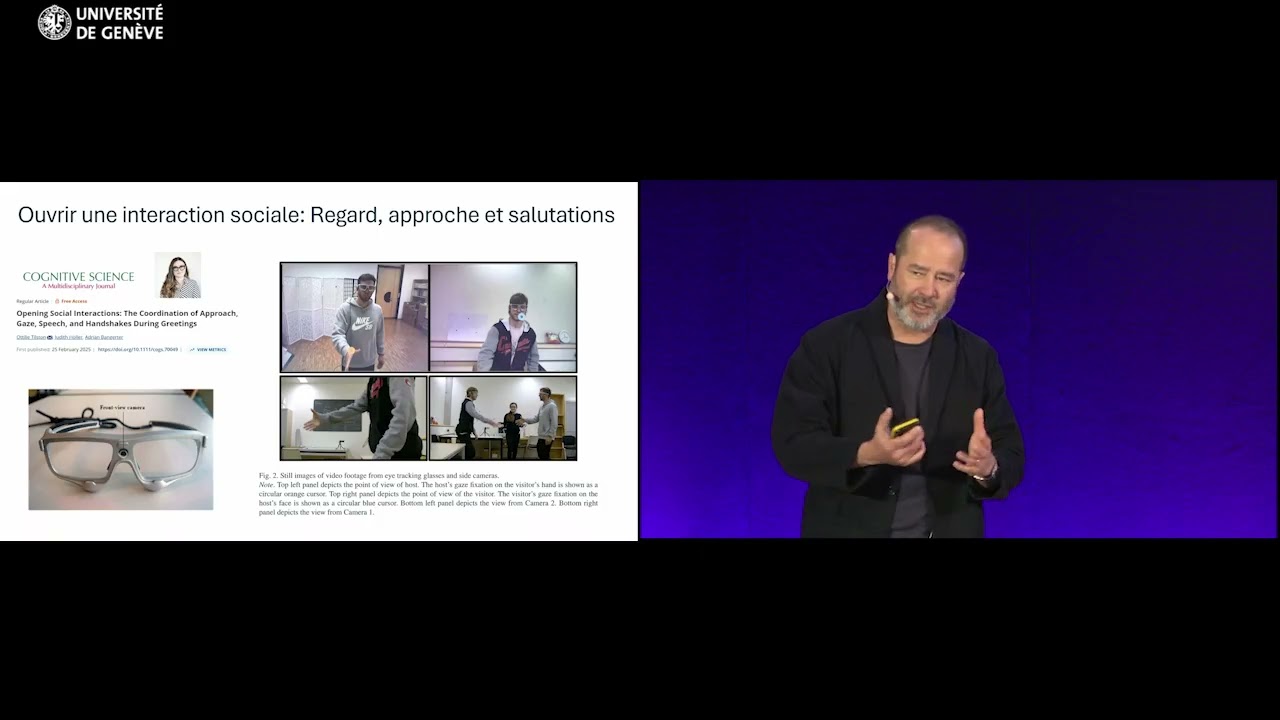
- Eye-tracking study on greetings, showing gaze coordination during handshakes.
- Storytelling study, illustrating the role of gaze in eliciting back-channel signals.
- Cross-cultural comparison of storytelling gaze patterns in Swiss German, Shipibo-Konibo, and Mom.
- Transition to Grandjean's talk on vocal emotions in primates.
- Grandjean discusses the neural basis of emotional vocalizations in primates.
- Comparative analysis of vocal emotional expressions across primate species.
Cited Sources
- Janet Bavelas' research on back-channeling — Mentioned in Bangerter's talk as foundational to understanding interactive storytelling.
- Evolving Language National Centre of Competence in Research — Mentioned as the partnership for the conference and the context for cross-cultural storytelling research.
- Swiss Center for Affective Sciences — Mentioned as the center directed by Didier Grandjean.
Concurring Sources
- Bavelas, J. B., & Chovil, N. (2000). Visible acts of meaning. — Bangerter's discussion of back-channeling aligns with Bavelas's work on visible acts of meaning.
- Grandjean, D., & Scherer, K. R. (2008). Unpacking the cognitive architecture of emotion processes. — Grandjean's research on emotional prosody is consistent with this work.
Dissenting Sources
- Pseudoscientific claims about nonverbal communication — Bangerter explicitly refutes claims from NLP and synergology, which lack empirical support.
Contribution & Novelties
The video provides a valuable synthesis of current research on nonverbal communication, debunking popular myths and presenting empirical evidence for a multimodal, interactive view. It highlights the importance of gaze coordination in social interactions and extends the discussion to primate vocalizations, offering an evolutionary perspective. The cross-cultural storytelling study is particularly novel, suggesting universal patterns in gaze and back-channeling.
Pour aller plus loin :
- Multimodal communication — Overview of multimodal communication theory.
- Eye tracking — Technique used in the greeting study.
- Backchannel (linguistics) — Concept of listener responses in conversation.
- Primate communication — General overview of primate communication.
- Affective neuroscience — Field relevant to Grandjean’s work on emotions.
108 words
Radar Profile
The radar profile shows high scores across all dimensions, indicating a well-balanced and reliable presentation. The strong scores in quality and reliability reflect the academic expertise and empirical grounding, while the slightly lower technical level suggests accessibility to a general audience.
💬 Sur les 0 commentaires analysés, aucune tendance n'est disponible.