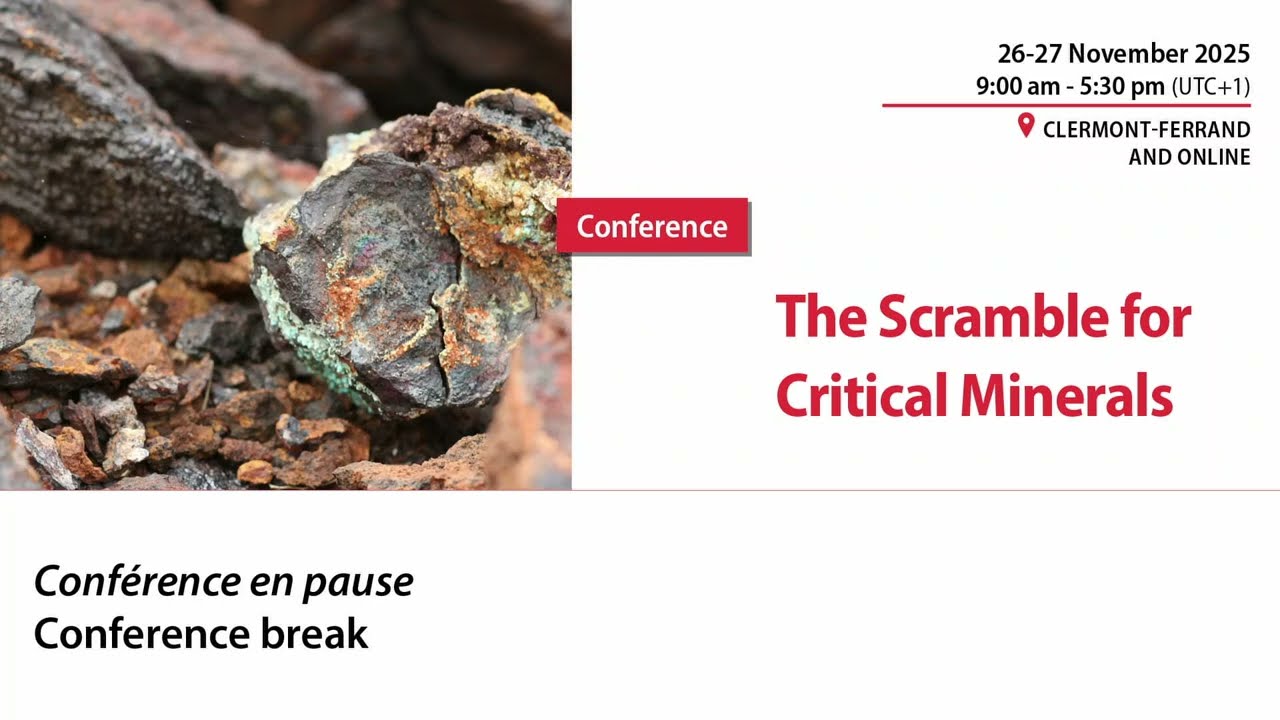
The Scramble for Critical Minerals (Part 3: Geoeconomics of Critical Minerals)
Keywords
Summary
172 words
Critical Evaluation
Value of the Information & Strength of the Argument
The presentations offer valuable insights into the geoeconomics of critical minerals. The first paper provides a rigorous theoretical framework using real options analysis, highlighting the ambiguous effects of geopolitical fragmentation and recycling on mine opening decisions. The second paper combines empirical analysis with theoretical modeling, showing that geopolitical shocks are perceived as demand shocks, which is a novel finding. The third paper addresses a timely policy issue with empirical evidence. The argumentation is solid, with clear methodologies and appropriate caveats. However, the presentations are work in progress, and some results are preliminary, which limits the overall value.
Scientific Rigor, Source Quality, Title Accuracy
The presentations demonstrate scientific rigor, with references to relevant literature and data sources. The first paper builds on established real options literature and cites empirical studies on resource prices. The second paper uses a well-known political relations index and structural VAR methodology, and references the work of Kilian. The third paper likely uses trade data and policy documents. The title accurately reflects the content, which focuses on geoeconomic aspects. The sources are appropriate, though not all are explicitly cited in the video. The adéquation between title and content is good.
202 words
Title / Content Match
The title accurately reflects the content, which focuses on the geoeconomic aspects of critical minerals, including geopolitical risks, strategic stockpiling, and supply chain dependencies.
Quality & Reliability
7/10
The video presents three academic papers with rigorous theoretical and empirical methodologies, but the content is preliminary and not peer-reviewed. The presentations are clear and well-structured, but the lack of published results and the limited audience prevent a higher score.
Key Moments
Markers derived by PSI from the transcript: the creator did not define chapters.
- Introduction and first presentation by Aude Pommeret on opening mines under geopolitical risk.
- Discussion of the European Critical Raw Materials Act and the objective of 10% domestic extraction.
- Literature review on critical raw materials and the gap in supply-side analysis.
- Presentation of the real options model with jump diffusion processes.
- Analysis of the effects of uncertainty and geopolitical fragmentation on mine opening.
- Discussion of recycling and its three effects on the model.
- Q&A session on the first paper, addressing policy implications and limitations.
- Second presentation by Jamel Saadaoui on critical minerals and geopolitical rivalry.
- Empirical analysis using political relations index and structural VAR.
- Theoretical model of strategic stockpiling and its implications.
- Third presentation by Kevin Thow on China's export bans and diversification.
- Q&A and concluding remarks.
Cited Sources
- Critical Raw Materials Act — Mentioned in the first presentation as a policy benchmark for EU domestic extraction.
- World Bank Commodity Price Data — Used in the first presentation to show impulse response functions of resource prices to supply shocks.
- Kilian (2009) - Not All Oil Price Shocks Are Alike — Referenced in the second presentation for the methodology to classify shocks.
- Jordà (2005) - Estimation and Inference of Impulse Responses by Local Projections — Referenced in the second presentation for local projection methodology.
Concurring Sources
- Critical Raw Materials Act — Supports the policy context discussed in the first presentation.
- World Bank Commodity Price Data — Provides data consistent with the empirical analysis in the first presentation.
Dissenting Sources
- Kilian (2009) - Not All Oil Price Shocks Are Alike — The second presentation finds geopolitical shocks act as demand shocks, while Kilian's framework often classifies geopolitical events as supply shocks. This is a point of contention.
Contribution & Novelties
The video provides novel contributions to the geoeconomics of critical minerals. The first paper introduces a real options model that explicitly incorporates geopolitical fragmentation risk and recycling, offering new insights into mine opening decisions. The second paper empirically identifies geopolitical shocks as demand shocks, challenging conventional wisdom, and develops a theoretical model of strategic stockpiling. The third paper provides empirical evidence on the impact of China’s export bans. These contributions advance the understanding of supply chain vulnerabilities and policy responses.
Pour aller plus loin :
- Real options analysis — Foundational concept for the first paper.
- Geopolitical risk index — Alternative measure of geopolitical risk.
- Critical minerals list — USGS list of critical minerals.
- Strategic petroleum reserve — Analogous concept for stockpiling.
121 words
Radar Profile
The radar profile shows high scores in quantity of information and technical level, indicating a dense and specialized content. Quality of information and global reliability are slightly lower, reflecting the preliminary nature of the research. The overall balance suggests a technically strong but not yet fully validated presentation.
💬 No comments were provided for analysis.