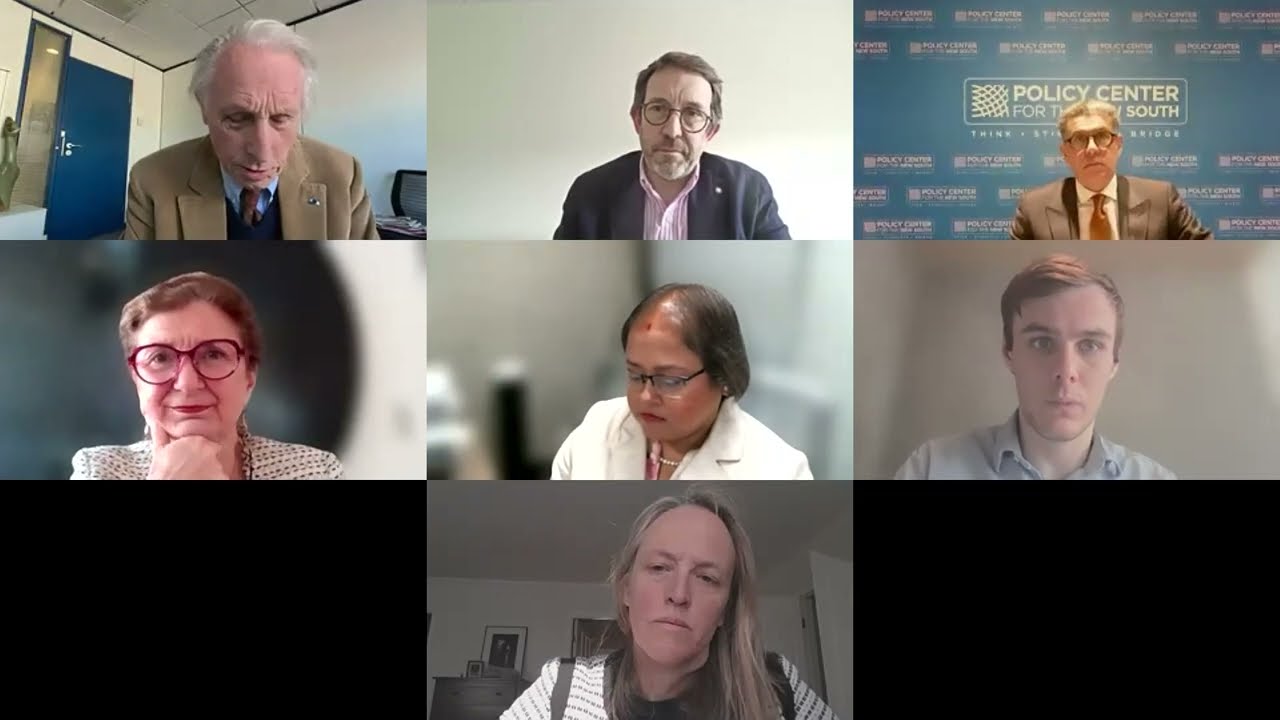
Qui doit financer la lutte internationale contre le changement climatique ?
Keywords
Summary
269 words
Critical Evaluation
Value of the Information & Strength of the Argument
The webinar provides substantial value by bringing together diverse expert perspectives on a critical policy issue. The arguments are well-structured and grounded in empirical data, such as the shift in global GDP and emissions shares. Sylvie Lemmet’s presentation offers a clear historical context and a compelling case for updating the CBDR principle. Gaia Larsen’s tool adds a practical dimension, allowing for scenario analysis. The panelists engage with each other’s points, creating a dynamic debate. However, some arguments are more normative than evidence-based, and the discussion sometimes lacks concrete proposals for implementation. The overall argumentation is solid, but the value could be enhanced by more specific policy recommendations.
Scientific Rigor, Source Quality, Title Accuracy
The webinar demonstrates high scientific rigor, with panelists referencing official reports, data from international organizations, and their own research. The sources cited are credible and relevant. The title accurately reflects the content, as the entire discussion revolves around the question of financing climate action. The panelists do not shy away from controversial topics, such as the role of China and the need to reform the donor base. The discussion is well-moderated and stays on topic. The only minor weakness is that some claims are not fully sourced, but overall, the rigor is commendable.
215 words
Title / Content Match
The title accurately reflects the central question of the webinar, which is thoroughly addressed by the panel.
Quality & Reliability
8/10
High-level expert panel with recognized institutions (FERDI, WRI, ICRIER, I4CE, etc.), data-driven arguments, and references to official reports. The debate is structured and balanced, though it remains a policy discussion rather than a peer-reviewed study.
Key Moments
Markers derived by PSI from the transcript: the creator did not define chapters.
- Patrick Guillaumont introduces the webinar series on climate finance and development.
- Sylvie Lemmet presents the historical evolution of the CBDR principle and the obsolescence of Annex I/II categories.
- Gaia Larsen introduces the WRI tool for exploring donor country scenarios based on income and emissions.
- Karim El Aynaoui discusses the need for a new framework reflecting current geopolitical realities.
- Amrita Goldar highlights the perspective of developing countries on adaptation finance and just transition.
- Justin Yifu Lin argues for a structural approach to support developing countries in their development paths.
- Guillaume Pottier discusses practical challenges in mobilizing and allocating climate finance.
- Q&A session and concluding remarks on the future of climate finance.
Cited Sources
- Après Bélém, refonder la responsabilité commune mais différenciée à l'heure du grand basculement — Working paper by Sylvie Lemmet, referenced during her presentation.
- WRI Climate Finance Access Tool — Interactive tool presented by Gaia Larsen to explore donor country scenarios.
Concurring Sources
- World Resources Institute (WRI) Climate Finance — WRI's work on climate finance aligns with the webinar's discussion on access and allocation.
- OECD Development Assistance Committee (DAC) — OECD data on development finance, referenced in the discussion on donor contributions.
Dissenting Sources
- Climate Finance: A Critical Review — Some academic critiques argue that the current climate finance architecture perpetuates inequalities and fails to address the needs of the most vulnerable, which contrasts with the more reformist approach of the webinar.
Contribution & Novelties
The webinar provides a timely and comprehensive analysis of the challenges facing the international climate finance system. It brings together experts from both developed and developing countries, offering a balanced perspective on the need to reform the CBDR principle. The introduction of the WRI tool is a novel contribution, as it allows stakeholders to visualize different scenarios for donor contributions. The discussion also highlights the importance of updating the criteria for both contributors and beneficiaries, moving beyond the static Annex I/II categories. The webinar contributes to the ongoing debate on climate justice and the future of international cooperation.
Pour aller plus loin :
- Common but Differentiated Responsibilities — Provides background on the principle and its evolution.
- Paris Agreement — The key international treaty on climate change, which builds on the CBDR principle.
- World Resources Institute Climate Finance — Additional resources and analysis on climate finance from WRI.
147 words
Radar Profile
The radar profile shows high scores in information quantity, quality, and technical level, reflecting the expert panel and data-rich presentations. The reliability score is also high, indicating a trustworthy discussion. The overall profile suggests a well-rounded and informative webinar.
💬 No comments were provided for analysis.