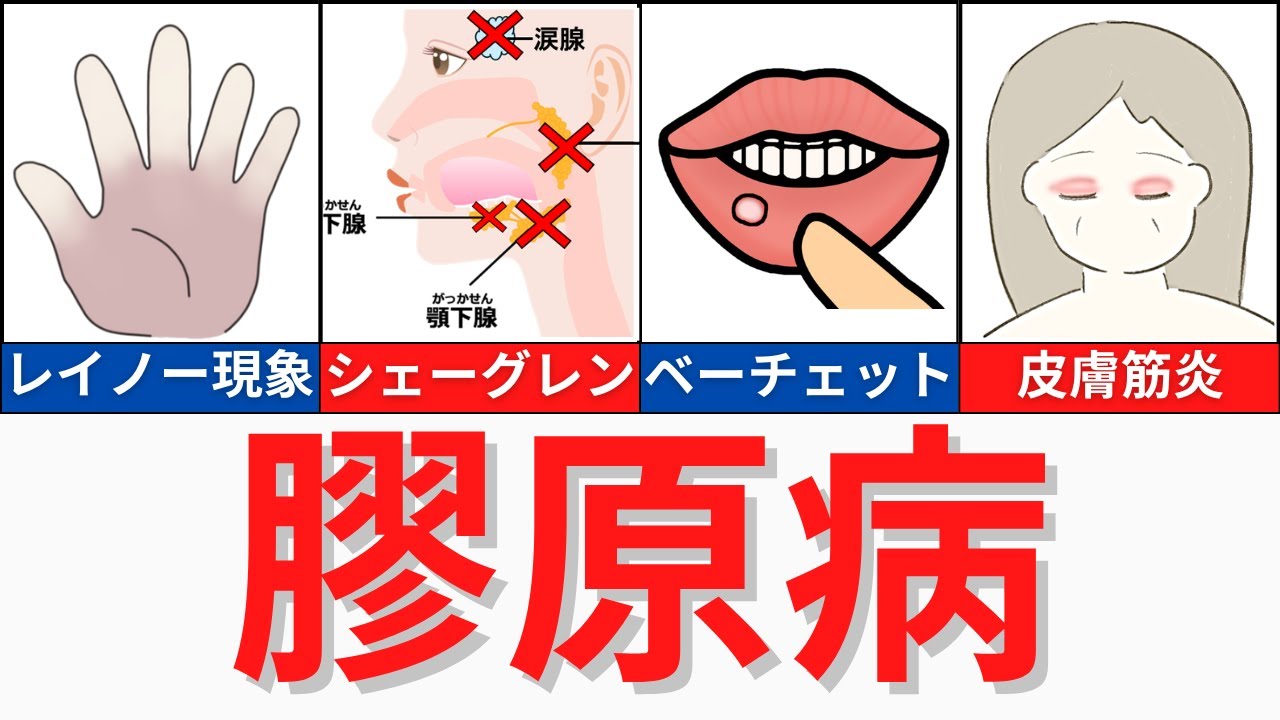
【10分で解説】膠原病について解説 SLE・関節リウマチ以外 17:10は読み間違いです💦胸腺ではなく涙腺が正解です🙏
Keywords
Summary
172 words
Critical Evaluation
Value of the Information & Strength of the Argument
The video provides valuable educational content for nursing students, systematically presenting the key features, symptoms, and mechanisms of various collagen diseases. The argumentation is clear and logical, using simple analogies and visual aids to explain complex concepts. The inclusion of exam-style questions reinforces learning and helps viewers apply the knowledge. However, the scientific depth is limited, as it does not delve into molecular mechanisms or recent research findings. The presenter acknowledges the complexity and simplifies the content for the target audience, which is appropriate for an educational tutorial.
Scientific Rigor, Source Quality, Title Accuracy
The video demonstrates a reasonable level of scientific rigor, with accurate descriptions of disease characteristics and symptoms. However, it does not cite specific sources or references, relying on general medical knowledge. The title accurately reflects the content, and the presenter corrects a misreading, showing attention to accuracy. The video is well-structured with clear chapters, aiding comprehension. The lack of citations and the simplified nature of the content may limit its use for advanced learners, but it is suitable for introductory education.
184 words
Title / Content Match
The title accurately reflects the content, which covers collagen diseases other than SLE and RA, and includes a correction note about a misreading.
Quality & Reliability
7/10
The video provides a structured overview of collagen diseases (excluding SLE and RA), with clear explanations of symptoms and mechanisms. It includes a disclaimer about a misreading, showing some attention to accuracy. However, it lacks citations to primary sources and is based on general medical knowledge, which limits its scientific depth.
Chapters
Cited Sources
- Related video: Systemic lupus erythematosus (SLE) explanation — Referenced as a related video for SLE, which is excluded from this video's scope.
- Related video: Steroids explanation — Referenced as a related video on steroid treatment, relevant to collagen disease management.
- Related video: Rheumatoid arthritis — Referenced as a related video on RA, another collagen disease not covered in detail here.
- Recommended playlist: Important anatomy, diseases, and treatments — Recommended playlist for further study on anatomy and diseases.
Concurring Sources
- Sjögren's syndrome - Mayo Clinic — Confirms the main symptoms of dryness and autoimmune nature.
- Behçet's disease - National Organization for Rare Disorders — Supports the description of oral ulcers and uveitis as common features.
- Systemic sclerosis - MedlinePlus — Provides information on skin thickening and organ involvement.
Dissenting Sources
- No discordant sources found — The video's content aligns with established medical knowledge; no conflicting sources were identified.
Contribution & Novelties
The video offers a concise and structured overview of collagen diseases, specifically targeting nursing students preparing for the Japanese national exam. Its originality lies in its focus on diseases other than SLE and RA, which are often covered separately, and its integration of exam-style questions to reinforce learning. The explanation of Raynaud’s phenomenon is particularly detailed, including the physiological basis for color changes. The video also provides practical patient education tips, such as using warm water for washing, which are clinically relevant.
Pour aller plus loin :
- Sjögren’s syndrome - Wikipedia — Provides comprehensive information on symptoms, diagnosis, and treatment.
- Behçet’s disease - Wikipedia — Detailed overview of the disease, including its systemic manifestations.
- Raynaud’s phenomenon - Wikipedia — Explains the pathophysiology and management of Raynaud’s phenomenon.
127 words
Radar Profile
The radar profile shows a balanced performance across all dimensions, with slightly higher scores in information quantity and reliability, reflecting the video's comprehensive yet accessible approach. The technical level is moderate, suitable for its target audience of nursing students.
💬 Sur les 0 commentaires analysés, aucune tendance n'a pu être dégagée.