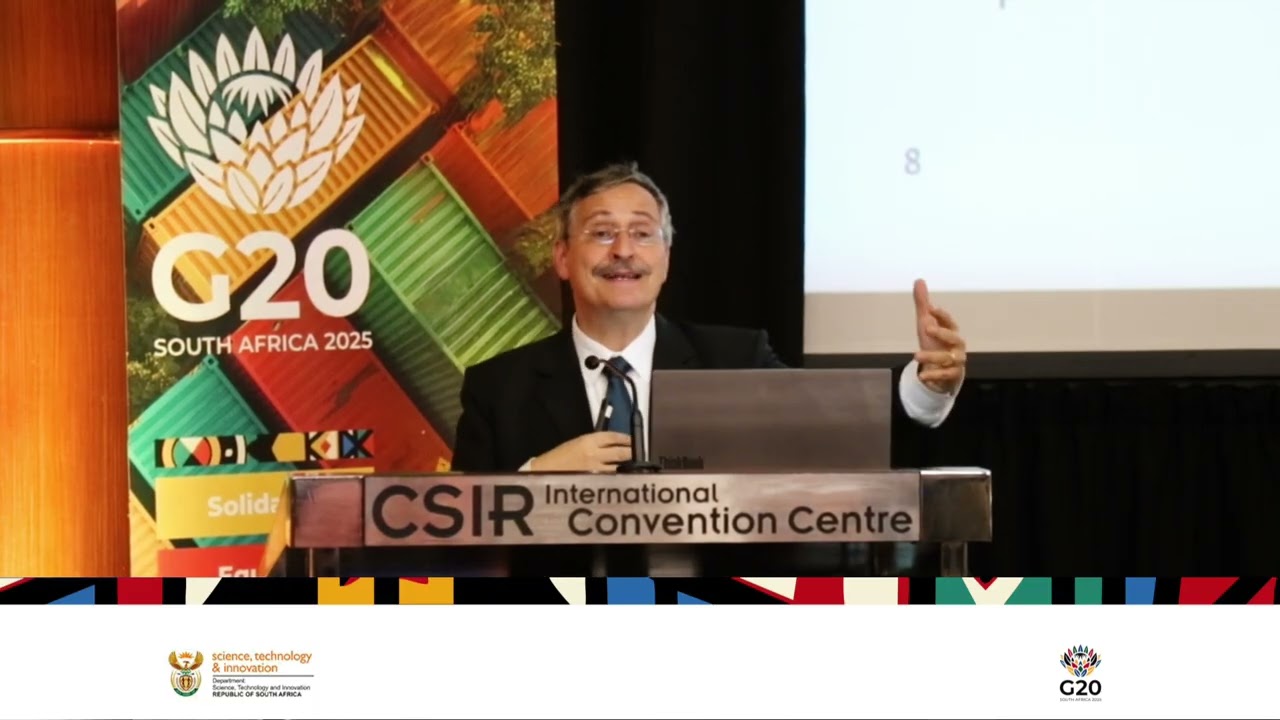
Future-Proofing Humanity: Science, Equity & the Next 25 Years | Prof. Michael Hengrtner
Keywords
Summary
125 words
Critical Evaluation
Value of the Information & Strength of the Argument
The talk provides valuable insights into the concept of anticipatory science diplomacy and the practical tools developed by GESDA. The argumentation is coherent, emphasizing the importance of proactive governance over reactive measures. However, it relies heavily on the authority of the speaker and the institutional credibility of GESDA, with limited critical examination of potential limitations or counterarguments. The value lies in raising awareness and offering a framework for future-oriented decision-making.
Scientific Rigor, Source Quality, Title Accuracy
The speaker is a credible authority, and the initiatives described are based on extensive scientific input. However, the talk does not provide detailed citations or references to specific studies, relying instead on general references to GESDA’s work. The title accurately reflects the content, and the talk is well-structured. No comments were provided for analysis.
139 words
Title / Content Match
The title accurately reflects the content: a forward-looking talk on using science for global equity and sustainability.
Quality & Reliability
7/10
The speaker is a high-level scientific leader (ETH Domain president), and the content is based on institutional initiatives (GESDA) with broad expert input. However, the talk is largely descriptive and promotional, with limited critical analysis or independent verification.
Key Moments
Markers derived by PSI from the transcript: the creator did not define chapters.
- Introduction and context of the talk.
- Mention of ETH Domain and its structure.
- Challenge to think about future challenges and use future to build present.
- Introduction to GESDA and its three-step approach.
- Explanation of the Science Breakthrough Radar and its methodology.
- Discussion of other GESDA initiatives, including citizen engagement and training.
- Open Quantum Institute and GESDA Summit.
- Key takeaways and conclusion.
Cited Sources
- GESDA Science Breakthrough Radar — Mentioned as the main tool for anticipating scientific breakthroughs.
- Open Quantum Institute — Mentioned as an initiative with CERN to provide quantum computing training and access.
- GESDA Summit — Mentioned as an annual gathering of stakeholders.
Concurring Sources
- GESDA Science Breakthrough Radar — The radar is the central tool described, and its website provides detailed information.
Contribution & Novelties
The talk introduces the concept of anticipatory science diplomacy and presents GESDA’s practical tools, such as the Science Breakthrough Radar and the Open Quantum Institute. It emphasizes the importance of proactive governance for emerging technologies.
Pour aller plus loin :
- Science and Technology Studies — Provides academic context on how science and technology interact with society.
- Technology Foresight — Discusses methods for anticipating future technological developments.
- Quantum Computing — Background on the technology mentioned in the talk.
77 words
Radar Profile
The radar profile shows moderate scores across all dimensions, with slightly higher reliability and information quality, reflecting the speaker's expertise and institutional backing, but lower technical depth and novelty.