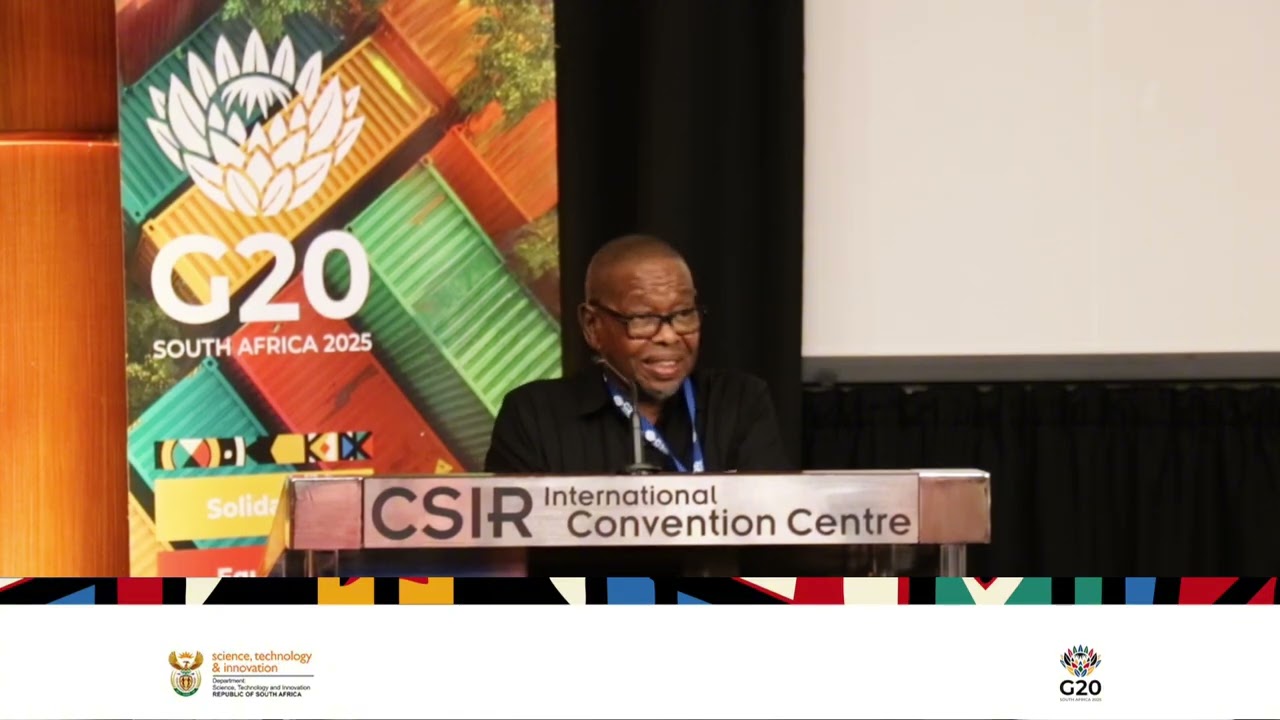
Minister Nzimande: How Science Can Heal—Not Harm | G20 Science Roundtable Address
Keywords
Summary
158 words
Critical Evaluation
Value of the Information & Strength of the Argument
The value of this speech lies in its high-level perspective from a government minister, offering insights into how science policy is framed at the national and international levels. The argumentation is coherent and structured, moving from historical examples to current crises and future needs. However, it lacks concrete evidence or data, relying on rhetorical appeals and personal anecdotes. The speaker’s authority lends weight, but the absence of citations weakens the scientific rigor.
Scientific Rigor, Source Quality, Title Accuracy
The speech is an opinion piece with no explicit sources cited. The title accurately reflects the content, focusing on the dual role of science. The speaker’s position as a minister adds authority, but the lack of verifiable references limits the scientific quality. No comments were provided for analysis.
135 words
Title / Content Match
The title accurately reflects the content: the minister discusses the dual role of science in oppression and healing, with a focus on equity.
Quality & Reliability
6/10
The speaker is a government minister with authority, but the content is an opinion speech with no empirical data or citations. The arguments are coherent and grounded in historical and current events, but lack verifiable sources.
Key Moments
Markers derived by PSI from the transcript: the creator did not define chapters.
- Introduction and greetings to the G20 Chief Science Advisors.
- Reflection on post-apartheid reconstruction and the role of policy.
- Critique of science as a tool of apartheid and current AI use in Gaza.
- Call for science advice to adhere to moral and ethical standards.
- Discussion of global challenges: inequality, conflicts, climate change, pandemics.
- Emphasis on interconnectedness and the need for global cooperation.
- Advocacy for evidence-based policymaking and science literacy.
- Call for an African agenda in science and technology, moving from consumer to producer.
- Conclusion and thanks to participants.
Contribution & Novelties
This speech provides a unique perspective from an African minister on the ethical dimensions of science policy, linking historical injustices to current technological challenges. It emphasizes the need for inclusive and multidisciplinary science, and advocates for a shift in global science governance towards greater equity.
Pour aller plus loin :
- Science diplomacy — Relevant for understanding the role of science in international relations.
- Decolonizing science — Discusses the movement to reform scientific knowledge production.
- Global health equity — Provides background on health disparities and vaccine distribution.
86 words
Radar Profile
The radar profile shows moderate scores across all dimensions, with slightly higher quality and reliability compared to quantity and technical depth. This reflects a speech that is authoritative and ethically grounded but lacks detailed technical content and extensive information.