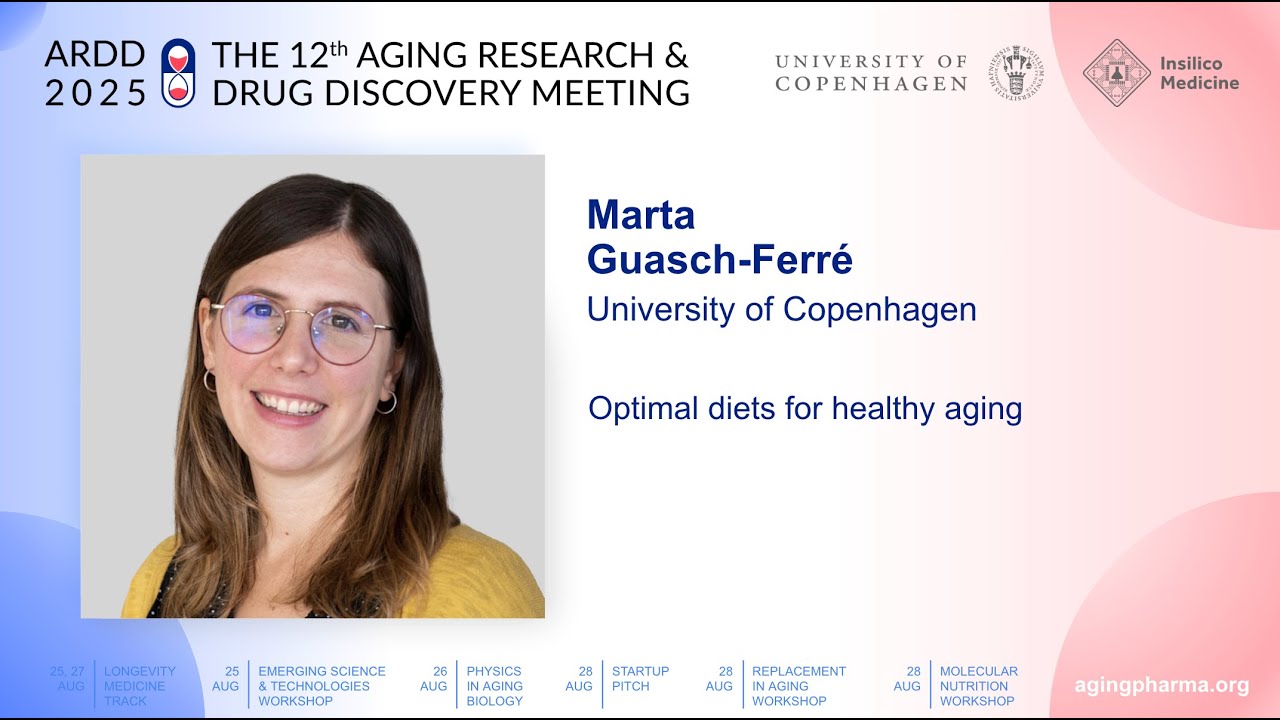
Marta Guasch-Ferré at ARDD2025: Optimal diets for healthy aging
Keywords
Summary
170 words
Critical Evaluation
Value of the Information & Strength of the Argument
The presentation provides valuable insights into the relationship between diet and healthy aging, supported by robust epidemiological data. The argumentation is solid, based on a large prospective cohort with long follow-up and validated dietary assessments. The speaker appropriately acknowledges limitations, such as potential confounding and generalizability, and discusses the complexity of dietary patterns. The findings align with existing literature and offer practical implications for public health.
Scientific Rigor, Source Quality, Title Accuracy
The scientific rigor is high, as the study is published in a reputable journal and uses established methodologies. The speaker cites relevant sources, including the Global Burden of Disease study and the American Heart Association’s Life’s Essential 8. The title accurately reflects the content. The presentation is well-structured and evidence-based, with appropriate caveats.
134 words
Title / Content Match
The title accurately reflects the content, which focuses on optimal dietary patterns for healthy aging.
Quality & Reliability
8/10
Presentation of a peer-reviewed prospective cohort study with robust methodology, large sample size, and long follow-up. The speaker is a recognized researcher in nutritional epidemiology. Limitations are acknowledged, including generalizability and self-reported dietary data.
Key Moments
Markers derived by PSI from the transcript: the creator did not define chapters.
- Introduction to the importance of diet in preventing chronic diseases, referencing the American Heart Association's Life's Essential 8.
- Overview of dietary patterns associated with health, including Mediterranean, DASH, MIND, and Nordic diets.
- Presentation of the study design: Nurses' Health Study and Health Professionals Follow-up Study, with 30 years of follow-up.
- Definition of healthy aging outcome: surviving to 70 free of 11 chronic diseases, with preserved cognitive, physical, and mental health.
- Results: only 10% of participants achieved healthy aging; higher adherence to any of eight dietary patterns associated with 45-86% greater odds.
- AHEI showed strongest association, with even stronger effects at age 75.
- Higher intake of ultra-processed foods associated with lower odds of healthy aging.
- Specific dietary factors: beneficial foods include fruits, vegetables, nuts, legumes, unsaturated fats; harmful include trans fats, sodium, red/processed meats.
- Discussion of broader factors influencing diet: policies, food environment, cultural beliefs, and individual behavior change.
- Conclusion: healthy dietary patterns are associated with greater odds of healthy aging; importance of public health interventions.
Cited Sources
- Optimal dietary patterns for healthy aging — The paper presented by the speaker, published in a peer-reviewed journal.
- American Heart Association Life's Essential 8 — Referenced in the introduction as a framework for cardiovascular health.
- Global Burden of Disease Study — Referenced to illustrate the impact of dietary factors on mortality.
Concurring Sources
- Global Burden of Disease Study — Supports the claim that dietary factors are major contributors to mortality.
- American Heart Association Life's Essential 8 — Aligns with the emphasis on lifestyle factors for cardiovascular health.
Contribution & Novelties
The study’s novelty lies in its comprehensive assessment of multiple dietary patterns over time and its multidimensional definition of healthy aging, including cognitive, physical, and mental health. It provides evidence that various healthy diets can be beneficial, supporting flexibility in dietary recommendations. The findings on ultra-processed foods add to the growing body of evidence linking them to adverse health outcomes.
Pour aller plus loin :
- Mediterranean diet — Overview of the Mediterranean diet and its health benefits.
- DASH diet — Explanation of the DASH diet designed to combat hypertension.
- MIND diet — Description of the MIND diet for brain health.
- Ultra-processed foods — Definition and health implications of ultra-processed foods.
- Nurses’ Health Study — Information on the landmark cohort study used in this research.
124 words
Radar Profile
The radar profile shows high scores across all dimensions, indicating a well-rounded and reliable presentation. The lowest score is in technical level, which is still moderate, reflecting the accessibility of the content to a general scientific audience.
💬 No comments were provided for analysis.