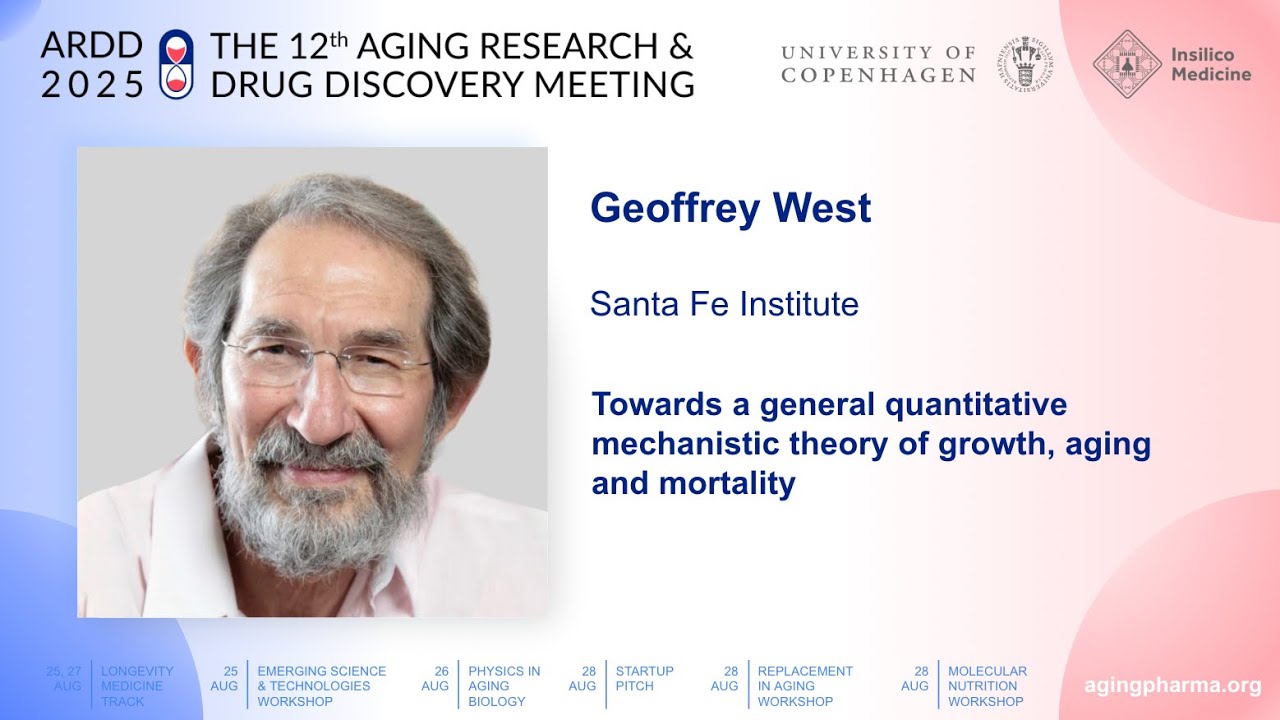
Geoffrey West at ARDD2025: Towards a general quantitative mechanistic theory of growth, aging...
Keywords
Summary
196 words
Critical Evaluation
Value of the Information & Strength of the Argument
The talk provides a compelling and elegant framework that unifies many biological observations under a few physical principles. The argumentation is logically structured, starting from network properties and deriving scaling laws that are empirically supported. The speaker acknowledges the coarse-grained nature of the theory and its limitations, which adds credibility. However, the presentation is dense and assumes familiarity with scaling concepts. The value lies in its ability to generate quantitative predictions and connect disparate phenomena (growth, aging, sleep) through a common theoretical lens.
Scientific Rigor, Source Quality, Title Accuracy
The talk is based on the speaker’s extensive published work, including seminal papers on scaling in biology. The sources are not explicitly cited in the video, but the description mentions the Santa Fe Institute and the ARDD conference. The title accurately reflects the content. The talk is a high-level overview rather than a detailed exposition, but the underlying science is well-established. The speaker is a leading expert, and the theory has been widely discussed and tested. The main weakness is the lack of explicit citations in the talk itself, which makes it difficult for viewers to verify specific claims.
197 words
Title / Content Match
The title accurately reflects the content: a presentation of a quantitative theory of growth, aging, and mortality.
Quality & Reliability
8/10
The talk presents a well-established theoretical framework (scaling laws, quarter-power exponents) supported by decades of research and published papers. However, it is a high-level overview with limited technical detail, and some claims are presented without full derivation. The speaker is a renowned physicist, but the content is largely a summary of his own work, which may introduce bias.
Key Moments
Markers derived by PSI from the transcript: the creator did not define chapters.
- Introduction: the talk is a physics approach to aging, seeking universal principles.
- Key questions: why 100 years lifespan, why growth stops, why sleep changes.
- Networks: space-filling, invariant terminal units, optimization.
- Derivation of Kleiber's law (3/4 power scaling) and quarter-power exponents.
- Consequences: larger animals have lower mass-specific metabolic rate, live longer, sleep less.
- Growth model: energy allocation between maintenance and growth, universal growth curves.
- Aging theory: damage accumulation, repair, threshold for death.
- Prediction of human lifespan ~100 years from fundamental constants.
- Temperature dependence of lifespan, heartbeats and ATP invariance.
- Sleep: brain repair, prediction of sleep time, connection to lifespan.
- Lifespan extension: caloric restriction, lower temperature, genetic manipulation, unintended consequences.
Cited Sources
- ARDD2025 conference — The talk was presented at the 12th Aging Research and Drug Discovery meeting.
- Santa Fe Institute — Geoffrey West is affiliated with the Santa Fe Institute.
Concurring Sources
- West, G. B., Brown, J. H., & Enquist, B. J. (1997). A general model for the origin of allometric scaling laws in biology. Science, 276(5309), 122-126. — The foundational paper presenting the scaling theory.
- West, G. B., Brown, J. H., & Enquist, B. J. (2001). A general model for ontogenetic growth. Nature, 413(6856), 628-631. — Paper on growth curves derived from the theory.
Dissenting Sources
- Critique of the metabolic theory of ecology — Some researchers have questioned the universality of the 3/4 scaling exponent and the assumptions of the model.
Contribution & Novelties
The talk presents a unified quantitative theory that connects growth, aging, and mortality through scaling laws derived from network principles. It offers a mechanistic explanation for the quarter-power scaling of lifespan and other biological rates, and provides a framework for understanding the relationship between sleep and lifespan. The theory is coarse-grained but powerful, generating testable predictions.
Pour aller plus loin :
- Kleiber’s law — The empirical scaling law for metabolic rate.
- Quarter-power scaling — The theoretical basis for the exponents.
- West, Brown, Enquist model — The original model for scaling in biology.
- Allometric scaling — General concept of scaling relationships.
- Caloric restriction — A proposed lifespan extension method.
108 words
Radar Profile
The radar profile shows high scores in quality and reliability, reflecting the speaker's expertise and the established nature of the theory. The quantity of information is moderate, as the talk is a high-level overview. The technical level is moderate, requiring some background in physics and biology. Overall, the talk is a valuable synthesis of a complex theory.