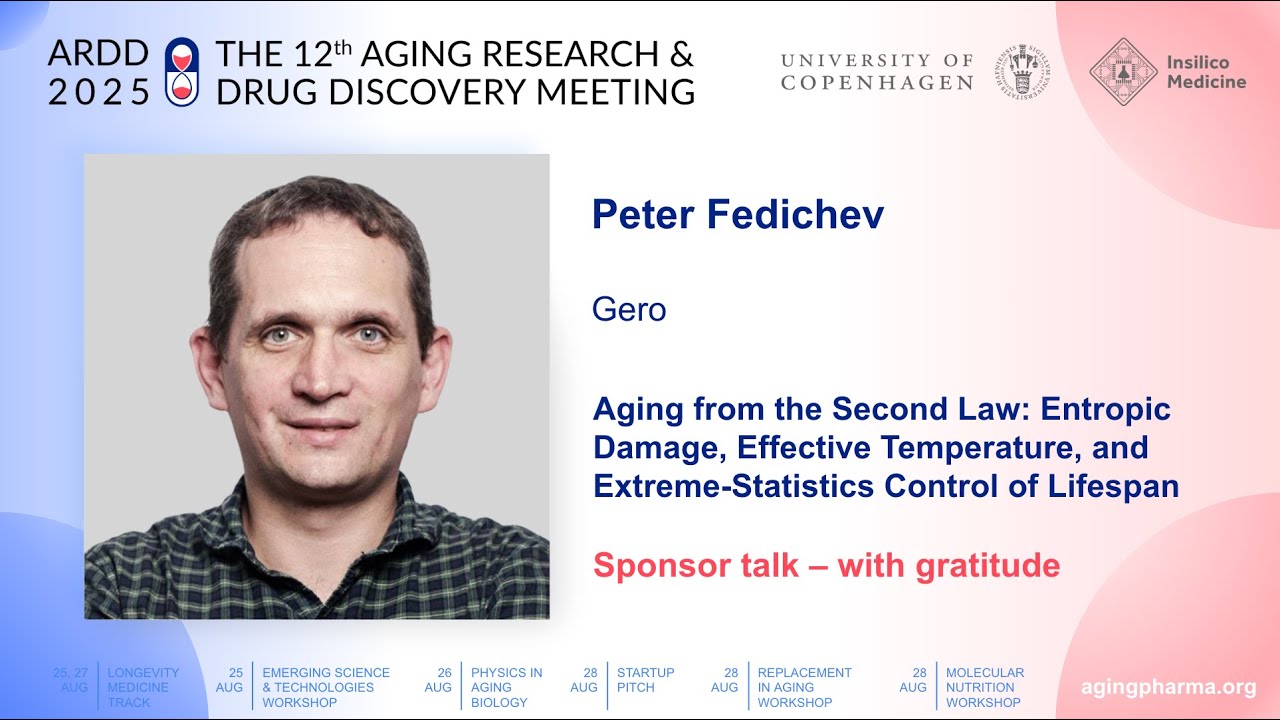
Aging from the Second Law: Entropic Damage, Effective Temperature, and Extreme-Statistics Control of Lifespan
Keywords
Summary
133 words
Critical Evaluation
Value of the Information & Strength of the Argument
The presentation offers a novel perspective on aging by applying thermodynamic principles, which is valuable for conceptualizing aging as a stochastic process. The argumentation is logically structured, moving from empirical observations to a theoretical model. However, the model is not fully validated, and some claims are speculative. The speaker acknowledges the limitations and emphasizes the need for further research.
Scientific Rigor, Source Quality, Title Accuracy
The talk is based on empirical data and theoretical models, but specific sources are not cited in the transcript. The speaker references his own work and mentions unpublished data. The title accurately reflects the content. The presentation is scientifically rigorous in its reasoning, but the lack of explicit references reduces its verifiability.
126 words
Title / Content Match
The title accurately reflects the content, focusing on entropic damage, effective temperature, and extreme statistics in aging.
Quality & Reliability
7/10
The presentation is based on empirical data and theoretical models, but it is a conference talk with limited peer-reviewed references provided. The speaker is an expert in the field, and the arguments are coherent, but some claims are speculative and not fully detailed.
Key Moments
Markers derived by PSI from the transcript: the creator did not define chapters.
- Introduction and motivation: mortality curves across species, highlighting the difference between vertical and horizontal curves.
- Physiological indicators decline linearly with age, not exponentially, contrasting with mortality.
- Recovery time and variance of physiological markers show linear decline, indicating loss of resilience.
- Proposal of a Langevin dynamics model for physiology, with recovery force decreasing with age.
- Introduction of entropic damage: uncorrelated molecular events accumulate linearly, while correlated pathways respond to interventions.
- Evidence from DNA methylation data: linear and exponential principal components correspond to uncorrelated and correlated features.
- Single-cell methylation analysis shows mutual information distinguishes entropic and dynamic signatures.
- Effective theory: total damage ZL affects regulatory interactions, and thermodynamic fidelity determines rate of aging.
- Examples: parabiosis reverses dynamic signatures but not entropic signatures, illustrating irreversibility.
- Rate of aging formula: RD = metabolic rate * thermodynamic fidelity, with fidelity as a statistical property of the regulatory landscape.
- Extreme statistics: Gumbel distribution for barrier heights, explaining rare events that drive aging drift.
- Mortality model: noise controls difference between average and maximum lifespan, suggesting noise reduction could extend lifespan.
- Preliminary dog data: low noise correlates with higher compress exponent, supporting the model.
- Conclusion: targeting noise is promising, while targeting specific manifestations yields small effects. Questions and discussion.
Contribution & Novelties
The presentation offers a novel theoretical framework linking aging to the second law of thermodynamics, proposing that entropic damage and noise are key determinants of lifespan. It distinguishes between reversible and irreversible aging signatures, and suggests that targeting noise could significantly extend lifespan. The concept of thermodynamic fidelity as a statistical property of the regulatory network is innovative.
Pour aller plus loin :
- Second law of thermodynamics — Foundation for the entropic damage concept.
- Langevin equation — Used to model physiological dynamics.
- Gumbel distribution — Extreme value statistics applied to barrier heights.
- Epigenetic clock — Related to DNA methylation changes with age.
- Gompertz law — Mortality model referenced in the talk.
111 words
Radar Profile
The radar profile shows high scores in technical level and information quality, reflecting the advanced theoretical content. The fiabilite_globale is moderate, indicating that while the arguments are plausible, they lack extensive peer-reviewed support. The quantite_information is high, providing a comprehensive overview of the model.