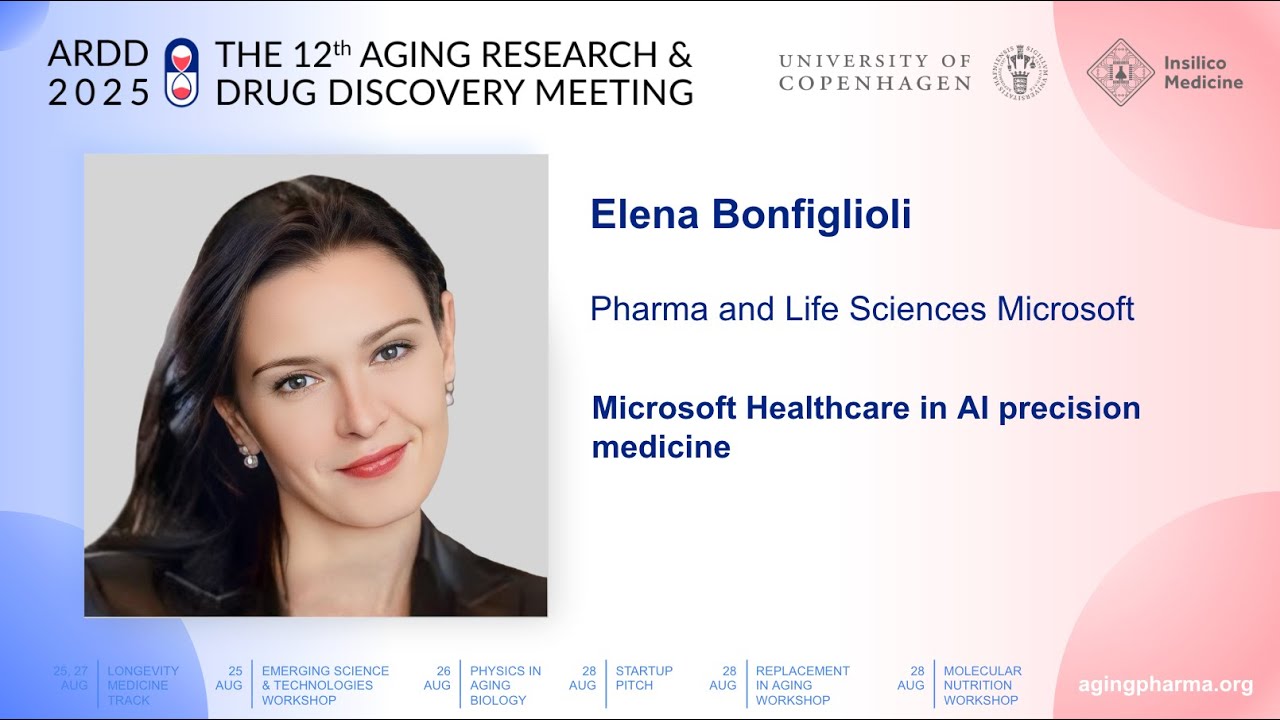
Elena Bonfiglioli at ARDD2025: Microsoft Healthcare in AI precision medicine
Keywords
Summary
106 words
Critical Evaluation
Value of the Information & Strength of the Argument
The talk provides valuable insights into Microsoft’s AI healthcare initiatives, with concrete examples and partnerships. The argumentation is persuasive, emphasizing practical applications and future potential. However, it is largely promotional, lacking critical discussion of limitations or risks. The speaker’s background in economics and healthcare adds credibility, but the presentation is more of an overview than a deep technical analysis.
Scientific Rigor, Source Quality, Title Accuracy
The presentation references collaborations with Stanford, Providence, and NEJM cases, but does not provide specific citations or URLs. The title accurately reflects the content. The talk is based on expert opinion and company initiatives, not peer-reviewed research. The lack of detailed methodology and independent validation limits the scientific rigor.
123 words
Title / Content Match
The title accurately reflects the content: a talk on Microsoft's AI applications in precision medicine and healthcare.
Quality & Reliability
7/10
Presentation by a Microsoft executive with concrete examples and collaborations (Stanford, NEJM benchmark), but lacks detailed methodology and independent verification.
Key Moments
Markers derived by PSI from the transcript: the creator did not define chapters.
- Introduction and three pillars of Microsoft Healthcare
- Need for complete longitudinal patient record
- Three generations of AI: copilot, agents, hybrid teams
- Healthcare Orchestrator for tumor boards with Stanford
- Diagnostic orchestrator benchmark with NEJM cases
- Microsoft Discovery platform for drug discovery
- Q&A: training clinicians and data interoperability
- Q&A: data privacy and IP rights
- Call for collaboration on longevity paper
Cited Sources
- Healthcare Orchestrator with Stanford — Mentioned as a collaboration for tumor boards
- New England Journal of Medicine cases — Used for diagnostic benchmark
- Microsoft Discovery — Platform for drug discovery
Concurring Sources
- Stanford Medicine — Collaboration on healthcare orchestrator
- New England Journal of Medicine — Source of clinical cases for benchmark
Contribution & Novelties
The talk presents Microsoft’s latest AI healthcare tools, including agent-based systems for clinical workflows and drug discovery. The diagnostic benchmark achieving 85.5% accuracy is a notable proof point. The emphasis on hybrid human-agent teams and the call for equity in healthcare are valuable contributions.
Pour aller plus loin :
- AI in healthcare — Overview of AI applications in medicine.
- Large language models in medicine — Background on LLMs.
- Precision medicine — Concept and applications.
74 words
Radar Profile
The radar profile shows high scores in information quantity and quality, with moderate technical depth and reliability. The talk is informative but relies on company claims rather than independent validation.
💬 No comments were provided for analysis.