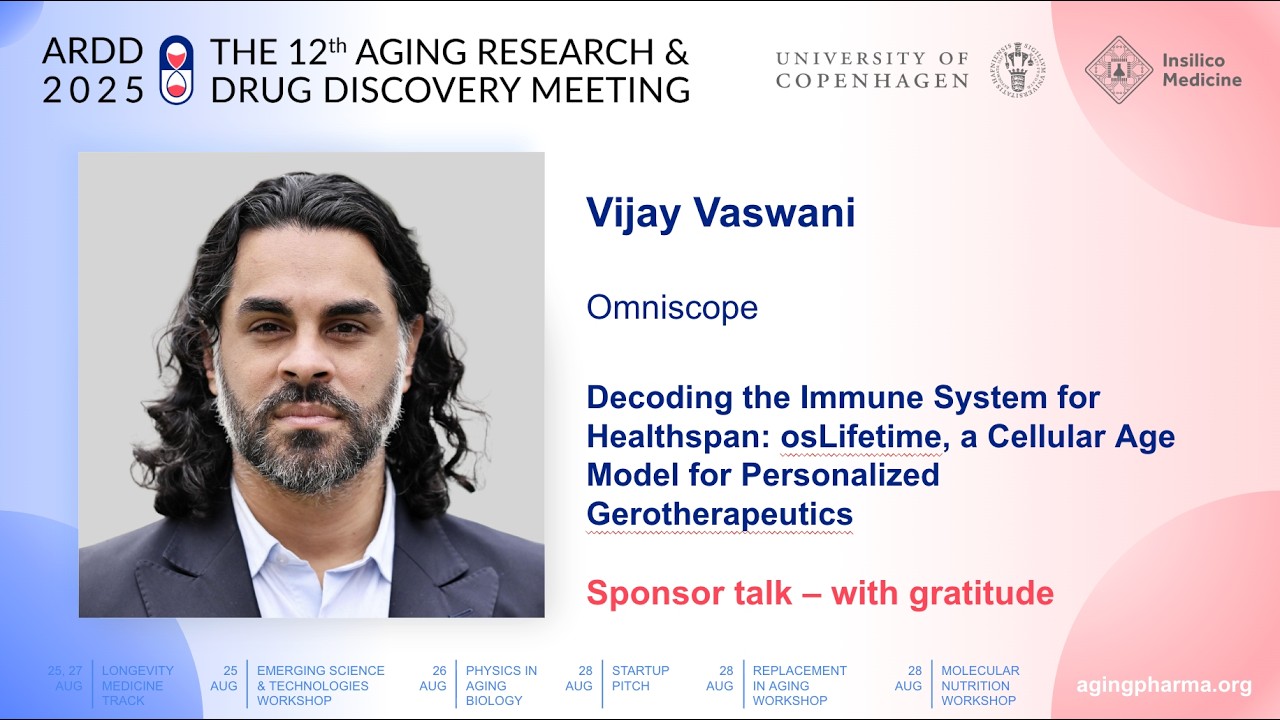
Vijay Vaswani at ARDD2025: Decoding the Immune System for Healthspan: osLifetime, a Cellular Age ...
Keywords
Summary
164 words
Critical Evaluation
Value of the Information & Strength of the Argument
The talk provides valuable insights into the application of single-cell immune profiling for aging research and personalized health. The argumentation is persuasive, leveraging the speaker’s personal experience and company data. However, the scientific evidence is largely anecdotal (n-of-1) and lacks rigorous peer-reviewed validation. The claims about the platform’s capabilities are impressive but not fully substantiated in the talk.
Scientific Rigor, Source Quality, Title Accuracy
The talk references several sources, including the Annals of Oncology publication and the World Vaccine Congress presentation, but does not provide specific citations or URLs. The title accurately reflects the content. The scientific rigor is moderate; the speaker mentions peer-reviewed science and collaborations with institutions like UCSF, but the lack of detailed methodology and independent verification limits the overall reliability.
133 words
Title / Content Match
The title accurately reflects the content, focusing on decoding the immune system for healthspan and introducing the osLifetime model.
Quality & Reliability
6/10
The talk presents original data from the company's proprietary platform, but lacks detailed methodology and independent validation. Claims are plausible but not fully verifiable from the talk alone.
Key Moments
Markers derived by PSI from the transcript: the creator did not define chapters.
- Introduction: The immune system as a key to longevity and health.
- Omniscope's technology: reading over a million cells per sample.
- Building a cellular model of age: hallmarks of aging and immune system's role.
- Personal story: losing father to chickenpox, motivation for the work.
- Application to existing therapies: Shingrix vaccination study.
- Engineering T cells with mRNA for cancer treatment (Annals of Oncology).
- Personal n-of-1: osLifetime results showing immune age, inflammation, and psoriasis.
- Non-pharmaceutical interventions: diet, sleep, exercise, and their impact.
- Collaboration with FC Barcelona: immune system of elite athletes.
Cited Sources
- Annals of Oncology publication on engineering T cells — Mentioned as published work on engineering T cells using mRNA for cancer treatment.
- World Vaccine Congress presentation — Mentioned as a presentation on understanding immune response to Shingrix vaccination.
Concurring Sources
- Hallmarks of aging — The talk aligns with the established hallmarks of aging, particularly those related to the immune system.
- Single-cell RNA sequencing — The technology described is based on single-cell analysis, which is a recognized field.
Dissenting Sources
- N-of-1 studies — The talk's reliance on a single individual's data is not generalizable, and the scientific community often requires larger cohorts for validation.
Contribution & Novelties
The talk introduces osLifetime, a platform that provides a comprehensive cellular age model based on immune system analysis, offering a new axis for understanding aging beyond genetics. It emphasizes the practical application of immune profiling for personalized health interventions and highlights the elasticity of immune age in response to lifestyle and exercise. The n-of-1 approach, while not scientifically rigorous, demonstrates the potential for self-quantification and democratization of health data.
Pour aller plus loin :
- Hallmarks of aging — Overview of the hallmarks of aging, which the talk references.
- Single-cell sequencing — Technology enabling cell-by-cell analysis, central to the talk.
- Immunosenescence — Age-related changes in the immune system, relevant to the concept of immune age.
114 words
Radar Profile
The radar profile shows high scores in quantity and technical level, reflecting the depth of information and specialized content. However, the quality and reliability scores are moderate, indicating that while the information is presented with authority, it lacks rigorous scientific validation.
💬 No comments were provided for analysis.