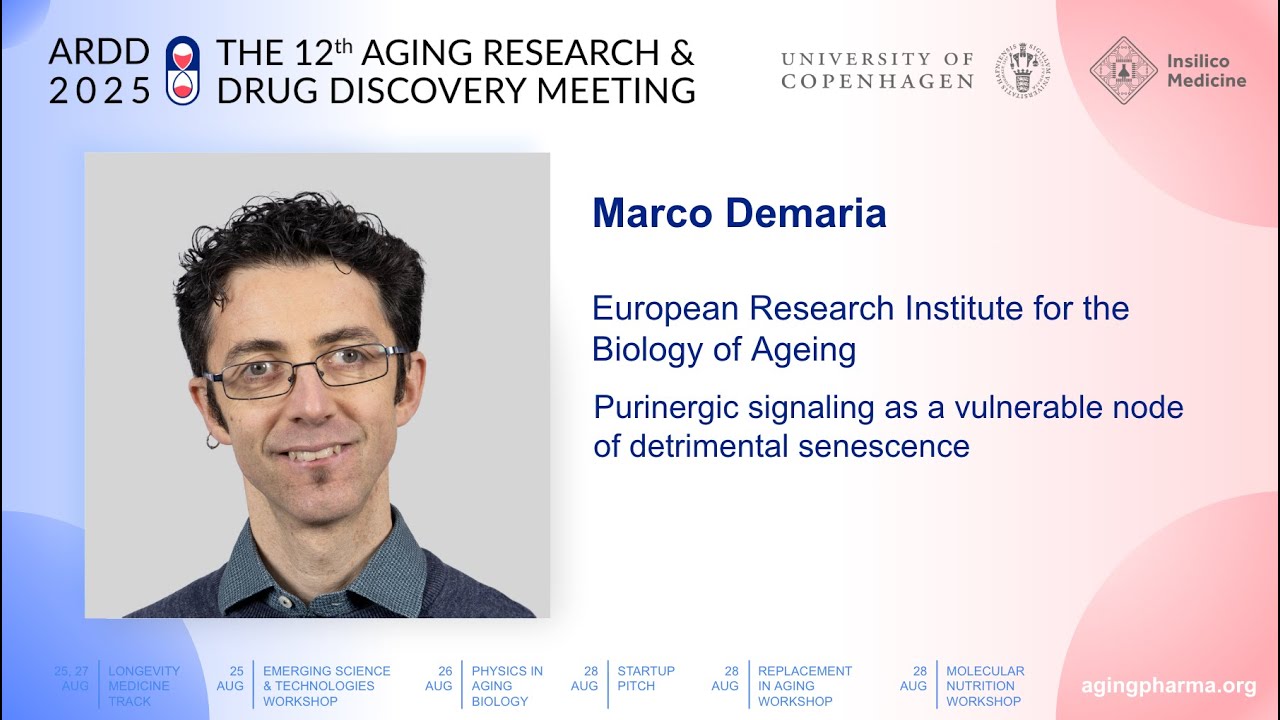
Marco Demaria at ARDD2025: Purinergic signaling as a vulnerable node of detrimental senescence
Keywords
Summary
135 words
Critical Evaluation
Value of the Information & Strength of the Argument
The presentation provides valuable insights into a novel molecular node (P2X1) that distinguishes detrimental from beneficial senescence. The argumentation is logical and well-supported by experimental data across multiple models. The speaker clearly explains the rationale and potential therapeutic implications. However, as unpublished data, the results are preliminary and require further validation.
Scientific Rigor, Source Quality, Title Accuracy
The scientific rigor is high, with clear methodology and validation steps. The speaker references his own published work and collaborations, but no specific external sources are cited in the talk. The title accurately reflects the content, focusing on purinergic signaling in detrimental senescence.
109 words
Title / Content Match
The title accurately reflects the content, focusing on purinergic signaling in detrimental senescence.
Quality & Reliability
8/10
Presentation of unpublished research with clear methodology, multiple models, and validation steps. Data is preliminary but presented transparently. No external sources cited, but the work is grounded in established senescence biology.
Key Moments
Markers derived by PSI from the transcript: the creator did not define chapters.
- Introduction to senescence and SASP, including non-protein components.
- Discussion of beneficial functions of SASP and the need for selective targeting.
- Identification of connexin 43 upregulation in senescence and its role in ATP release.
- Discovery of P2X1 receptor overexpression specifically in detrimental senescence.
- Validation of P2X1 knockdown reducing NF-κB activity and SASP.
- Screening of P2X1 inhibitors and selection of NF157.
- In vivo testing in chemotherapy-induced senescence model.
- In vivo testing in osteoarthritis models.
- Results in naturally aged mice showing improved physical performance.
- Summary and hypothesis on senomorphic effect leading to immune-mediated clearance.
Contribution & Novelties
This research identifies P2X1 as a novel molecular target that distinguishes detrimental from beneficial senescence, offering a potential strategy for selective senotherapy. The finding that ATP signaling via P2X1 potentiates NF-κB and SASP provides a new mechanistic understanding of senescence-associated inflammation.
Pour aller plus loin :
- Cellular senescence — Overview of senescence biology.
- Purinergic signalling — General background on ATP signaling.
- NF-κB — Transcription factor central to SASP regulation.
69 words
Radar Profile
The profile shows high scores in information quantity, quality, and technical level, with slightly lower reliability due to unpublished data. This indicates a technically rich presentation with solid preliminary evidence, but requiring further validation.