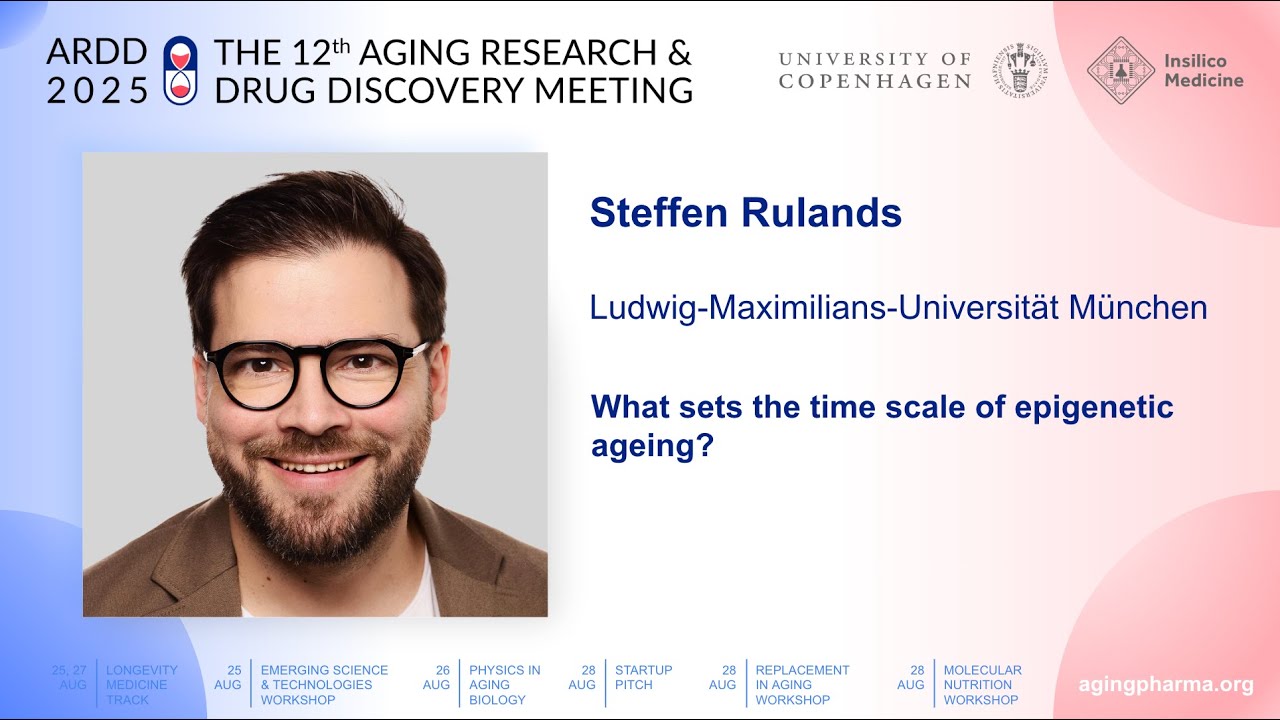
Steffen Rulands at ARDD2025: What sets the time scale of epigenetic ageing?
Keywords
Summary
257 words
Critical Evaluation
Value of the Information & Strength of the Argument
The talk provides a compelling theoretical framework that unifies molecular and organismal timescales of epigenetic aging. The argumentation is rigorous, building from empirical data to a mathematical model with predictive power. The model’s ability to explain both short-term and long-term dynamics is a significant strength. The speaker carefully addresses potential confounding factors, such as tissue composition changes, and acknowledges limitations. The value lies in offering a mechanistic explanation for the timescale of epigenetic aging, which is often treated as a black box in epigenetic clock studies.
Scientific Rigor, Source Quality, Title Accuracy
The talk is based on original research, presented as a preprint (referenced via QR code). The speaker cites data from Anne Ferguson-Smith’s lab and longitudinal aging datasets. The title accurately reflects the content. The scientific rigor is high, with a clear methodology and transparent reasoning. However, since the work is not yet peer-reviewed, the reliability is slightly reduced. The speaker also mentions other works on boundary dynamics, indicating a broader research program.
173 words
Title / Content Match
The title accurately reflects the talk's focus on the timescale of epigenetic aging.
Quality & Reliability
8/10
Presentation of original research with a clear theoretical model grounded in empirical data, but not yet peer-reviewed (preprint).
Key Moments
Markers derived by PSI from the transcript: the creator did not define chapters.
- Introduction: physicist's perspective on aging, spanning timescales from milliseconds to decades.
- Introduction to epigenetics and DNA methylation as a key layer, and the use of epigenetic clocks.
- Presentation of short-term DNA methylation dynamics data from cell division experiments.
- Introduction of the dynamical systems model with three components: coordination, noise, and chromatin geometry.
- Prediction of a bifurcation in fixed points as a function of coordination strength (alpha).
- Validation of the model against genomic data, showing active regions are more deterministic.
- Application to aging data: same dynamical system describes aging on intermediate timescales.
- Extrapolation to long timescales: stochastic switching dominates after ~10 years, leading to a hierarchical model of aging.
- Linking molecular parameters to aging timescales: compacted chromatin ages slower, weak cooperativity accelerates aging.
Cited Sources
- Preprint (via QR code) — The speaker mentions a preprint with details of the model and data, accessible via QR code on the slide.
- Data from Anne Ferguson-Smith lab — Used for short-term DNA methylation dynamics over cell divisions.
- Longitudinal DNA methylation datasets — Used to study aging dynamics across tissues.
Concurring Sources
- Epigenetic clock literature — The concept of epigenetic clocks is widely accepted in aging research, supporting the relevance of DNA methylation changes.
Dissenting Sources
- Potential alternative models — Other models may attribute epigenetic changes to external factors or tissue composition changes, which the speaker argues against.
Contribution & Novelties
The talk presents a novel theoretical framework that explains the timescale of epigenetic aging by bridging molecular events to organismal aging. It introduces a dynamical systems model with a bifurcation parameter (alpha) that captures the transition from deterministic to stochastic behavior. The model quantitatively links molecular parameters (e.g., chromatin compaction, cooperativity) to aging timescales, providing testable predictions. This is a significant contribution to understanding the mechanisms behind epigenetic clocks.
Pour aller plus loin :
- Epigenetic clock — Background on epigenetic clocks and their use in aging research.
- Dynamical systems theory — Mathematical framework used in the model.
- DNA methylation — Overview of the epigenetic mark studied.
106 words
Radar Profile
The radar profile shows high scores in quantity and quality of information, and technical level, reflecting the dense and rigorous content. The reliability score is slightly lower due to the preprint status. Overall, the talk is highly informative and technically advanced, with a strong theoretical contribution.
💬 Sur les 0 commentaires analysés, aucune tendance n'est disponible.