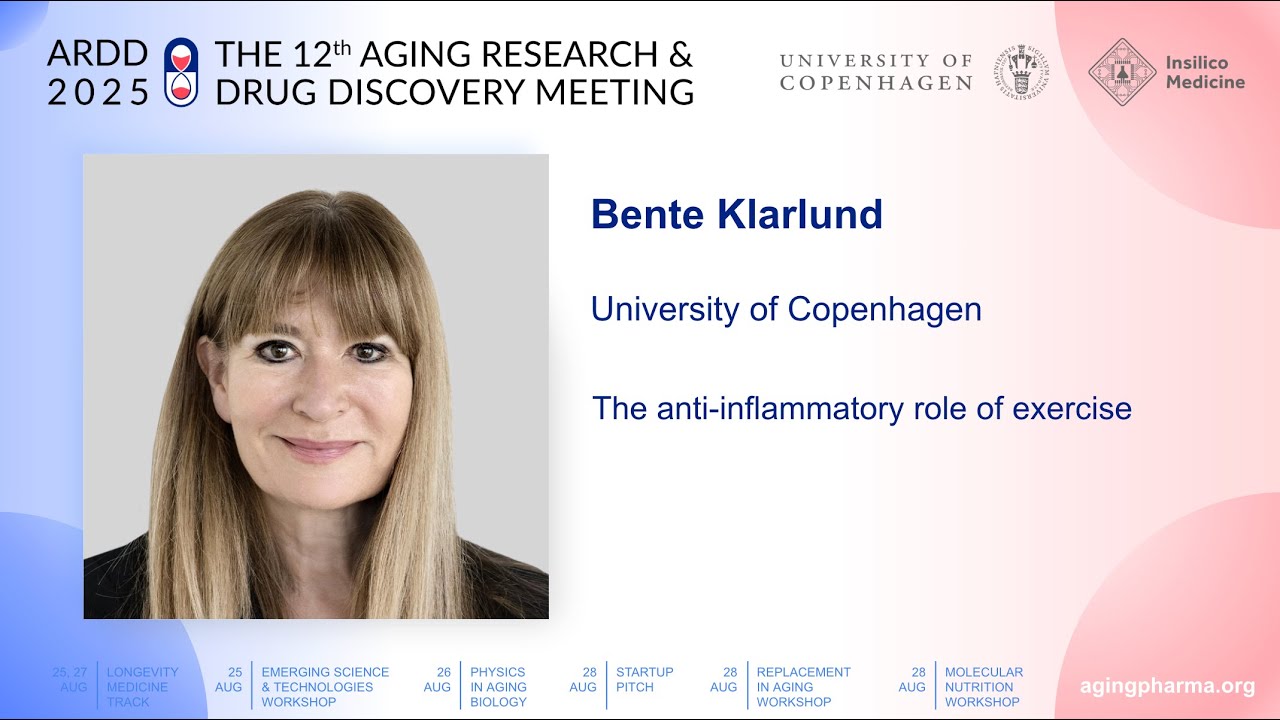
Bente Klarlund at ARDD2025: The anti-inflammatory role of exercise
Keywords
Summary
178 words
Critical Evaluation
Value of the Information & Strength of the Argument
The talk provides valuable insights into the mechanisms by which exercise exerts anti-inflammatory effects, particularly through the myokine IL-6. The argumentation is solid, based on a series of well-designed studies, including randomized controlled trials and mechanistic experiments in humans and mice. The speaker clearly explains the paradox of IL-6, distinguishing between acute beneficial effects and chronic harmful effects, and proposes the concept of IL-6 resistance to explain this paradox. The evidence is presented logically, building from basic mechanisms to clinical implications. The talk also highlights the importance of exercise in cancer prevention and survival, with a plausible mechanism involving natural killer cells. Overall, the value of the information is high, and the argumentation is coherent and evidence-based.
Scientific Rigor, Source Quality, Title Accuracy
The speaker is a credible researcher, and the talk is based on published studies, including those from her own group and others. She references specific studies, such as the one on lifestyle habits and longevity, and her own work on inactivity and visceral fat. The quality of sources is high, as they are peer-reviewed publications. The title accurately reflects the content, focusing on the anti-inflammatory role of exercise. The talk is well-structured and scientifically rigorous, though it is a conference presentation and not a full research paper, so some details are omitted. No comments were provided for analysis.
230 words
Title / Content Match
The title accurately reflects the content, which focuses on the anti-inflammatory effects of exercise, particularly through the myokine IL-6.
Quality & Reliability
8/10
The speaker is a recognized researcher in exercise physiology, presenting at a scientific conference. The talk is based on published studies, including randomized controlled trials and mechanistic experiments. However, it is a conference presentation and not a peer-reviewed publication itself, and some claims are presented without full methodological detail.
Key Moments
Markers derived by PSI from the transcript: the creator did not define chapters.
- Introduction: exercise and longevity, lifestyle habits study.
- Muscle as an endocrine organ, myokines, and IL-6's role.
- IL-6 as an energy sensor and its effects on metabolism.
- TNF infusion study and IL-6's anti-inflammatory feedback.
- Inactivity study: 14 days of reduced steps, visceral fat accumulation.
- IL-6 blockade blunts exercise-induced fat loss, IL-6 resistance.
- IL-6's role in fight-or-flight response and liver glucose output.
- Exercise and cancer: reduced risk, improved survival, NK cells.
- Conclusion: closing the gap between knowledge and practice.
Cited Sources
- 8 lifestyle habits and longevity — Mentioned as a recent publication showing lifestyle habits can add up to 24 years to life.
- JAMA study on inactivity and visceral fat — Study published in JAMA showing 14 days of reduced steps leads to visceral fat accumulation.
- Exercise and cancer risk reduction — Mentioned that exercise decreases risk of 13 cancers.
- Structured exercise training and colon cancer mortality — Study showing 3 years of structured exercise reduces mortality risk by 37%.
Concurring Sources
- Exercise and IL-6: A systematic review — Many studies support the acute increase in IL-6 with exercise and its anti-inflammatory effects.
- IL-6 and insulin resistance — Literature supports the link between IL-6 resistance and insulin resistance.
Dissenting Sources
- Chronic IL-6 elevation and disease — Some studies associate high IL-6 levels with chronic diseases, which contrasts with the beneficial acute effects.
Contribution & Novelties
The talk provides a comprehensive overview of the anti-inflammatory effects of exercise, focusing on the myokine IL-6. It highlights the paradox of IL-6, where acute exercise-induced IL-6 is beneficial, while chronic elevated levels are harmful. The concept of IL-6 resistance is introduced as a potential mechanism linking insulin resistance and impaired exercise benefits. The talk also presents evidence that IL-6 is required for exercise-induced reductions in visceral fat and improvements in metabolic health. Additionally, it discusses the role of exercise in cancer prevention and survival, with a mechanism involving natural killer cells. The talk emphasizes the need for personalized exercise prescriptions and closing the gap between research and practice.
Pour aller plus loin :
- Myokine — Overview of myokines and their roles.
- Interleukin-6 — Detailed information on IL-6 signaling and functions.
- Exercise and inflammation — Review on exercise and inflammatory markers.
- Visceral fat — Explanation of visceral fat and its health implications.
152 words
Radar Profile
The radar profile shows high scores in information quantity, quality, and reliability, with a slightly lower technical level, indicating a well-supported but accessible presentation. The talk is strong in evidence-based content and scientific rigor.