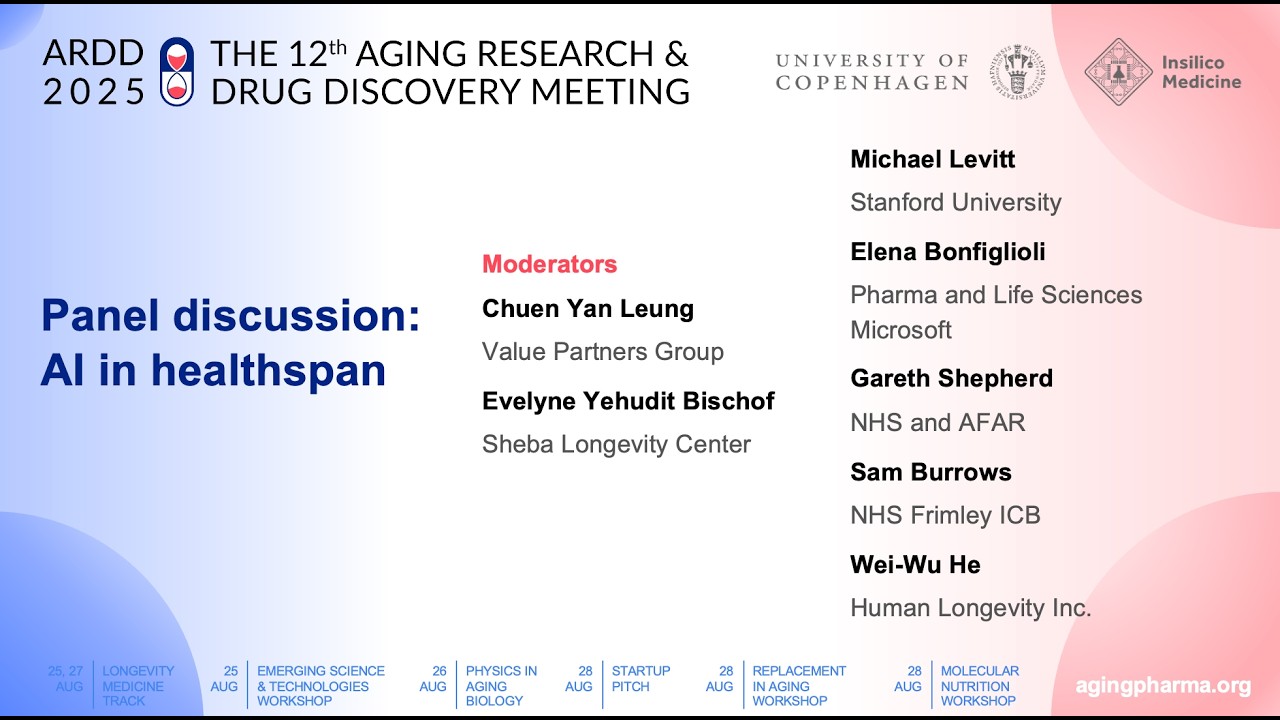
Panel discussion: AI in healthspan
Keywords
Summary
147 words
Critical Evaluation
Value of the Information & Strength of the Argument
The panel provides valuable insights into the practical applications of AI in healthcare and longevity, drawing on diverse professional experiences. Elena Bonfiglioli frames the healthcare capacity problem with statistics on clinician shortages and the potential of AI agents, arguing that three conditions (training, diffusion, and incentives) are necessary for success. Sam Burrows offers a concrete example from the NHS, highlighting the disproportionate resource consumption by a small fraction of patients and the potential of data-driven, personalized interventions. Gareth Shepherd presents investment trends, noting a shift towards health-related startups and consumer adoption of AI for health questions. Michael Levitt emphasizes the personal and scientific utility of AI, advocating for its widespread adoption while cautioning about its fallibility. Wei-Wu He describes his clinic’s data-intensive approach to preventive care. The argumentation is generally coherent, though some claims lack detailed evidence, and the discussion remains at a high level without deep technical analysis.
Scientific Rigor, Source Quality, Title Accuracy
The panel is scientifically credible due to the expertise of the participants, particularly Nobel laureate Michael Levitt. However, the discussion is largely opinion-based, with few specific citations or references to studies. The description provides no links to sources, limiting verifiability. The title accurately reflects the content, which is a panel discussion on AI in healthspan. The panelists mention some data points (e.g., WHO projections, NHS statistics) but do not provide sources. Overall, the rigor is moderate, with a reliance on expert opinion rather than systematic evidence.
250 words
Title / Content Match
Title accurately reflects the panel discussion on AI applications in healthspan.
Quality & Reliability
7/10
Panel with experts including Nobel laureate Michael Levitt, but discussion is largely opinion and anecdotal, with limited data citations. No formal sources provided in description.
Key Moments
Markers derived by PSI from the transcript: the creator did not define chapters.
- Introduction and panelist introductions
- Elena Bonfiglioli discusses healthcare capacity and AI agents
- Sam Burrows on NHS challenges and data integration
- Gareth Shepherd on investment trends in longevity
- Michael Levitt on AI's transformative potential and personal use
- Wei-Wu He describes his longevity clinic and data-driven approach
- Round two: Levitt on health trajectories and AI, Bonfiglioli on barriers
Contribution & Novelties
The panel offers a multi-stakeholder perspective on AI in healthspan, combining insights from a Nobel laureate, tech industry, NHS leadership, investment, and clinical practice. It highlights practical challenges and opportunities, such as the healthcare capacity gap and the need for AI adoption. The discussion underscores the potential of AI to personalize medicine and transform healthcare systems.
Pour aller plus loin :
- AI in healthcare: overview — Provides a broad overview of AI applications in healthcare.
- Healthspan and longevity research — Discusses the science of longevity and healthspan.
- NHS Long Term Plan — Official NHS plan outlining digital and AI strategies.
100 words
Radar Profile
The radar profile shows moderate to high scores across all dimensions, with slightly lower technical depth and reliability due to the panel format and lack of detailed citations. The content is informative and credible, but not highly technical or rigorously sourced.
💬 No comments were provided for analysis.