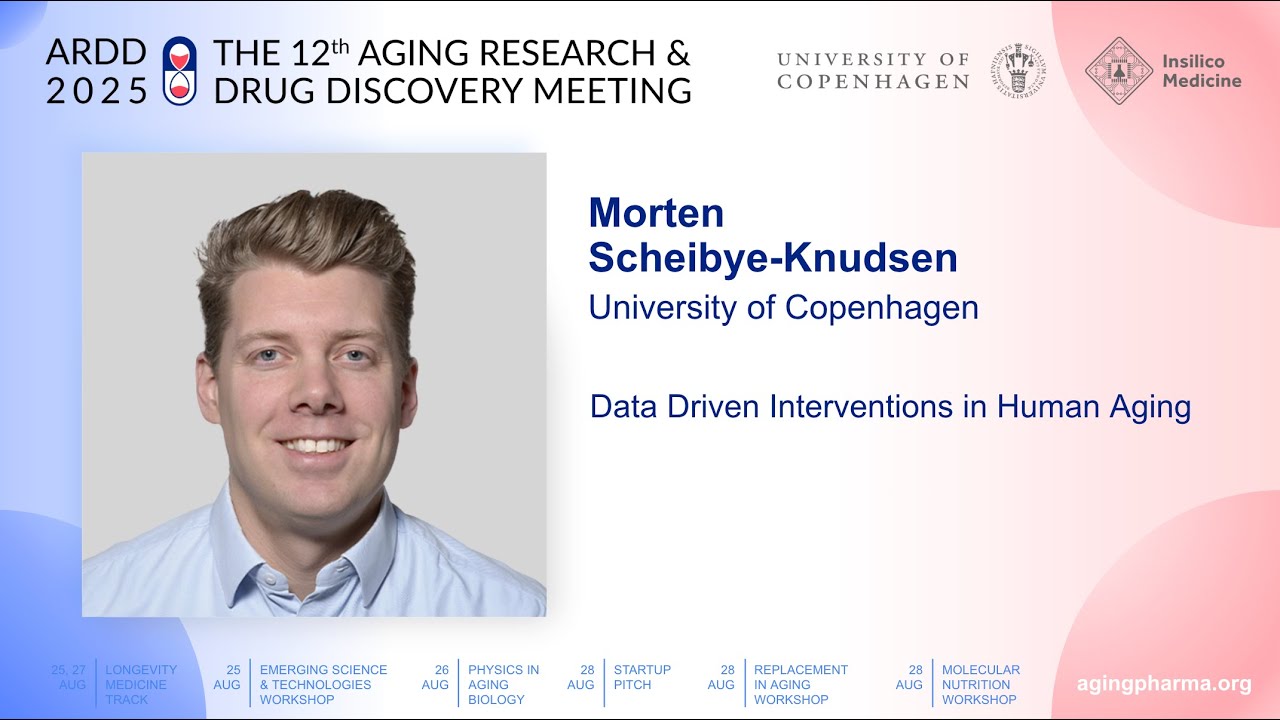
Morten Scheibye-Knudsen at ARDD2025: Data Driven Interventions in Human Aging
Keywords
Summary
160 words
Critical Evaluation
Value of the Information & Strength of the Argument
The presentation provides valuable insights into novel biomarkers and therapeutic approaches for aging. The argumentation is based on preliminary data and ongoing research, which is compelling but not yet fully published. The speaker effectively connects observations from facial photographs to cellular senescence and DNA damage, building a coherent narrative. However, some claims lack detailed evidence in the talk, and the mechanism of action for the drug is not fully disclosed due to patenting.
Scientific Rigor, Source Quality, Title Accuracy
The talk demonstrates scientific rigor through the use of quantitative methods and references to specific studies, such as the KM tissue bank and the 5xFAD mouse model. However, many findings are unpublished, and the speaker does not provide specific citations during the talk. The title accurately reflects the content, focusing on data-driven approaches. The speaker is a recognized expert in the field, lending credibility to the presentation.
155 words
Title / Content Match
The title accurately reflects the content, focusing on data-driven approaches to aging interventions.
Quality & Reliability
8/10
Presentation by a recognized researcher in aging biology, with references to ongoing research and unpublished data. The talk includes specific findings and methodologies, but lacks detailed peer-reviewed citations for some claims.
Key Moments
Markers derived by PSI from the transcript: the creator did not define chapters.
- Introduction and emphasis on facial photographs as a biomarker for aging and mortality.
- Discussion of computational quantification of senescence using nuclear morphology.
- Application of senescence predictor to predict cancer risk in breast tissue.
- Studies on high-altitude populations in Ethiopia and correlation with senescence.
- Introduction of drug discovery project targeting DNA repair and hormesis.
- Identification of drug F and its effects on DNA damage and replicative lifespan.
- Effects of drug F on motor function in fruit flies and neurons.
- Testing of compound in Alzheimer's disease mouse model (5xFAD).
- Conclusion and take-home messages on quantifying aging and designing trials.
Cited Sources
- ARDD2025 Conference — The presentation was given at the 12th Aging Research and Drug Discovery meeting.
Concurring Sources
- KM tissue bank — Used for breast cancer risk prediction study.
Contribution & Novelties
The talk presents novel data on facial photographs as a mortality predictor, a computational senescence predictor based on nuclear morphology, and a drug candidate that reduces persistent DNA damage and improves phenotypes in Alzheimer’s disease models. The approach of using hormesis to stimulate DNA repair is innovative.
Pour aller plus loin :
- Cellular senescence — Key concept in aging research.
- DNA damage theory of aging — Relevant to the drug’s mechanism.
- Hormesis — The concept underlying the drug screening approach.
80 words
Radar Profile
The profile shows high scores in information quantity, quality, and reliability, with a slightly lower technical level, indicating a presentation that is informative and credible but not overly technical.