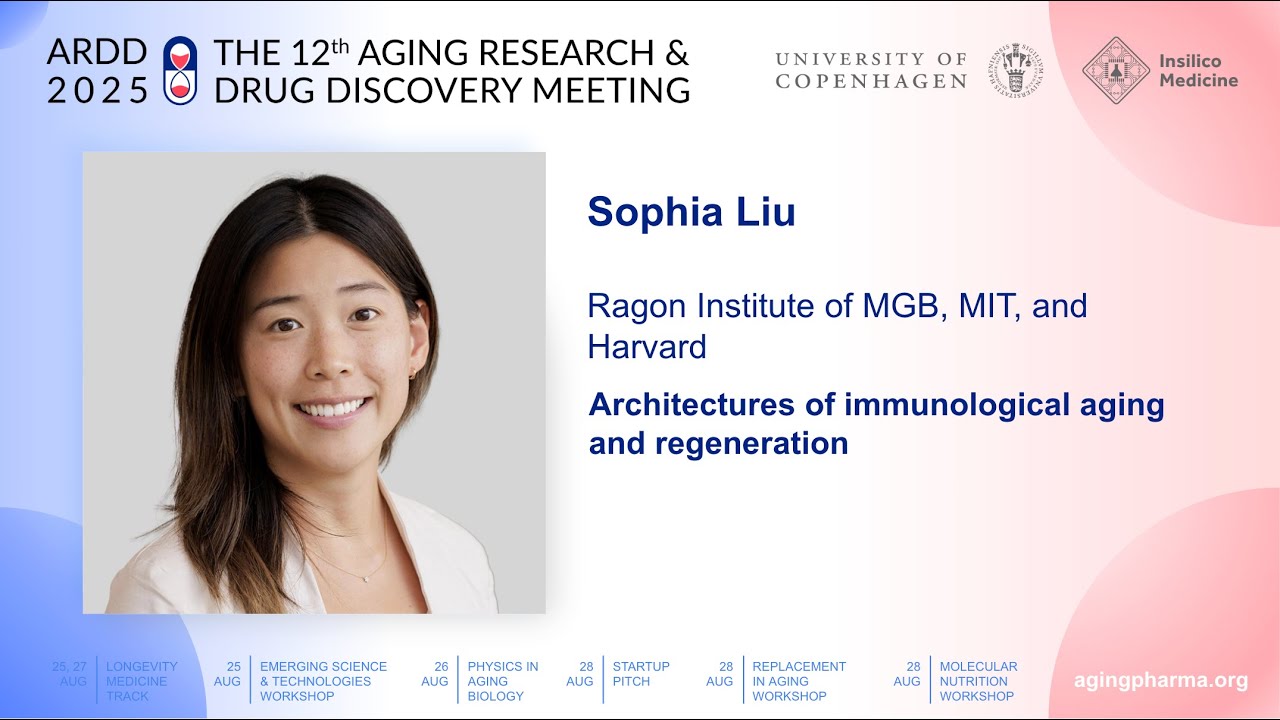
Sophia Liu at ARDD2025: Architectures of immunological aging and regeneration
Keywords
Summary
142 words
Critical Evaluation
Value of the Information & Strength of the Argument
The talk provides valuable insights into the spatial and temporal dynamics of thymic aging, supported by extensive data from spatial transcriptomics and single-cell sequencing. The argumentation is solid, with clear logical progression from the problem of immune aging to the technological gap and the specific findings. The use of a functional aging clock and perturbation experiments strengthens the causal claims. However, some conclusions are speculative, such as the role of methylation in V(D)J bias, and the presenter acknowledges uncertainties.
Scientific Rigor, Source Quality, Title Accuracy
The presentation demonstrates scientific rigor through detailed methodology and data presentation. However, no specific sources are cited in the talk or description, limiting the ability to verify claims. The title accurately reflects the content, focusing on architectures of immunological aging and regeneration. The talk is based on original research, but without peer-reviewed references, the reliability is moderate.
151 words
Title / Content Match
The title accurately reflects the content, focusing on immunological aging and regeneration.
Quality & Reliability
8/10
Presentation of original research with detailed methodology and data, but limited peer-reviewed context and no external sources cited.
Key Moments
Markers derived by PSI from the transcript: the creator did not define chapters.
- Introduction to immune aging and the immune escape threshold.
- Discussion of thymic involution and its early onset.
- Historical overview of microscopy and the need for multiplexing.
- Explanation of spatial transcriptomics and its limitations.
- Description of the longitudinal sampling strategy in mice.
- Presentation of spatial data showing thymic organization changes.
- Identification of lost cell interactions, including Delta-Notch signaling.
- Observation of biased V(D)J recombination with age.
- Development of a functional aging clock and macrophage perturbation experiment.
- Preliminary human data showing thymic disorganization with age.
Contribution & Novelties
The talk presents novel spatial transcriptomics data on thymic aging, revealing early and dynamic changes in cell interactions and gene expression. The development of a functional aging clock based on cell-cell interactions is a unique contribution. The finding of biased V(D)J recombination with age is intriguing and opens new avenues for research.
Pour aller plus loin :
- Thymic involution — Background on the process.
- Spatial transcriptomics — Overview of the technology.
- V(D)J recombination — Mechanism of TCR generation.
78 words
Radar Profile
The radar profile shows high scores in information quantity, quality, and technical level, with slightly lower reliability due to lack of cited sources. This indicates a technically rich presentation with original data, but the absence of external references tempers the overall reliability.
💬 Sur les 0 commentaires analysés, aucune tendance n'est disponible.