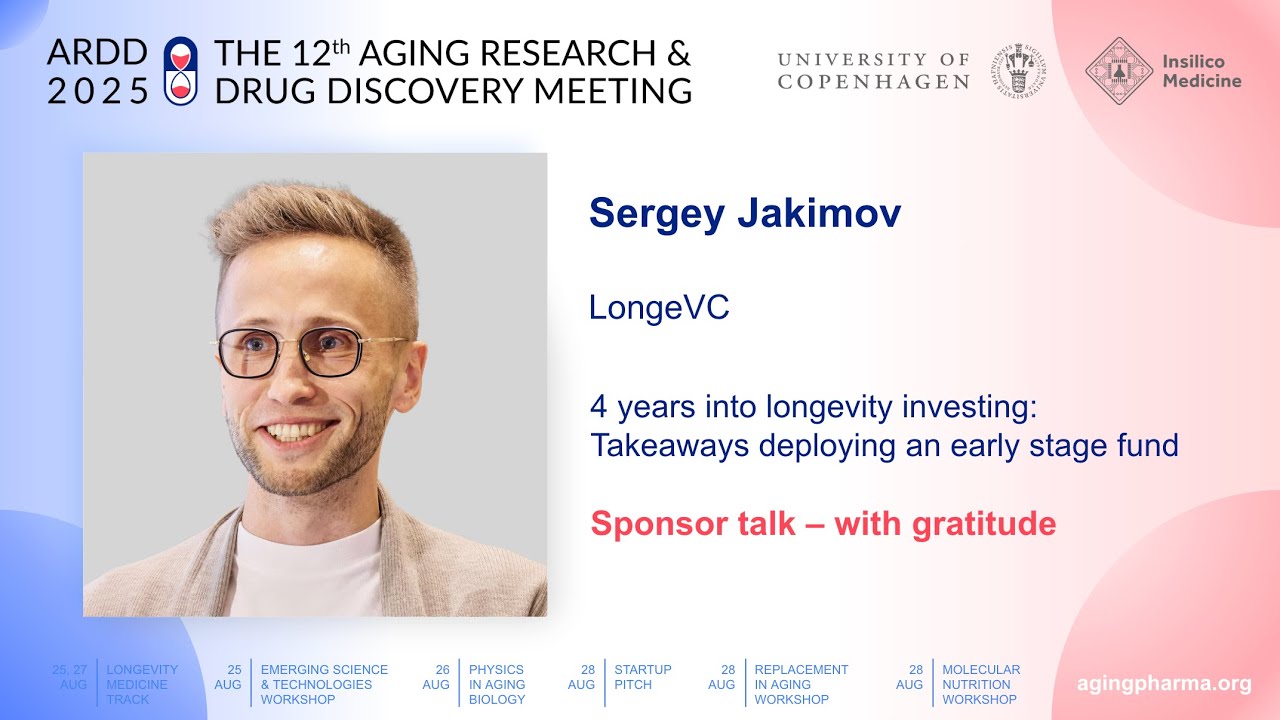
Sergey Jakimov at ARDD2025: 4 years into longevity investing: Takeaways deploying an early stage...
Keywords
Summary
190 words
Critical Evaluation
Value of the Information & Strength of the Argument
The talk provides valuable insights from a practitioner’s perspective, offering concrete data on deal flow, round sizes, and pharma partnerships. The argumentation is coherent and pragmatic, emphasizing the need for commercial viability in longevity biotech. However, the evidence is largely anecdotal and based on a single fund’s experience, limiting its generalizability. The speaker’s logic is sound, but the lack of external validation and potential conflicts of interest (as an investor promoting his own fund) should be considered.
Scientific Rigor, Source Quality, Title Accuracy
The talk is an expert opinion based on personal experience, not a scientific review. The speaker cites no external sources, but his claims are grounded in his fund’s data. The title accurately reflects the content. The presentation is well-structured and clear, but the lack of citations and reliance on anecdotal evidence reduce its scientific rigor.
147 words
Title / Content Match
The title accurately reflects the content: a presentation on lessons learned from four years of investing in longevity startups.
Quality & Reliability
7/10
The speaker is a practitioner with direct experience in longevity investing, providing concrete data from their fund's operations. However, the talk is largely anecdotal and lacks peer-reviewed evidence or external validation. The claims are plausible but not independently verified.
Key Moments
Markers derived by PSI from the transcript: the creator did not define chapters.
- Introduction: importance of longevity biotech and need for success stories.
- Fund overview: LongeVC's portfolio, ecosystem, and team.
- Investment thesis: focus on age-related diseases and actionable targets.
- Deal flow funnel: from 2,500 companies to 20 investments.
- Round size trends: Series A rounds getting larger, bridge rounds shrinking.
- Pharma partnerships: 13 out of 20 portfolio companies have strategic deals.
- Examples: UNP and Turn Bio, importance of own pipeline.
- Common founder mistakes: overvaluing mouse studies, lack of regulatory focus.
- Current investor trends: focus on assets, NHP studies, pay-to-play terms.
- Conclusion: need for pragmatism and industry collaboration.
Contribution & Novelties
The talk offers a unique insider perspective on the practical challenges of longevity investing, including detailed data on deal flow and pharma partnerships. It provides actionable advice for founders and investors.
Pour aller plus loin :
- Longevity Science Foundation — A foundation funding early-stage aging research, mentioned by the speaker.
- Healthy Longevity Medicine Society — A society promoting healthy longevity medicine, co-created by LongeVC.
- NIVC — A sister fund focusing on animal aging and health.
- Aging and Drug Discovery Meeting — The conference where this talk was given, a key event in the longevity field.
95 words
Radar Profile
The radar profile shows high scores in information quantity and quality, reflecting the speaker's extensive experience and concrete data. The technical level is moderate, suitable for a general audience. The reliability is moderate due to the anecdotal nature of the evidence.