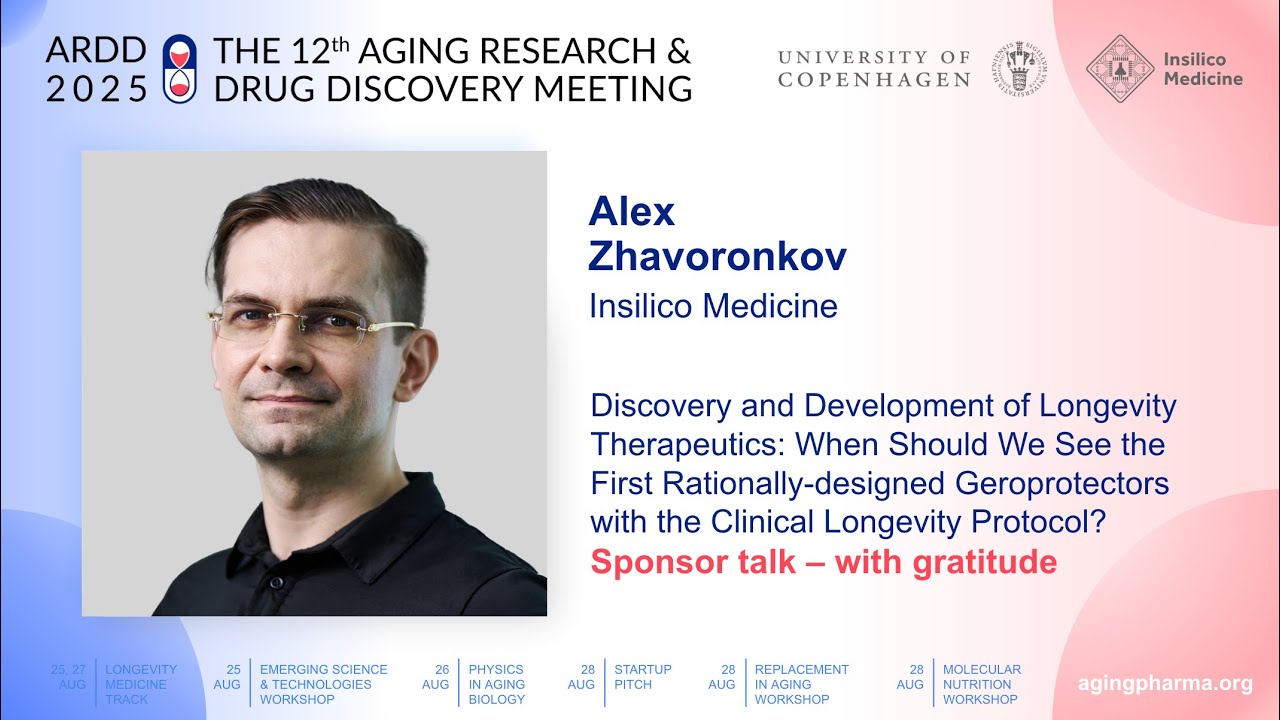
Alex Zhavoronkov at ARDD2025: Discovery and Development of Longevity Therapeutics: When Should We...
Keywords
Summary
158 words
Critical Evaluation
Value of the Information & Strength of the Argument
The talk provides valuable insights into the practical aspects of AI-driven drug discovery for longevity, including timelines, data quality requirements, and business models. The argumentation is based on the company’s track record and specific examples, such as the TNIK inhibitor’s clinical progress. However, the presentation is largely promotional, and the scientific evidence for the anti-aging effects of their drug is not presented in detail, as it is reserved for an upcoming publication.
Scientific Rigor, Source Quality, Title Accuracy
The speaker references several peer-reviewed publications, including a Nature Medicine paper on the Phase 2a trial and a Nature Biotechnology paper on the PCC package. The title accurately reflects the content. The talk is an expert opinion, and while the sources are credible, the lack of detailed data and the promotional nature limit the overall rigor.
143 words
Title / Content Match
The title accurately reflects the content, which focuses on the discovery and development of longevity therapeutics, including a discussion of when rationally-designed geroprotectors might appear.
Quality & Reliability
8/10
The speaker is a recognized expert in AI-driven drug discovery, presenting at a specialized conference. The talk includes references to peer-reviewed publications and ongoing clinical trials, but is primarily a company update and opinion piece, with limited independent verification.
Key Moments
Markers derived by PSI from the transcript: the creator did not define chapters.
- Introduction and company update: 22 developmental candidates, timelines, and business models.
- Discussion of PandaOmics target discovery platform and LifeStar 2 automated lab.
- Introduction of the target discovery benchmark and invitation for collaboration.
- Focus on the TNIK inhibitor: discovery, Phase 1 and Phase 2a trials in IPF.
- Presentation of Phase 2a results and the use of proteomics aging clocks.
- Announcement of upcoming paper with consensus data from multiple clocks.
- Conclusion and call for collaboration.
Cited Sources
- Nature Medicine paper on Phase 2a trial — Mentioned as published, providing details of the Phase 2a trial in IPF.
- Nature Biotechnology paper on PCC package — Referenced as describing the quality of the PCC package for a PHD12 inhibitor.
- Paper on TNIK inhibitor discovery and development — Described as the most important paper, covering discovery to Phase 1 completion.
Concurring Sources
- Nature Medicine paper on Phase 2a trial — The speaker's claims about the trial are consistent with the published paper.
Dissenting Sources
- No discordant sources identified — No sources contradicting the speaker's claims were mentioned.
Contribution & Novelties
The talk provides an update on Insilico Medicine’s AI-driven drug discovery pipeline, including the first geroprotector candidate to reach Phase 2a trials. It introduces a novel benchmarking system for target discovery and emphasizes the use of proteomics aging clocks to assess anti-aging efficacy.
Pour aller plus loin :
- Aging clocks — Relevant to the use of biological age predictors.
- Idiopathic pulmonary fibrosis — The disease targeted in the clinical trial.
- Artificial intelligence in drug discovery — Context for AI-driven approaches.
80 words
Radar Profile
The radar profile shows high scores in information quantity and quality, with moderate technical level and reliability. This reflects a talk that is rich in content but relies on the speaker's expertise and company data rather than independent verification.