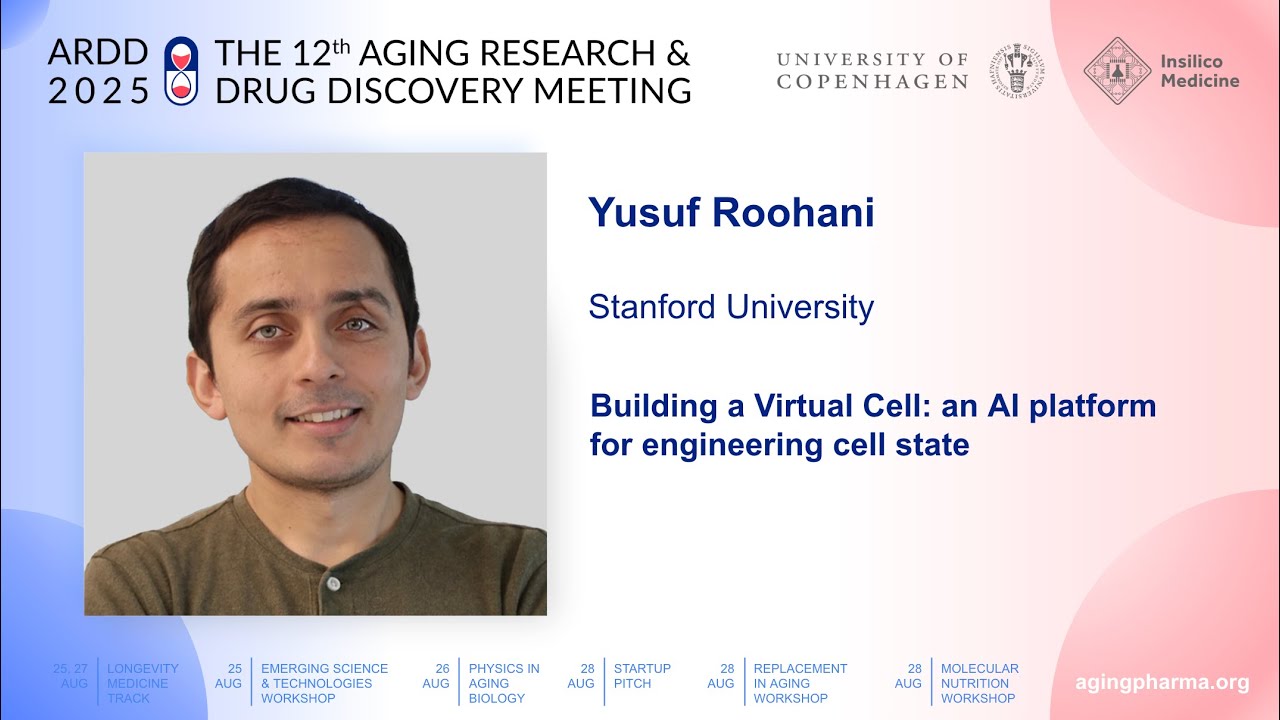
Yusuf Roohani at ARDD2025: Building a Virtual Cell: an AI platform for engineering cell state
Keywords
Summary
170 words
Critical Evaluation
Value of the Information & Strength of the Argument
The presentation provides valuable insights into the state-of-the-art in AI-driven cell modeling. The argumentation is solid, grounded in published research and concrete results. Roohani clearly explains the motivation, methodology, and outcomes of their work, making a compelling case for the virtual cell approach. He acknowledges limitations and open questions, such as the need for better evaluation frameworks and the potential for errors in agent-curated data. The talk is well-structured and persuasive, though it primarily presents the speaker’s own work without deep critical comparison to alternative approaches.
Scientific Rigor, Source Quality, Title Accuracy
The scientific rigor is high, as the work is published in reputable journals like Cell. The speaker cites specific papers and provides a link to his website for further details. The title accurately reflects the content. The talk is a conference presentation, so it does not provide full methodological details, but it references the relevant literature. The sources are credible and directly related to the presented work.
168 words
Title / Content Match
The title accurately reflects the content, which focuses on building a virtual cell platform using AI for engineering cell state.
Quality & Reliability
8/10
The presentation is by a leading researcher in the field, affiliated with the Arc Institute and Stanford, and describes peer-reviewed work published in Cell. The claims are supported by specific results and references to published papers. However, the talk is a conference presentation and does not provide full methodological details, and some claims about the superiority of their model are based on their own evaluations.
Key Moments
Markers derived by PSI from the transcript: the creator did not define chapters.
- Introduction: Yusuf Roohani introduces himself and the Arc Institute, and outlines the vision for a virtual cell.
- AlphaFold as an example of AI transforming scientific discovery, and the paradigm of in silico experiments.
- The virtual cell vision: building representations at the cellular level to predict responses to perturbations.
- The four research fronts: model development, evaluation, data curation, and data generation.
- Introduction of STATE, a transformer-based model for perturbation prediction, and the context generalization task.
- Evaluation results: STATE outperforms baselines in detecting differentially expressed genes and recapitulating perturb-seq experiments.
- Launch of the Virtual Cell Challenge: a community competition to evaluate virtual cell models.
- SCBase: an agent-curated repository of single-cell data, five times larger than existing repositories.
- Using AI agents to guide data generation for perturbation experiments, achieving 21% improvement in hit rate.
- Conclusion: AI as a 'virtual biologist', and acknowledgments.
Cited Sources
- Perspective on virtual cells published in Cell — Roohani mentions a perspective paper published in Cell last year describing the vision for a virtual cell.
- STATE paper — The model STATE is described, and the paper is referenced as published.
- Virtual Cell Challenge paper — The competition was published in Cell in June of this year.
- SCBase paper — The agent-curated repository SCBase is described, with a preprint mentioned.
Concurring Sources
- AlphaFold — Referenced as a successful AI model for protein structure prediction.
- Foundation Models paper — The paper that introduced the term 'foundation models'.
Contribution & Novelties
The talk presents novel contributions in AI-driven cell modeling, including the STATE model that learns over sets of cells, the Virtual Cell Challenge for community evaluation, and the use of AI agents for data curation and generation. The emphasis on a closed-loop platform integrating experimental and computational efforts is a distinctive approach.
Pour aller plus loin :
- Foundation Models — The paper that introduced the term ‘foundation models’.
- AlphaFold — The AI system for protein structure prediction.
- Perturb-seq — A technique for high-throughput perturbation screens with single-cell readouts.
- Single-cell RNA sequencing — Overview of the technology used in the talk.
100 words
Radar Profile
The radar profile shows high scores across all dimensions, indicating a well-rounded presentation with strong information content, technical depth, and reliability. The talk is particularly strong in terms of novelty and practical impact, with slightly lower scores in breadth of sources due to the focus on the speaker's own work.
💬 Sur les 0 commentaires analysés, aucune tendance n'a pu être dégagée.