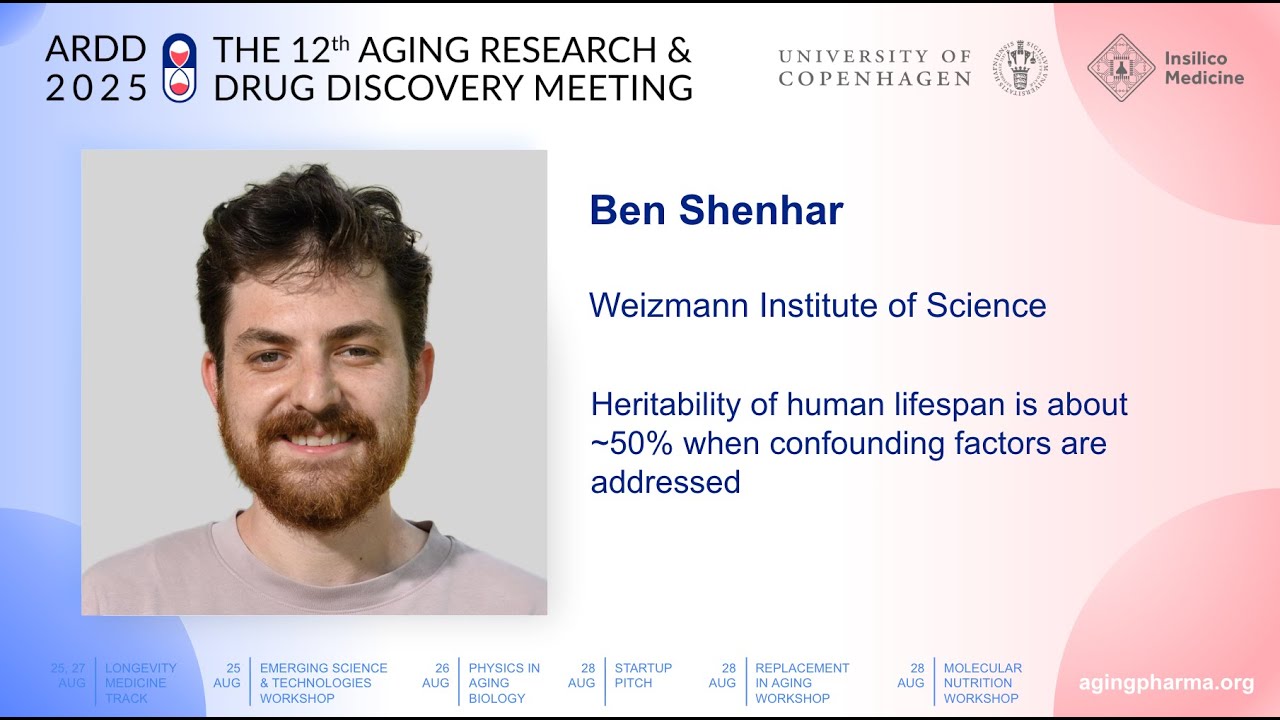
Ben Shenhar at ARDD2025: Heritability of human lifespan is about ~50% when confounding factors...
Keywords
Summary
141 words
Critical Evaluation
Value of the Information & Strength of the Argument
The talk provides a compelling argument that previous heritability estimates were underestimated due to extrinsic mortality. The use of two independent mortality models and validation on independent cohorts strengthens the claim. The mathematical demonstration that extrinsic mortality reduces correlations is intuitive and well-explained. The prediction that heritability increases with lower extrinsic mortality is confirmed in Swedish twins, supporting the causal interpretation. The discussion of heritability of reaching specific ages adds nuance and practical relevance. The argumentation is logical and addresses potential counterarguments, such as the use of a high cutoff age.
Scientific Rigor, Source Quality, Title Accuracy
The presentation is scientifically rigorous, with clear methodology and reliance on published data (Danish and Swedish twin studies, large-scale pedigree studies). The models are based on established frameworks (Makeham, saturating removal model). The author acknowledges limitations, such as lack of cause-of-death data for twins and the need to model extrinsic mortality. The title accurately reflects the content. No external sources are cited in the video description, but the presenter mentions a preprint and collaboration with Sarah H from Stockholm. The talk is part of a conference (ARDD2025), indicating peer context.
196 words
Title / Content Match
The title accurately reflects the main finding presented: heritability of human lifespan is about 50% when confounding factors are addressed.
Quality & Reliability
8/10
Presentation of original research with mathematical modeling, simulation, and validation on independent twin cohorts. Methods are clearly described, and results are consistent across models. Limitations are acknowledged, and the preprint is available for scrutiny.
Key Moments
Markers derived by PSI from the transcript: the creator did not define chapters.
- Introduction: Ben Shenhar presents his work on heritability of human lifespan.
- Background: Most traits are ~50% heritable, but lifespan estimates are lower (10-25%).
- Explanation of twin studies and the off-diagonal effect in twin lifespan correlations.
- Partitioning mortality into intrinsic and extrinsic components using cause-of-death data.
- Illustration of how extrinsic mortality reduces heritability by compressing and stretching genetic group distributions.
- Introduction of two mortality models (Makeham and saturating removal) to simulate twin lifespans.
- Simulation results: removing extrinsic deaths raises heritability to ~50%.
- Validation on Swedish twin cohorts: heritability increases with lower extrinsic mortality.
- Heritability of reaching specific ages decreases linearly but remains high (~30% at age 80).
- Conclusion: Heritability is ~50% when extrinsic mortality is accounted for; environment becomes more important with age.
Cited Sources
- Preprint (not specified) — Mentioned as available for review.
Concurring Sources
- Danish Twin Study (original) — Provided the original heritability estimate of ~25%.
- Swedish Twin Cohorts (SATA) — Used for validation, showing higher heritability in later cohorts.
Dissenting Sources
- Large-scale pedigree studies — These studies found lower heritability (~10%), but the presenter argues they were confounded by high extrinsic mortality and environmental variance.
Contribution & Novelties
This work provides a novel methodological approach to estimate the heritability of lifespan by isolating intrinsic mortality using two mortality models and simulations. It challenges previous low estimates and suggests that genetic factors play a larger role than previously thought. The finding that heritability of reaching a specific age decreases with age offers a nuanced perspective on gene-environment interactions.
Pour aller plus loin :
- Heritability — Background on heritability concepts.
- Twin study — Methodology used in classical heritability estimates.
- Gompertz–Makeham law of mortality — One of the mortality models used.
- Aging — Overview of biological aging.
96 words
Radar Profile
The radar profile shows high scores in information quantity, quality, and reliability, with a slightly lower technical level, indicating a presentation that is accessible yet scientifically robust. The overall high scores reflect the strong methodological foundation and clear communication.
💬 No comments were provided for analysis.