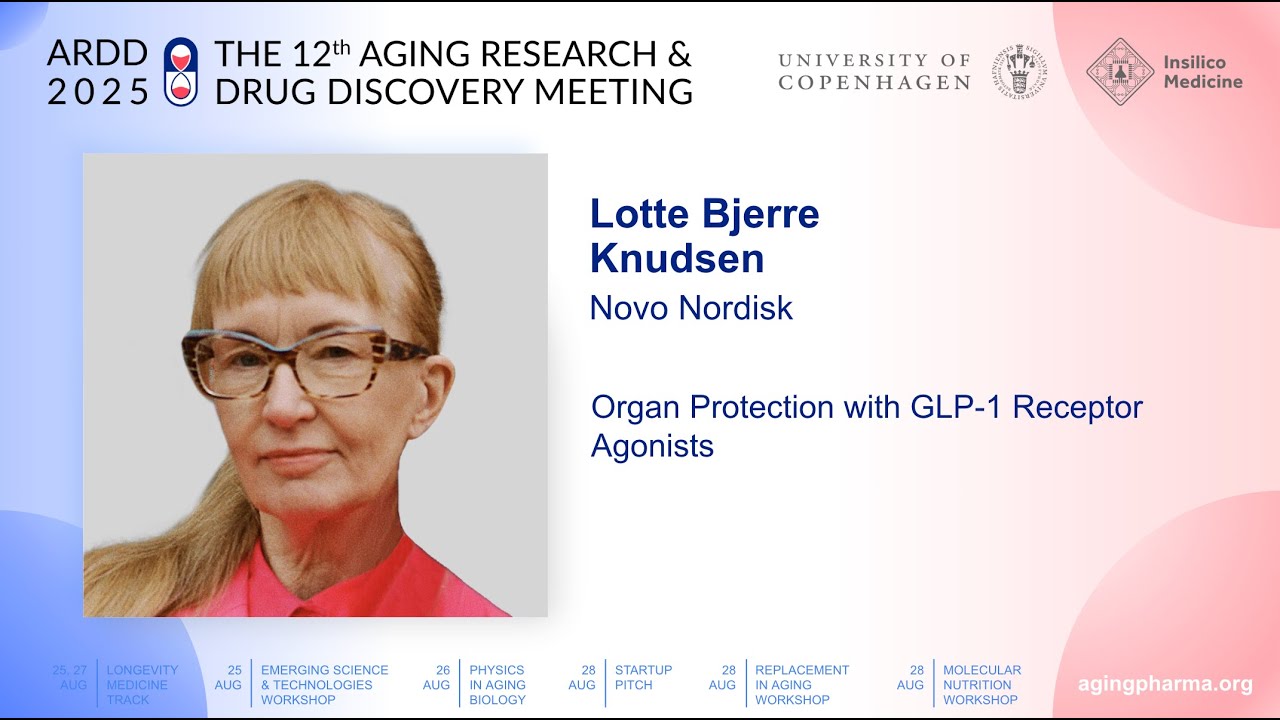
Lotte Bjerre Knudsen at ARDD2025: Organ Protection with GLP-1 Receptor Agonists
Keywords
Summary
181 words
Critical Evaluation
Value of the Information & Strength of the Argument
The talk provides a comprehensive overview of the clinical evidence for GLP-1 receptor agonists in organ protection, with a focus on semaglutide. The speaker presents data from landmark trials such as SELECT, FLOW, and the recent liver fibrosis approval, and explains the underlying mechanisms, including effects on inflammation and homeostasis. The argumentation is solid, backed by peer-reviewed publications and real-world data. However, the presentation is given by a representative of the manufacturer, which introduces potential bias. The speaker acknowledges the collaborative nature of the research and the need for further studies, particularly in areas like Alzheimer’s disease. The discussion of the reward system and addiction is intriguing but based on hypothesis and real-world data rather than definitive clinical outcomes. Overall, the value of the information is high, and the argumentation is coherent and evidence-based, though the commercial context should be considered.
Scientific Rigor, Source Quality, Title Accuracy
The presentation demonstrates high scientific rigor, with references to major clinical trials and publications in journals like NEJM and Nature Medicine. The speaker cites specific studies and mechanisms, and she mentions that some data are openly available for research. The title accurately reflects the content, focusing on organ protection with GLP-1 receptor agonists. The talk is well-structured and provides a balanced view of the evidence, including limitations and areas of uncertainty. The speaker also addresses questions from the audience, clarifying points about Alzheimer’s trial design and aging clocks. The sources are credible, though the commercial affiliation of the speaker should be noted. The title is appropriate and does not overstate the content.
268 words
Title / Content Match
The title accurately reflects the content, focusing on organ protection with GLP-1 receptor agonists as presented by Lotte Bjerre Knudsen.
Quality & Reliability
8/10
The speaker is a leading scientist from Novo Nordisk with decades of experience in GLP-1 research. The talk presents data from major clinical trials (SELECT, FLOW, etc.) and peer-reviewed publications, but it is a conference presentation with potential commercial bias. The evidence is high-quality but not independently verified in this context.
Key Moments
Markers derived by PSI from the transcript: the creator did not define chapters.
- Introduction and acknowledgment of collaborative work
- Overview of GLP-1 receptor agonists and their differences
- Weight loss effects and comparison of GLP-1s
- Mechanisms of GLP-1: glucose-dependent effects and systemic actions
- Cardiovascular benefits: SELECT trial and inflammation
- Heart failure: mechanism and clinical studies
- Kidney outcomes: FLOW trial and mechanisms
- Liver fibrosis: recent approval and mechanistic insights
- Addiction and brain effects: real-world data and proteomics
- Alzheimer's disease: ongoing trials and neuroinflammation hypothesis
Cited Sources
- JAMA viewpoint on GLP-1 history — Mentioned as a viewpoint written for JAMA
- SELECT trial — Landmark cardiovascular outcome trial with semaglutide in obesity
- FLOW trial — Kidney outcome study with semaglutide
- Nature Medicine paper on liver fibrosis mechanisms — Recent paper detailing mechanisms of semaglutide on liver fibrosis
Concurring Sources
- SELECT trial publication — Landmark trial showing cardiovascular benefits of semaglutide in obesity.
- FLOW trial publication — Trial showing kidney benefits of semaglutide.
Contribution & Novelties
This presentation provides an expert overview of the expanding evidence for GLP-1 receptor agonists in organ protection, highlighting recent clinical trial results and mechanistic insights. The speaker emphasizes the pleiotropic effects of semaglutide beyond weight loss, including cardiovascular, renal, and hepatic benefits, and discusses emerging areas such as addiction and Alzheimer’s disease. The talk underscores the importance of understanding individual drug differences rather than assuming a class effect. The speaker also suggests a conceptual split in the longevity field between healthspan and fundamental aging mechanisms.
Pour aller plus loin :
- GLP-1 receptor agonists: mechanisms of action — Overview of GLP-1 receptor agonists and their mechanisms.
- SELECT trial: Semaglutide and Cardiovascular Outcomes in Obesity — Key clinical trial showing cardiovascular benefits.
- FLOW trial: Semaglutide and Renal Outcomes — Trial demonstrating kidney protection.
- Neuroinflammation in Alzheimer’s disease — Review on neuroinflammation, relevant to the Alzheimer’s hypothesis.
144 words
Radar Profile
The radar profile shows high scores across all dimensions, indicating a well-rounded presentation with substantial information, strong evidence, and appropriate technical depth. The reliability is high, though the commercial affiliation slightly tempers the score.
💬 No comments were provided for analysis.