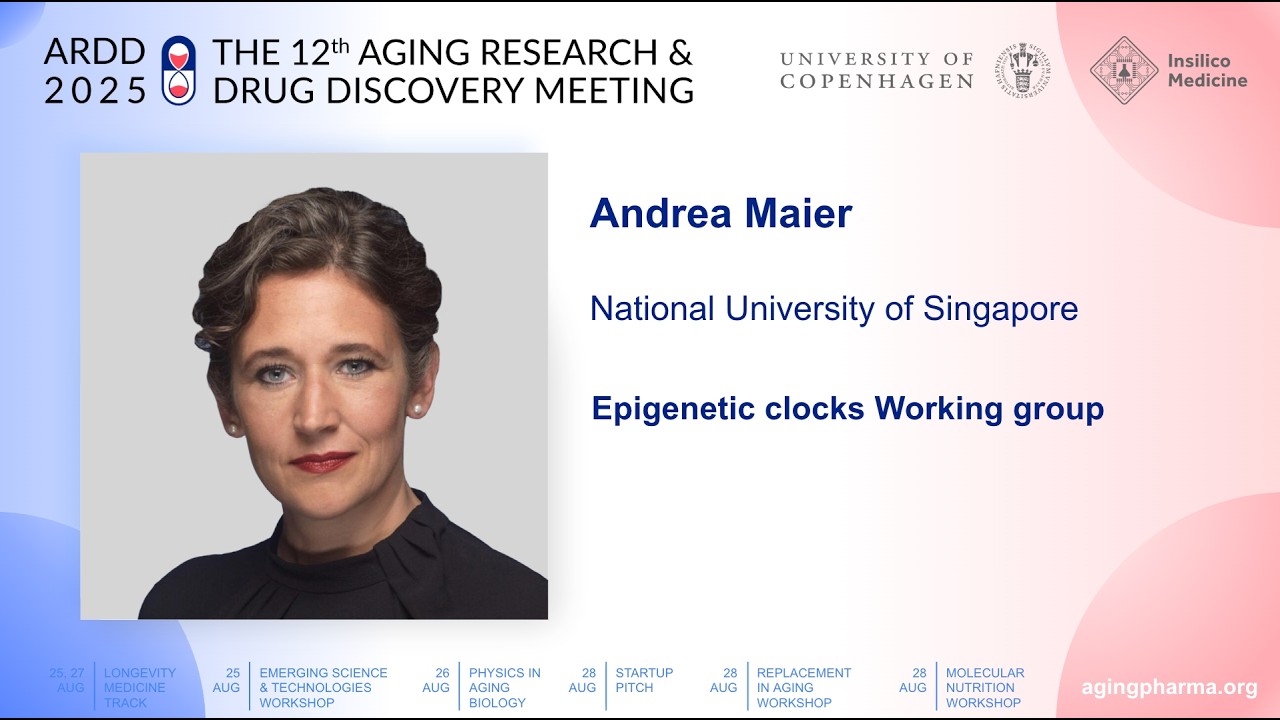
Andrea Maier at ARDD2025: Epigenetic clocks Working group
Keywords
Summary
118 words
Critical Evaluation
Value of the Information & Strength of the Argument
The presentation provides valuable information by synthesizing a large body of evidence on epigenetic clocks. The argumentation is solid, based on a systematic review and meta-analysis, and acknowledges limitations such as the predominance of cross-sectional data and the need for longitudinal validation. The speakers clearly distinguish between evidence for association and predictive capacity, and they provide practical recommendations for clinical use. The call for volunteers and the mention of ongoing work indicate a collaborative and rigorous approach.
Scientific Rigor, Source Quality, Title Accuracy
The scientific rigor is high, as the work is based on a systematic review and meta-analysis conducted by a consortium. The sources are not explicitly cited in the video, but the methodology is described, and the presenters mention that some papers are in revision. The title accurately reflects the content. The presentation is an expert opinion based on ongoing research, and the limitations are acknowledged. No comments were provided, so no analysis of public trends is included.
169 words
Title / Content Match
The title accurately reflects the content, which is a presentation by Andrea Maier on the Epigenetic clocks Working group at ARDD2025.
Quality & Reliability
8/10
Presentation by leading researchers in aging, based on a systematic review and meta-analysis conducted by a consortium, with transparent methodology and acknowledgment of limitations. However, it is a conference talk, not peer-reviewed, and some claims are based on unpublished data.
Key Moments
Markers derived by PSI from the transcript: the creator did not define chapters.
- Introduction to working groups and the question of using epigenetic clocks in clinical practice.
- Description of the systematic review consortium and methodology.
- Meta-analysis results for frailty, showing cross-sectional associations but limited longitudinal predictive capacity.
- Summary of results across outcomes, indicating that second-generation clocks have the strongest evidence.
- Discussion of practical considerations for clinical implementation, including sample type and standardization.
- Call for volunteers to join the consortium and list of topics needing analysis.
- Conclusion: second-generation clocks are ready for prime time, third and fourth need more evidence.
- Q&A session addressing questions about interventions, cancer prediction, and sample handling.
Cited Sources
- Biomarkers of Aging Consortium — Mentioned as a partner in the systematic review consortium.
- Healthy Longevity Medicine Society (HLMS) — Mentioned as the organizing body for the working groups.
- GrimAge paper — Referenced as the source for the second-generation clock GrimAge.
Concurring Sources
- Epigenetic clock - Wikipedia — Provides general information on epigenetic clocks, consistent with the talk's description.
- DNA methylation - Wikipedia — Explains the biological mechanism underlying epigenetic clocks.
Contribution & Novelties
The presentation provides a comprehensive synthesis of the evidence on epigenetic clocks, highlighting the need for longitudinal data and the current limitations. It offers practical guidance for clinicians on which clocks to use and considerations for implementation. The systematic review and meta-analysis are ongoing, and the call for volunteers indicates a collaborative effort to advance the field.
Pour aller plus loin :
- Epigenetic clock - Wikipedia — Background on epigenetic clocks and their generations.
- DNA methylation - Wikipedia — Overview of DNA methylation and its role in aging.
- Biomarkers of Aging Consortium — Official website of the consortium mentioned in the talk.
102 words
Radar Profile
The radar profile shows high scores in quantity and quality of information, reflecting the comprehensive systematic review. The technical level is high, indicating the presentation is aimed at a specialized audience. The overall reliability is strong, but the lack of peer-reviewed publication at the time of the talk slightly reduces the score.