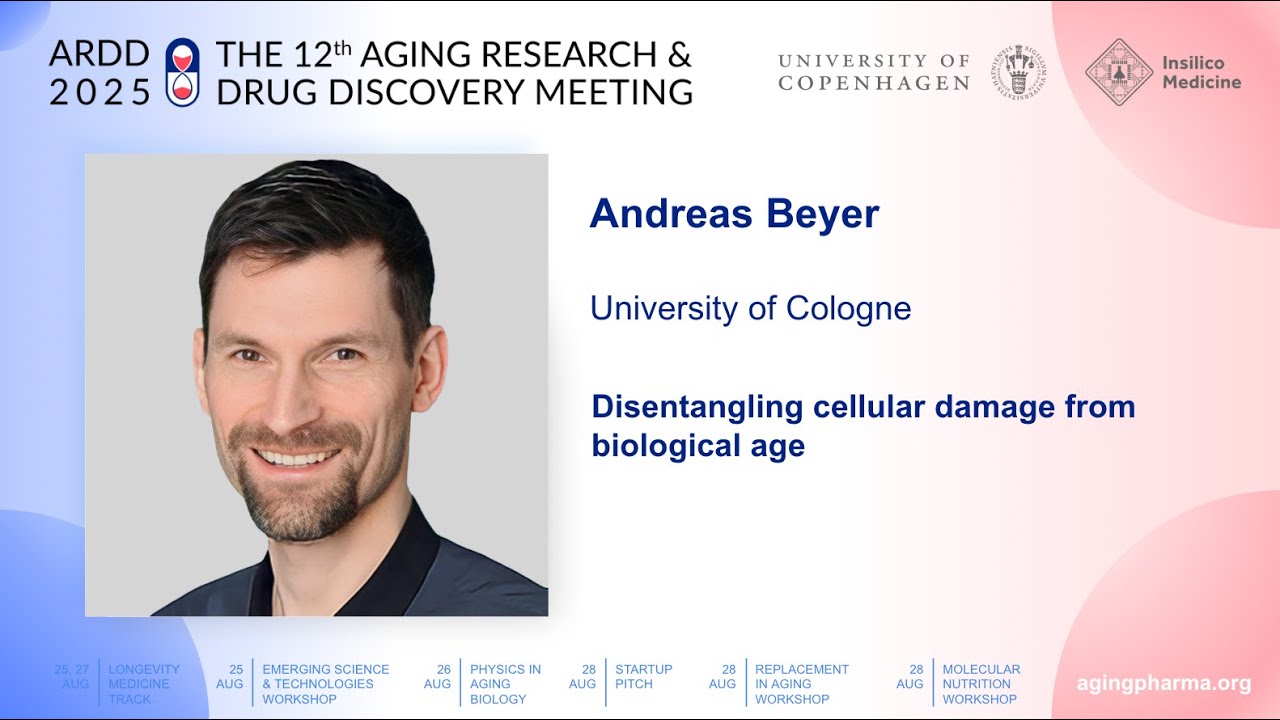
Andreas Beyer at ARDD2025: Disentangling cellular damage from biological age
Keywords
Summary
135 words
Critical Evaluation
Value of the Information & Strength of the Argument
The talk presents a valuable methodological advance: a data-driven, cell-type-specific damage score that is robust across disease models and applicable to human data and spatial transcriptomics. The argumentation is solid, supported by multiple validation steps (correlation with histology, physiological readouts, and comparison with aging signatures). The speaker clearly explains the rationale and limitations, and the discussion addresses potential confounders. The claim that damage is distinct from biological age is convincingly supported by the data showing that the damage score better captures kidney function than an aging signature.
96 words
Title / Content Match
The title accurately reflects the content, focusing on distinguishing cellular damage from biological age.
Quality & Reliability
8/10
Presentation of original research with clear methodology, validation across multiple datasets, and peer discussion. Limitations acknowledged (e.g., operational definition of damage).
Key Moments
Markers derived by PSI from the transcript: the creator did not define chapters.
- Introduction: motivation to use single-cell transcriptomics to assess cellular damage.
- Methodology: identifying consistent differentially expressed genes across disease models.
- Application to kidney and liver disease: damage scores align with sample types.
- Validation: damage scores correlate with histological damage and physiological function.
- Damage vs. biological age: damage score better captures kidney function than aging signature.
- Application to hepatocytes: damage leads to different cell fates (senescence, cancer).
- Metabolic changes in senescent vs. non-senescent damaged cells.
- Conclusions: damage is distinct from biological age and senescence; future directions.
Cited Sources
- Preprint on bioRxiv (mentioned in talk) — The speaker mentions a preprint on bioRxiv containing the damage score methodology.
Concurring Sources
- Preprint on bioRxiv (mentioned in talk) — The speaker mentions a preprint on bioRxiv containing the damage score methodology.
Contribution & Novelties
The talk introduces a novel computational framework to quantify cellular damage from single-cell RNA-seq data, independent of specific disease etiology. This allows disentangling damage from biological age and senescence, providing a tool to study age-related degenerative diseases. The approach is validated across multiple datasets and species, and reveals that damage precedes loss of cell identity and functional decline.
Pour aller plus loin :
- Single-cell RNA sequencing — Overview of the technology used.
- Biological aging clocks — Context on aging signatures.
- Cellular senescence — Relevant to the cell fate analysis.
89 words
Radar Profile
The radar profile shows high scores in information quality and technical level, with slightly lower but still strong scores in quantity and reliability. This indicates a technically advanced, well-supported presentation with substantial content.