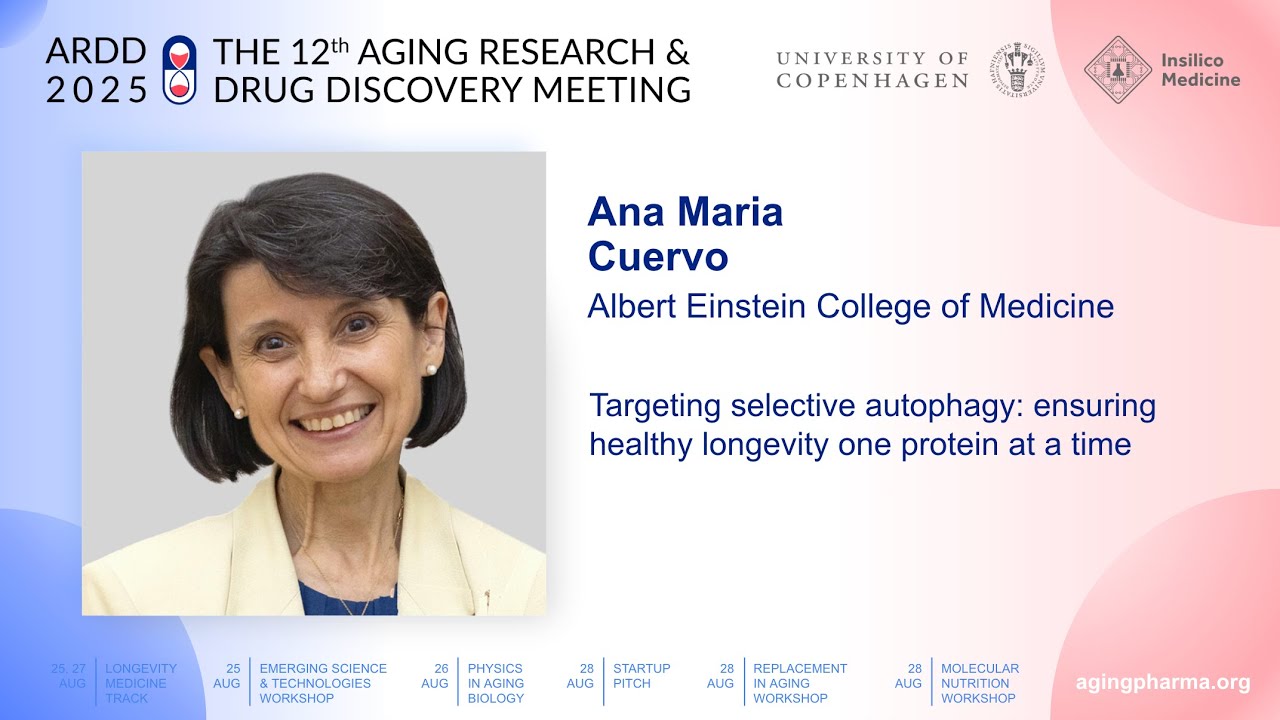
Ana Maria Cuervo at ARDD2025: Targeting selective autophagy: ensuring healthy longevity one protein at a time
Keywords
Summary
165 words
Critical Evaluation
Value of the Information & Strength of the Argument
The talk provides valuable insights into the role of CMA in aging and disease, supported by a combination of genetic, proteomic, and pharmacological approaches. The argumentation is strong, with clear logical progression from basic mechanisms to translational applications. The speaker presents both published and preliminary data, and acknowledges limitations, such as the need for further validation in humans. The discussion of sex differences and cell-type specificity adds depth, and the potential for CMA activation as a therapeutic strategy is compelling.
Scientific Rigor, Source Quality, Title Accuracy
The speaker cites her own published work and collaborations, but does not provide specific citations during the talk. The title accurately reflects the content. The scientific rigor is high, with data from well-controlled experiments and validation in multiple models. However, some claims are based on unpublished data, and the lack of detailed methodology in the talk limits independent verification. The description provides no additional sources.
160 words
Title / Content Match
The title accurately reflects the content, focusing on targeting selective autophagy (CMA) for healthy longevity.
Quality & Reliability
8/10
The talk is given by a leading expert in the field, presenting data from published studies and ongoing research. The methods are well-established and the results are consistent with existing literature. However, some claims are based on unpublished or preliminary data, and the presentation is a conference talk rather than a peer-reviewed publication.
Key Moments
Markers derived by PSI from the transcript: the creator did not define chapters.
- Introduction and overview of autophagy and CMA
- Explanation of CMA mechanism and its role in protein quality control
- Development of fluorescent reporter for CMA activity in mice
- Systemic analysis of CMA activity across organs and sex differences
- Sex-specific CMA substrates in neurons and functional implications
- Measuring CMA in humans using gene expression score
- CMA decline in Alzheimer's disease and correlation with pathology
- CMA in cognitive resilience and caloric restriction studies
- Small-molecule activators of CMA and their effects in disease models
- Effects of CMA activation on normal aging and concluding remarks
Cited Sources
- Nature Aging publication on systemic CMA changes — Mentioned as recently published work on systemic analysis of CMA in mice.
- Collaboration with Pablo Castillo on synaptic function — Mentioned in the context of functional relevance of sex-specific CMA substrates.
Concurring Sources
- Hallmarks of aging: An expanding universe — Updated hallmarks of aging include autophagy as a primary driver.
Contribution & Novelties
The talk presents novel findings on the systemic and cell-type-specific decline of CMA with age, sex differences in CMA activity and substrates, and the development of a gene expression-based CMA score for human tissues. It also introduces small-molecule activators of CMA as potential therapeutic agents for age-related diseases and normal aging.
Pour aller plus loin :
- Chaperone-mediated autophagy — Overview of CMA mechanism and regulation.
- Autophagy in aging and disease — Review on autophagy and aging.
- LAMP2A and CMA — Study on LAMP2A as limiting factor in CMA.
88 words
Radar Profile
The radar profile shows high scores in information quantity, quality, and reliability, with a slightly lower technical level, reflecting the speaker's expertise and the depth of data presented. The overall balance indicates a highly informative and credible talk.
💬 No comments were provided for analysis.