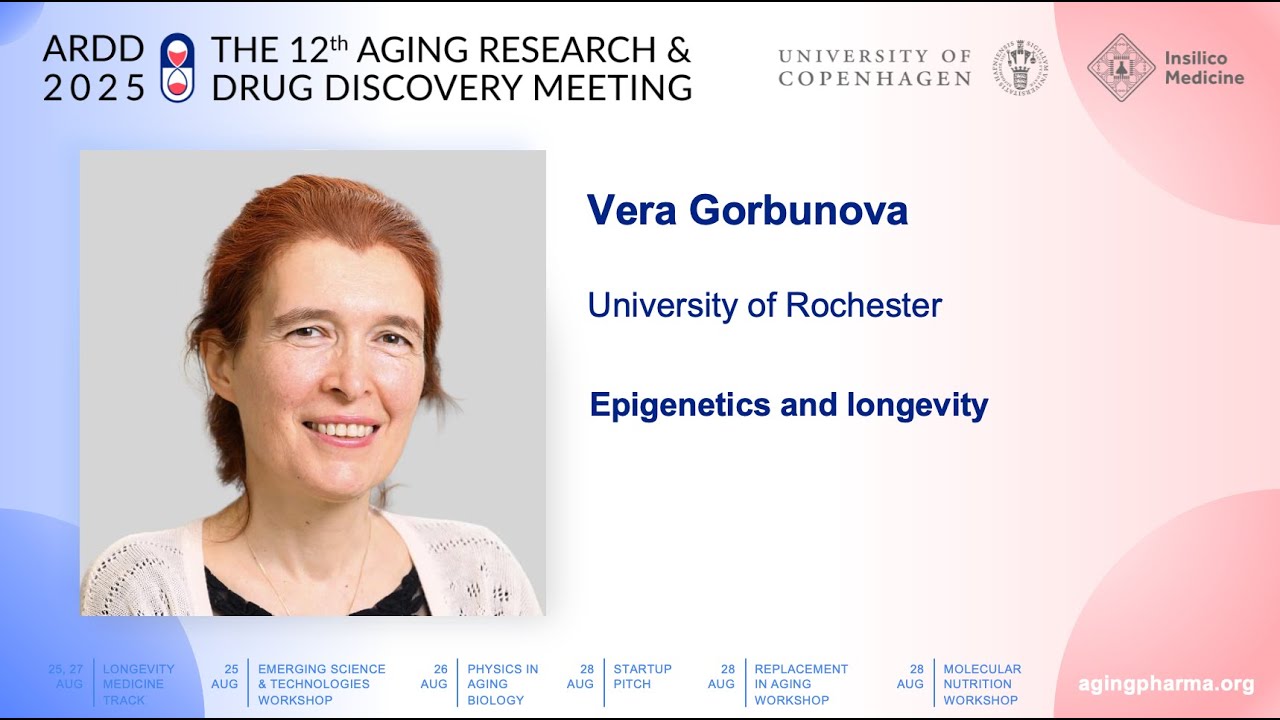
Vera Gorbunova at ARDD2025: Epigenetics and longevity
Keywords
Summary
144 words
Critical Evaluation
Value of the Information & Strength of the Argument
The talk provides valuable insights into potential gene targets for longevity interventions, supported by experimental evidence from multiple species. The argumentation is logical, moving from evolutionary observations to mechanistic studies and proof-of-concept gene therapy in mice. However, some claims are based on unpublished data and require further validation.
Scientific Rigor, Source Quality, Title Accuracy
The speaker cites her own published work (e.g., 2013 paper on hyaluronic acid) and collaborations. The title accurately reflects the content. The talk is a conference presentation, so it is not peer-reviewed, but the speaker is a reputable scientist.
102 words
Title / Content Match
The title accurately reflects the content: a presentation on epigenetics and longevity at a conference.
Quality & Reliability
8/10
Talk by a leading researcher in aging biology, presenting unpublished data and referencing published work. Claims are plausible and based on comparative biology, but lack peer-review for the new results.
Key Moments
Markers derived by PSI from the transcript: the creator did not define chapters.
- Introduction to comparative biology approach for gene replacement.
- Example of naked mole rat hyaluronic acid gene in mice.
- Bowhead whale cold-induced RNA-binding protein improves DNA repair.
- SIRT2 and SIRT6 gene therapy in mice lowers epigenetic age.
- Introduction of degu as a model for sporadic Alzheimer's disease.
- MSR deficiency in degus and human Alzheimer's patients.
- Discussion on gene replacement strategies and future directions.
Cited Sources
- High-molecular-mass hyaluronan mediates the cancer resistance of the naked mole rat — Referenced when discussing the 2013 discovery of high molecular weight hyaluronic acid in naked mole rats.
Concurring Sources
- Epigenetic clock — The concept of epigenetic age is used to measure the effect of SIRT2/6 gene therapy.
Contribution & Novelties
The talk presents novel findings on gene replacement strategies for longevity, including unpublished data on SIRT2/6 gene therapy and the degu model for Alzheimer’s. It suggests that replacing or enhancing specific genes from long-lived species could be a viable approach.
Pour aller plus loin :
- Naked mole rat — Background on the species and its longevity.
- Sirtuin — Overview of sirtuin proteins and their role in aging.
- Methionine sulfoxide reductase — Information on the enzyme family discussed in the context of Alzheimer’s.
82 words
Radar Profile
The radar profile shows high scores in information quantity and quality, with moderate technical level and reliability. This indicates a content-rich presentation with solid scientific basis, but with some technical depth that may require background knowledge.
💬 No comments were provided for analysis.