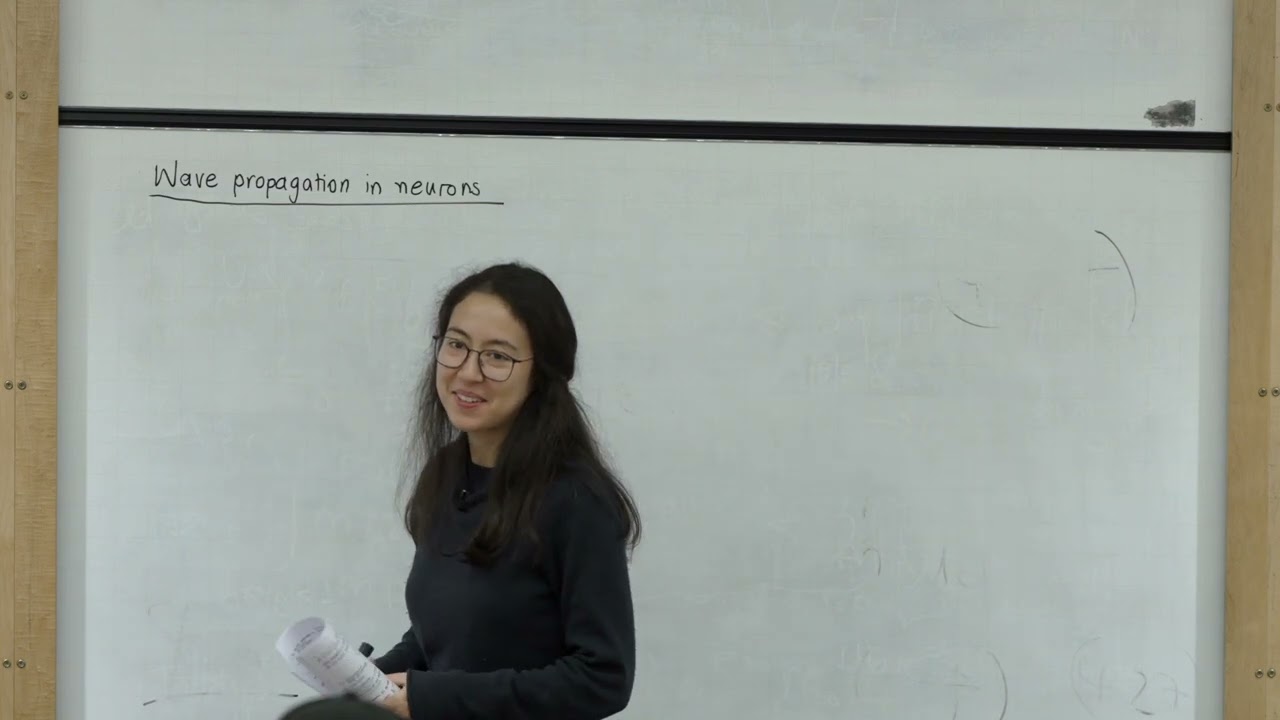
Mathematical Physiology, Lecture 6: Spatial dependence in the FitzHugh–Nagumo equations
Keywords
Summary
198 words
Critical Evaluation
Value of the Information & Strength of the Argument
The lecture provides a rigorous mathematical derivation of the space-dependent FitzHugh-Nagumo equations, building from the cable equation and non-dimensionalization. The argumentation is clear and logical, with each step justified. The lecturer effectively uses phase plane analysis and singular perturbation theory to simplify the complex three-dimensional system into a tractable two-dimensional one. The connection between the mathematical model and physiological phenomena (action potential propagation) is well-established, enhancing the value of the content.
Scientific Rigor, Source Quality, Title Accuracy
The lecture demonstrates high scientific rigor, with careful derivations and appropriate mathematical techniques. The sources are primarily the lecturer’s own course notes and standard references (Hodgkin-Huxley, FitzHugh-Nagumo models), which are not explicitly cited but are well-known in the field. The title accurately reflects the content, which focuses on spatial dependence in the FitzHugh-Nagumo equations. No comments were provided for analysis.
146 words
Title / Content Match
The title accurately reflects the content, which focuses on spatial dependence in the FitzHugh-Nagumo equations.
Quality & Reliability
9/10
Lecture from a university course by a named lecturer, with rigorous mathematical derivations and references to standard models (Hodgkin-Huxley, FitzHugh-Nagumo). The content is consistent with established literature.
Key Moments
Markers derived by PSI from the transcript: the creator did not define chapters.
- Introduction and review of stability analysis from previous lecture.
- Discussion of limit cycles and the need for energy input.
- Introduction of the FitzHugh-Nagumo equations and comparison with Hodgkin-Huxley.
- Derivation of the cable equation from circuit model of the neuron.
- Non-dimensionalization of the space-dependent FHN equations.
- Introduction of traveling wave ansatz and reduction to ODEs.
- Singular perturbation analysis: fast and slow regions.
- Rescaling and derivation of reduced system in fast region.
- Phase plane analysis of reduced system and identification of equilibria.
- Conclusion and summary of key points.
Cited Sources
- Oxford Mathematics Student Lectures Playlist — Playlist containing other student lectures from Oxford Mathematics.
- Mathematical Physiology Course Playlist — Playlist for the Mathematical Physiology course, including this lecture.
Concurring Sources
- FitzHugh-Nagumo model — The model analyzed in the lecture, confirming the equations and behavior.
- Hodgkin-Huxley model — The original model that the FitzHugh-Nagumo simplifies, providing background.
Contribution & Novelties
This lecture provides a clear and detailed exposition of how to incorporate spatial dependence into the FitzHugh-Nagumo model, a topic that is often treated briefly in textbooks. The step-by-step derivation from the cable equation, non-dimensionalization, and singular perturbation analysis offers a valuable pedagogical resource for advanced students. The lecture also highlights the physiological relevance of traveling wave solutions in neuronal signal propagation.
Pour aller plus loin :
- Hodgkin-Huxley model — The original model that the FitzHugh-Nagumo simplifies.
- FitzHugh-Nagumo model — The model analyzed in this lecture.
- Cable theory — The basis for the cable equation used in the lecture.
- Traveling wave — The concept of traveling waves in excitable media.
- Singular perturbation — The mathematical technique used to analyze the system.
121 words
Radar Profile
The radar profile shows high scores across all dimensions, indicating a lecture that is rich in information, technically rigorous, and highly reliable. The balance between quantitative and qualitative aspects is strong, with a slight emphasis on technical depth.