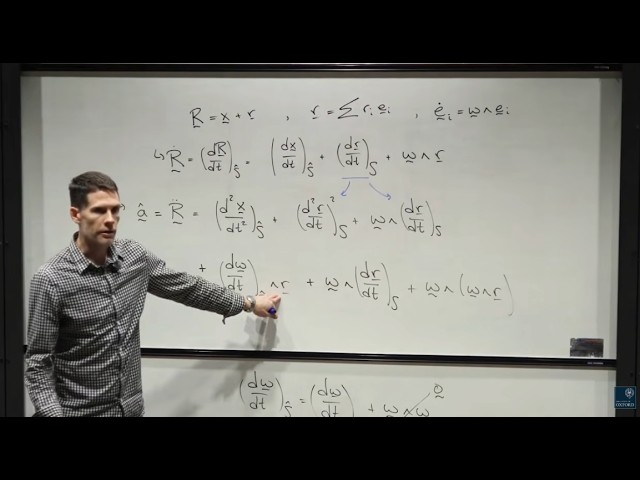
Dynamics, Lectures 15 & 16: Oxford Mathematics 1st Year Student Lecture
Keywords
Summary
108 words
Critical Evaluation
Value of the Information & Strength of the Argument
The lecture provides a solid, rigorous treatment of rigid body dynamics. The argumentation is logical and well-structured, building from fundamental principles to more complex applications. The use of a concrete example (rolling cylinder) effectively illustrates the theoretical concepts. The explanation of the inertia tensor’s physical meaning and the derivation of kinetic energy are particularly valuable. The lecturer also introduces the intermediate axis theorem as a challenge problem, encouraging deeper thinking. The presentation is clear and methodical, with careful attention to notation and coordinate systems.
Scientific Rigor, Source Quality, Title Accuracy
The lecture is scientifically rigorous, with all derivations shown step-by-step. However, no external sources are cited, which is typical for a lecture. The title accurately reflects the content, covering the specified topics. The description provides links to other lectures in the course and a playlist, which are useful for context. The content is consistent with standard university-level mechanics textbooks.
158 words
Title / Content Match
The title accurately describes the content: two lectures on dynamics covering the inertia tensor and non-inertial frames.
Quality & Reliability
8/10
Lecture by a university professor, rigorous mathematical derivations, clear explanations, but no external sources cited or verification of claims.
Key Moments
Markers derived by PSI from the transcript: the creator did not define chapters.
- Recap of inertia tensor and its physical meaning
- Comparison of inertia tensors for different cylinders
- Introduction of intermediate axis theorem
- Derivation of kinetic energy for rigid body
- Example: cylinder rolling down inclined plane
- Discussion of off-diagonal terms in inertia tensor
- Transition to non-inertial frames and fictitious forces
Cited Sources
- Oxford Mathematics Student Lectures Playlist — Link to the full course playlist
- Previous lecture in the course — Link to the previous lecture
Concurring Sources
- Classical Mechanics (Goldstein) — Standard textbook covering rigid body dynamics.
Contribution & Novelties
The lecture provides a clear and rigorous exposition of rigid body dynamics, particularly the inertia tensor and its application. It offers a solid foundation for understanding angular momentum and kinetic energy in rotating systems. The example of a rolling cylinder is a classic problem that illustrates the principles well.
Pour aller plus loin :
- Inertia tensor — Wikipedia article on moment of inertia, providing broader context.
- Euler’s equations — Wikipedia article on Euler’s equations for rigid body motion.
- Non-inertial frame — Wikipedia article on non-inertial frames and fictitious forces.
89 words
Radar Profile
The radar profile shows high scores in all dimensions, indicating a technically rigorous and informative lecture. The balance between quantity and quality of information is strong, with a high level of technical depth. The reliability is high due to the academic context.