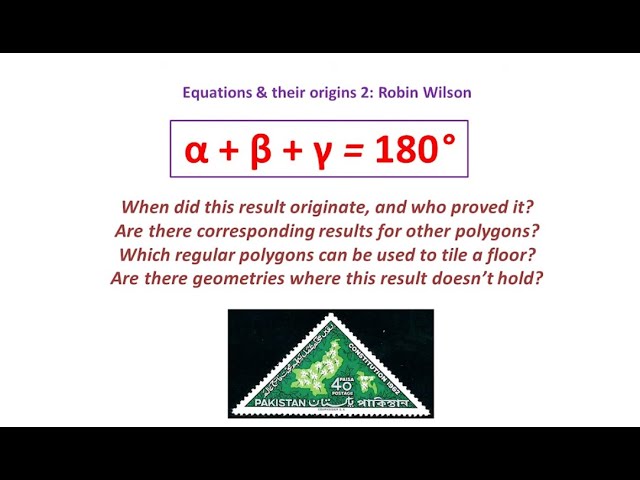
Angles of a triangle (α + β + γ = 180°)
Keywords
Summary
207 words
Critical Evaluation
Value of the Information & Strength of the Argument
The talk provides a clear and well-structured explanation of the angle sum theorem and its historical context. It offers both a formal proof and a historical narrative, making it valuable for viewers interested in mathematics and its development. The argumentation is solid: the proofs are logically sound, and the historical claims are accurate. The progression from the theorem to its applications (polygons, tilings) and then to the broader context of non-Euclidean geometries is coherent and insightful. The discussion of the parallel postulate and its role in the development of non-Euclidean geometry is particularly valuable, as it connects a simple geometric fact to a major conceptual shift in mathematics.
Scientific Rigor, Source Quality, Title Accuracy
The talk demonstrates high scientific rigor. The mathematical proofs are correct and clearly presented. The historical information about Euclid, the Elements, and the development of non-Euclidean geometry is accurate and well-documented. The speaker, Robin Wilson, is a respected mathematician and historian, which adds credibility. The title accurately reflects the content, which is focused on the angle sum theorem and its implications. The talk does not cite external sources directly, but it is based on well-established mathematical knowledge and historical scholarship. The description mentions a book by the speaker, ‘Sum Stories: Equations and their origins’, which could provide further reading. Overall, the content is reliable and well-presented.
229 words
Title / Content Match
The title accurately reflects the content, which focuses on the angle sum theorem for triangles and its historical and geometrical context.
Quality & Reliability
9/10
The talk is presented by a recognized mathematics historian and communicator, and it is based on well-established historical and mathematical facts. The proofs are standard and correctly presented. The historical claims are accurate and align with scholarly consensus. The presentation is clear and rigorous, with no evident errors or misleading statements.
Key Moments
Markers derived by PSI from the transcript: the creator did not define chapters.
- Introduction to the angle sum theorem and its statement.
- Examples of triangles with angle sums of 180 degrees.
- Introduction to Euclid's Elements and its historical significance.
- Euclid's definitions and postulates, including the parallel postulate.
- Proof of the angle sum theorem using parallel lines (Proposition 32).
- Second proof attributed to the Pythagoreans.
- Application to regular polygons and derivation of interior angle formula.
- Discussion of regular tilings and which polygons can tile the plane.
- Introduction to the parallel postulate and attempts to prove it.
- Spherical geometry and its properties.
- Hyperbolic geometry and Poincaré's disc model.
Cited Sources
- Oxford Mathematics YouTube Playlist — The playlist containing this talk and other episodes in the series.
Concurring Sources
- Euclid's Elements, Proposition I.32 — This source provides the original proof of the angle sum theorem as presented in Euclid's Elements.
Contribution & Novelties
The talk provides a concise and accessible overview of the angle sum theorem, its historical context, and its role in the development of non-Euclidean geometry. It effectively connects a basic geometric fact to broader mathematical ideas, making it a valuable educational resource. The presentation of multiple proofs and the discussion of regular tilings add depth. The talk also highlights the significance of the parallel postulate and the discovery of hyperbolic geometry, which are often not covered in introductory treatments.
Pour aller plus loin :
- Euclid’s Elements - Wikipedia — Provides a comprehensive overview of Euclid’s work and its historical impact.
- Parallel postulate - Wikipedia — Explains the parallel postulate and its role in geometry.
- Hyperbolic geometry - Wikipedia — Offers detailed information on hyperbolic geometry and its models.
- Poincaré disk model - Wikipedia — Describes the model used to visualize hyperbolic geometry.
- Non-Euclidean geometry - Wikipedia — Provides an overview of non-Euclidean geometries and their history.
156 words
Radar Profile
The radar profile shows high scores in quality of information, reliability, and technical level, with a slightly lower score for quantity of information due to the short duration. This indicates a well-structured and authoritative presentation that is accessible yet technically sound.