Algebraic Curves, Lecture 4: Properties of algebraic curves. 3rd Year Lecture
Keywords
Summary
191 words
Critical Evaluation
Value of the Information & Strength of the Argument
The lecture provides substantial mathematical value by bridging algebra and geometry, a central theme in algebraic geometry. It presents key theorems (Hilbert’s Nullstellensatz) and definitions (irreducible, nonsingular) with clear explanations and examples. The argumentation is rigorous: definitions are precise, and the logical flow is coherent. The lecturer motivates the need for algebraically closed fields and explains the geometric interpretation of algebraic concepts. The use of examples (e.g., XY=0) illustrates the concepts effectively. The lecture is self-contained, building on prior knowledge from earlier lectures, and prepares students for further study of conics.
Scientific Rigor, Source Quality, Title Accuracy
The lecture is scientifically rigorous, presenting standard results from algebraic geometry. The lecturer references a standard algebra textbook (Herstein’s ‘Topics in Algebra’) for background on commutative rings. The content aligns with established mathematical literature. The title accurately reflects the content: it is a lecture on properties of algebraic curves, covering Hilbert’s Nullstellensatz and irreducible/nonsingular curves. The lecture is part of a structured course, and the description provides links to other lectures in the series. No external sources are cited beyond the textbook mention, but the mathematical content is reliable.
195 words
Title / Content Match
The title accurately describes the content: a lecture on properties of algebraic curves, specifically covering Hilbert's Nullstellensatz and irreducible/nonsingular curves.
Quality & Reliability
9/10
Lecture by a recognized mathematician from a top university, presenting standard results in algebraic geometry with rigorous definitions and proofs sketched. The content is mathematically sound and aligns with established literature.
Key Moments
Markers derived by PSI from the transcript: the creator did not define chapters.
- Introduction and overview of the lecture topics: algebra and algebraic geometry facts.
- Review of commutative ring concepts: units, irreducible elements, unique factorization domains.
- Theorem: Polynomial rings over a field are unique factorization domains.
- Definition of algebraically closed fields and examples (C vs R, finite fields).
- Statement of Hilbert's Nullstellensatz and its geometric interpretation.
- Consequences of Hilbert's Nullstellensatz for curves: uniqueness of defining polynomial up to scaling.
- Definition of irreducible curves and decomposition into irreducible components.
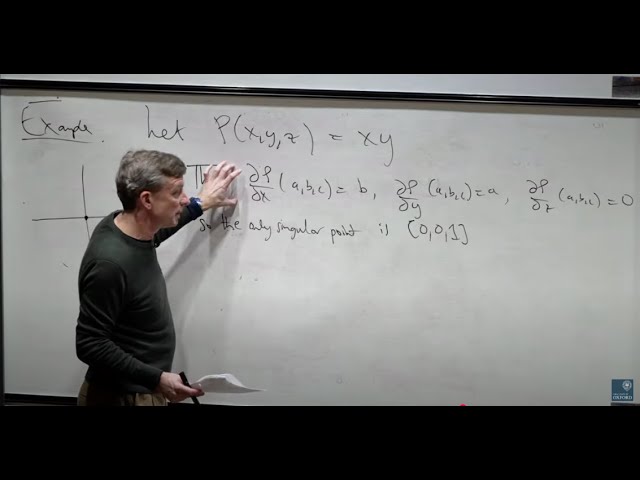
- Definition of singular points and explanation using the implicit function theorem.
- Definition of tangent line at a nonsingular point and Euler's relation.
- Discussion of tangent lines at singular points and preview of conics.
Cited Sources
- Topics in Algebra — Mentioned as a reference for commutative ring theory.
- Algebraic Curves course playlist — Link to the other lectures in this course.
- Student Lectures playlist — General playlist of student lectures at Oxford.
Concurring Sources
- Algebraic Curves (Oxford course) — Other lectures in the same course, providing consistent treatment.
Contribution & Novelties
This lecture provides a clear and rigorous introduction to key algebraic properties of curves, emphasizing the interplay between algebra and geometry. It explains Hilbert’s Nullstellensatz and its consequences for defining curves, and introduces irreducible and nonsingular curves with precise definitions and examples. The lecture is valuable for students learning algebraic geometry, as it bridges abstract algebra and geometric intuition.
Pour aller plus loin :
- Hilbert’s Nullstellensatz — Wikipedia article providing background and proof.
- Algebraic curve — Overview of algebraic curves, including singularities and components.
- Unique factorization domain — Definition and examples.
- Implicit function theorem — Used to justify smoothness condition.
- Algebraically closed field — Definition and properties.
107 words
Radar Profile
The radar profile shows high scores across all dimensions, indicating a lecture that is information-dense, technically rigorous, and highly reliable. The balance between quantity and quality of information is excellent, making it a valuable resource for advanced students.