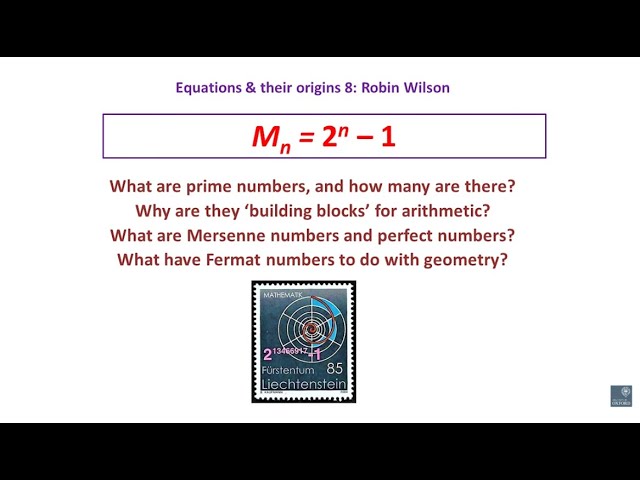
Prime Numbers (Mₙ = 2ⁿ − 1)
Keywords
Summary
131 words
Critical Evaluation
Value of the Information & Strength of the Argument
The talk provides a solid overview of prime number theory, covering key concepts and historical developments. The argumentation is clear and logical, with proofs presented in an accessible manner. For instance, Euclid’s proof of infinite primes is explained step-by-step, and the connection between Mersenne primes and perfect numbers is well-illustrated with examples. The presentation is engaging and informative, offering valuable insights into the beauty and complexity of prime numbers.
Scientific Rigor, Source Quality, Title Accuracy
The talk is scientifically rigorous, presenting well-established mathematical facts and theorems. The speaker, Robin Wilson, is a respected mathematician, and the content aligns with standard mathematical knowledge. The title accurately reflects the content, focusing on prime numbers and specifically Mersenne primes. The description provides a link to the full series and a related book, which serve as additional resources. No comments were provided for analysis.
149 words
Title / Content Match
The title accurately reflects the content, focusing on prime numbers and specifically Mersenne primes (Mₙ = 2ⁿ − 1).
Quality & Reliability
8/10
The talk is given by a mathematician (Robin Wilson) and presents well-established mathematical facts and proofs, including Euclid's proof of infinite primes and known results on Mersenne and Fermat primes. The content is accurate and historically contextualized. Minor simplifications are appropriate for a general audience.
Key Moments
Markers derived by PSI from the transcript: the creator did not define chapters.
- Introduction to prime numbers and their definition.
- Sieve of Eratosthenes method for finding primes.
- Fundamental theorem of arithmetic and why 1 is not prime.
- Euclid's proof of infinitely many primes.
- Discussion of twin primes and gaps between primes.
- Introduction to Mersenne primes and their properties.
- Perfect numbers and their connection to Mersenne primes.
- Fermat primes and their definition.
- Constructible polygons and Gauss's theorem.
- Conclusion and summary of key points.
Cited Sources
- Oxford Mathematics Playlist — The talk is part of a series on equations; this playlist contains other episodes.
Concurring Sources
- Prime number theorem — Supports the discussion on the distribution of primes.
- Mersenne prime — Confirms the definition and properties of Mersenne primes.
- Perfect number — Validates the connection between Mersenne primes and perfect numbers.
Contribution & Novelties
This talk provides a concise and engaging introduction to prime numbers, covering fundamental concepts and historical milestones. It highlights the significance of Mersenne primes and their link to perfect numbers, as well as Fermat primes and their connection to constructible polygons. The presentation is suitable for a general audience and serves as a valuable educational resource.
Pour aller plus loin :
- Prime number theorem — Discusses the asymptotic distribution of primes.
- Mersenne prime — Detailed information on Mersenne primes and their discovery.
- Perfect number — Explores the concept of perfect numbers and their properties.
- Fermat number — Information on Fermat numbers and their role in number theory.
- Constructible polygon — Explains the conditions for constructibility with ruler and compass.
119 words
Radar Profile
The radar profile shows high scores in information quantity and quality, with moderate technical level and reliability. This indicates a well-balanced presentation that is both informative and accessible, suitable for a general audience interested in number theory.