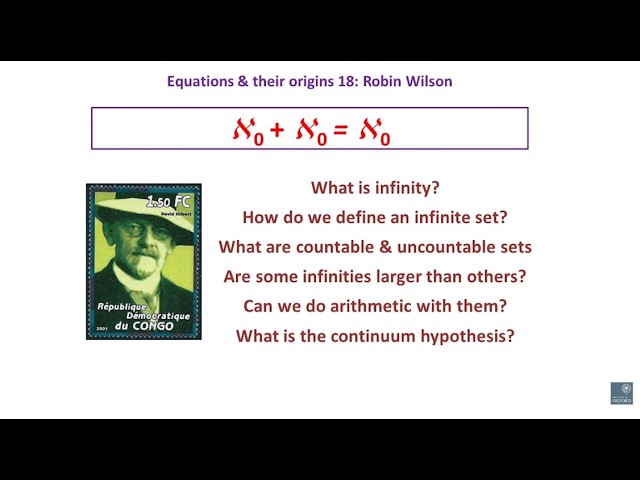
Infinity (ℵ₀+ℵ₀=ℵ₀)
Keywords
Summary
149 words
Critical Evaluation
Value of the Information & Strength of the Argument
The video provides a high-value introduction to the mathematical theory of infinity. It presents rigorous definitions and proofs, such as the countability of rationals and the uncountability of reals, in an accessible manner. The argumentation is solid, following a logical progression from historical paradoxes to modern results. The use of Hilbert’s hotel effectively illustrates the arithmetic of infinite cardinals. The discussion of the continuum hypothesis and its independence from ZFC is accurate and well-contextualized. The talk is well-structured and builds understanding step by step.
Scientific Rigor, Source Quality, Title Accuracy
The scientific rigor is high: the mathematical content is correct and presented by an expert. The video cites historical figures and their works, such as Galileo, Dedekind, Cantor, Hilbert, Gödel, and Cohen. The description provides a link to the full playlist and to Robin Wilson’s book, which serves as a source for further reading. The title accurately reflects the content, focusing on the arithmetic of infinite cardinalities. The video is part of a series by Oxford Mathematics, a reputable academic institution, enhancing its credibility.
183 words
Title / Content Match
The title accurately reflects the content, which explores the arithmetic of infinite cardinalities, specifically demonstrating that ℵ₀ + ℵ₀ = ℵ₀.
Quality & Reliability
9/10
The content is mathematically rigorous, historically accurate, and presented by an expert (Robin Wilson, a mathematics professor). The proofs and concepts are standard and correctly explained. The video is part of a series by Oxford Mathematics, a reputable institution.
Key Moments
Markers derived by PSI from the transcript: the creator did not define chapters.
- Introduction to the topic of infinity and the paradoxes of Galileo.
- Dedekind's definition of infinite sets and Russell's praise.
- Cantor's definition of countable sets and examples (squares, integers, halves).
- Proof that rational numbers are countable using a diagonal listing.
- Cantor's diagonal argument proving that real numbers are uncountable.
- Cantor's result that a line and a plane have the same cardinality.
- Hilbert's hotel and the arithmetic of infinite cardinals (ℵ₀ + ℵ₀ = ℵ₀).
- Introduction of aleph numbers and the continuum hypothesis.
- Russell's paradox and the development of Zermelo-Fraenkel set theory.
- Gödel's incompleteness theorems and the undecidability of the continuum hypothesis.
Cited Sources
- Stories of the Equations that Make Mathematics (playlist) — The video is part of this series; the playlist is provided in the description.
- Sum Stories: Equations and their origins (book) — Robin Wilson's book, mentioned at the end of the video as a source for further details.
Concurring Sources
- Cantor's diagonal argument — The video presents the diagonal argument to prove the uncountability of real numbers, which is a standard result.
- Hilbert's paradox of the Grand Hotel — The video uses Hilbert's hotel to illustrate the arithmetic of infinite cardinalities.
Contribution & Novelties
This video provides a clear and engaging exposition of the mathematical theory of infinity, from historical paradoxes to modern independence results. It effectively explains the concept of cardinality and the arithmetic of infinite numbers, making advanced topics accessible. The presentation is historically rich, connecting mathematical ideas to their origins.
Pour aller plus loin :
- Cantor’s diagonal argument — The core proof that real numbers are uncountable.
- Hilbert’s paradox of the Grand Hotel — The thought experiment illustrating countable infinity.
- Continuum hypothesis — The undecidable statement about cardinalities.
- Gödel’s incompleteness theorems — The broader context of undecidability in mathematics.
98 words
Radar Profile
The radar profile shows high scores across all dimensions, with particularly strong performance in information quality and reliability. The video is technically solid but accessible, making it a valuable resource for both students and enthusiasts.