Special Relativity, Lecture 6: The Twin Paradox - 3rd Year Student Lecture
Keywords
Summary
166 words
Critical Evaluation
Value of the Information & Strength of the Argument
The lecture provides a clear and rigorous explanation of two key consequences of special relativity. The resolution of the twin paradox is particularly well-argued, using spacetime diagrams to show the asymmetry between the twins and the crucial role of acceleration in breaking the symmetry. The derivation of the velocity addition formula is mathematically sound and clearly presented. The introduction of rapidity is a valuable addition, as it simplifies the mathematics and connects to group theory. The lecturer’s emphasis on understanding the physics rather than just memorizing formulas adds to the value. The argumentation is solid, with each step logically following from the previous one, and the lecturer anticipates and addresses potential questions from the audience.
Scientific Rigor, Source Quality, Title Accuracy
The lecture is scientifically rigorous, based on the well-established framework of special relativity. The derivations are correct and the explanations are precise. The lecturer does not cite external sources, but this is typical for a lecture that relies on standard textbook material. The title accurately reflects the content, as the lecture focuses on the twin paradox and also covers velocity addition. The description mentions both topics, so there is no mismatch. The lecture is part of a series, and the lecturer refers to previous lectures for the derivation of the Lorentz transformations, which is appropriate. Overall, the scientific quality is high, and the title is appropriate.
236 words
Title / Content Match
The title accurately reflects the content: the lecture focuses on the twin paradox and also covers velocity addition, as mentioned in the description.
Quality & Reliability
9/10
Lecture by a university professor, part of an official course, with rigorous mathematical derivations and clear explanations. The content is well-established physics, and the presentation is accurate and pedagogically sound.
Key Moments
Markers derived by PSI from the transcript: the creator did not define chapters.
- Introduction and motivation for studying special relativity
- Derivation of time dilation from Lorentz transformations
- Introduction of the twin paradox and its apparent contradiction
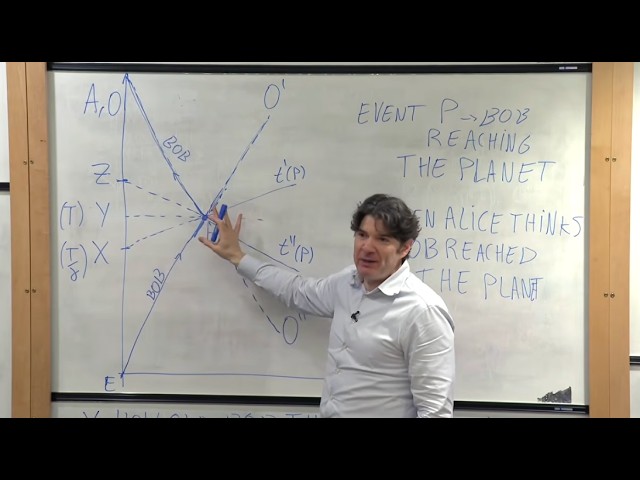
- Resolution of the twin paradox using spacetime diagrams and the role of acceleration
- Discussion of the turnaround and the jump in Alice's age from Bob's perspective
- Introduction to the problem of velocity addition in special relativity
- Derivation of the relativistic velocity addition formula
- Introduction of rapidity and its relation to velocity
- Expression of Lorentz transformations in terms of rapidity as hyperbolic rotations
- Conclusion and preview of next lecture on group theory
Cited Sources
- Oxford Mathematics Student Lectures Playlist — Description of the video, providing access to other student lectures.
- Special Relativity Course Playlist — Description of the video, providing access to the full lecture series.
Concurring Sources
- Special relativity - Wikipedia — General reference for the concepts discussed in the lecture.
- Twin paradox - Wikipedia — Provides a detailed explanation of the twin paradox and its resolution.
Contribution & Novelties
The lecture provides a clear and rigorous explanation of the twin paradox and velocity addition, which are standard topics but are presented with pedagogical clarity. The use of spacetime diagrams to illustrate the resolution of the paradox is particularly effective. The introduction of rapidity is a valuable addition, as it simplifies the mathematics and connects to group theory. The lecture also emphasizes the importance of understanding the physics rather than just memorizing formulas.
Pour aller plus loin :
- Special relativity - Wikipedia — Provides a comprehensive overview of the theory, including the twin paradox and velocity addition.
- Twin paradox - Wikipedia — Detailed explanation of the paradox and its resolution.
- Rapidity - Wikipedia — Explains the concept of rapidity and its use in special relativity.
- Lorentz transformation - Wikipedia — Covers the mathematical formulation of Lorentz transformations.
137 words
Radar Profile
The radar profile shows high scores across all dimensions, indicating a well-rounded and reliable lecture. The quantity and quality of information are strong, with a high technical level appropriate for a university course. The overall reliability is excellent, reflecting the authoritative source and rigorous presentation.