Aula 3_Lei 14.300
Keywords
Summary
189 words
Critical Evaluation
Value of the Information & Strength of the Argument
The video provides a clear and practical explanation of a complex regulatory topic, making it accessible to technicians and installers. The argumentation is logical, using simple examples to illustrate the impact of the law. It correctly identifies the key article (27) and explains the progressive Fio B charges. However, the video does not delve into the technical details of the tariff components beyond Fio B, and it relies on a national average for Fio B without explaining how to obtain the specific value for a given location. The argumentation is persuasive in emphasizing the continued viability of solar investments, but it lacks quantitative evidence such as payback calculations or cost-benefit analysis.
Scientific Rigor, Source Quality, Title Accuracy
The video does not cite specific sources, but it refers to the law itself and mentions that the information is based on the article 27 of Law 14.300. The description includes links to the course website, but no direct references to official documents. The title accurately reflects the content, which is a lesson on the law. The video is consistent with the channel’s focus on solar energy education. No comments were provided for analysis.
200 words
Title / Content Match
The title accurately reflects the content, which is a lesson on Law 14.300.
Quality & Reliability
6/10
The video provides a clear and structured explanation of the Brazilian Law 14.300, focusing on the compensation rules for distributed generation. It correctly identifies the key article (27) and explains the progressive Fio B charges with numerical examples. However, it relies on general averages (28% for Fio B) and does not cite specific regulatory documents or official sources, limiting its depth and verifiability.
Key Moments
Markers derived by PSI from the transcript: the creator did not define chapters.
- Introduction to the lesson and importance of Law 14.300 for PV professionals.
- Explanation of the 1:1 compensation before the law and the change after.
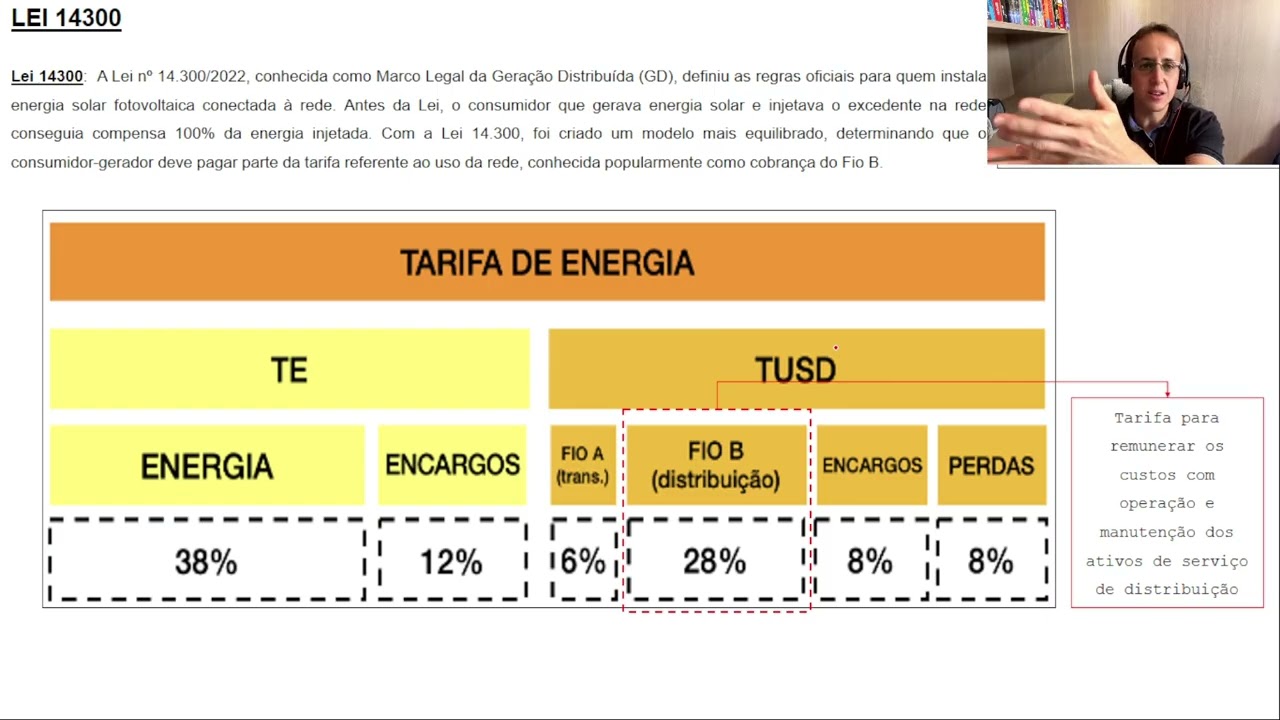
- Breakdown of the electricity tariff into TE and TUSD, and introduction of Fio B.
- Detailed explanation of Article 27 and the progressive Fio B charges from 2023 to 2028.
- Example calculation for 2024: 100 kWh injected, 30% of Fio B charged, resulting in 91.6 kWh compensated.
- Example calculation for 2028: 90% of Fio B charged, resulting in 74.8 kWh compensated.
- Discussion on the average Fio B percentage and how to find the specific value for a location.
- Conclusion and reassurance that solar remains viable, with mention of the spreadsheet for sizing.
Cited Sources
- Lei nº 14.300, de 6 de janeiro de 2022 — The law itself, which establishes the legal framework for micro and minigeneration distributed, including the compensation rules and Article 27.
Concurring Sources
- Lei 14.300: entenda o marco legal da geração distribuída — ANEEL's official page on distributed generation, which aligns with the video's explanation of the law and its implications.
Contribution & Novelties
The video offers a practical, tutorial-style explanation of Law 14.300, focusing on the Fio B charges and their impact on system sizing. It provides clear numerical examples that are easy to follow, making the regulatory content accessible to technicians and installers. The main novelty is the step-by-step calculation method for determining the net compensation, which is directly applicable to project design.
Pour aller plus loin :
- Lei 14.300 (Planalto) — Official text of the law, essential for detailed understanding.
- ANEEL - Tarifas — Information on tariff components and how to find specific Fio B values.
- ABSOLAR - Associação Brasileira de Energia Solar Fotovoltaica — Industry association providing data and updates on the solar market in Brazil.
116 words
Radar Profile
The radar profile shows a balanced performance across all dimensions, with slightly higher scores in information quantity and quality, reflecting the video's clear and structured content. The technical level is moderate, suitable for a general audience, while the reliability is adequate given the reliance on official law and common industry knowledge.