Aula 2_Conceitos iniciais e nivelamento_Parte 2
Keywords
Summary
178 words
Critical Evaluation
Value of the Information & Strength of the Argument
The video provides valuable foundational knowledge for beginners in photovoltaic systems, clearly explaining key concepts such as solar irradiation, its measurement, and its variation. The argumentation is logical and uses relatable analogies (e.g., comparing solar irradiation to water in hydroelectric plants) to enhance understanding. The instructor effectively demonstrates how daily irradiation totals are calculated and used for energy generation estimates. The explanation of system types (off-grid, on-grid, hybrid) is well-structured, with clear descriptions of components and operational principles. However, the video lacks quantitative examples or real-world data to reinforce the concepts, and the discussion of hybrid systems for high-tension consumers is brief and could be expanded.
Scientific Rigor, Source Quality, Title Accuracy
The scientific rigor is adequate for an introductory tutorial, with accurate explanations of fundamental principles. However, no external sources are cited, and the instructor mentions a website for irradiation data without providing the URL. The title accurately reflects the content, which is a continuation of basic concepts. The video’s educational value is high for its target audience, but it does not delve into advanced technical details or cite standards like NBR 16690, which are mentioned in the description but not in the video itself.
205 words
Title / Content Match
The title accurately reflects the content, which is a continuation of introductory concepts and leveling for a photovoltaic systems course.
Quality & Reliability
7/10
Content is pedagogically sound, explains fundamental concepts clearly, and aligns with standard photovoltaic engineering principles. However, it lacks citations to external sources and contains minor simplifications (e.g., average irradiation values) that are typical for introductory material.
Key Moments
Markers derived by PSI from the transcript: the creator did not define chapters.
- Introduction to the lesson and recap of previous content.
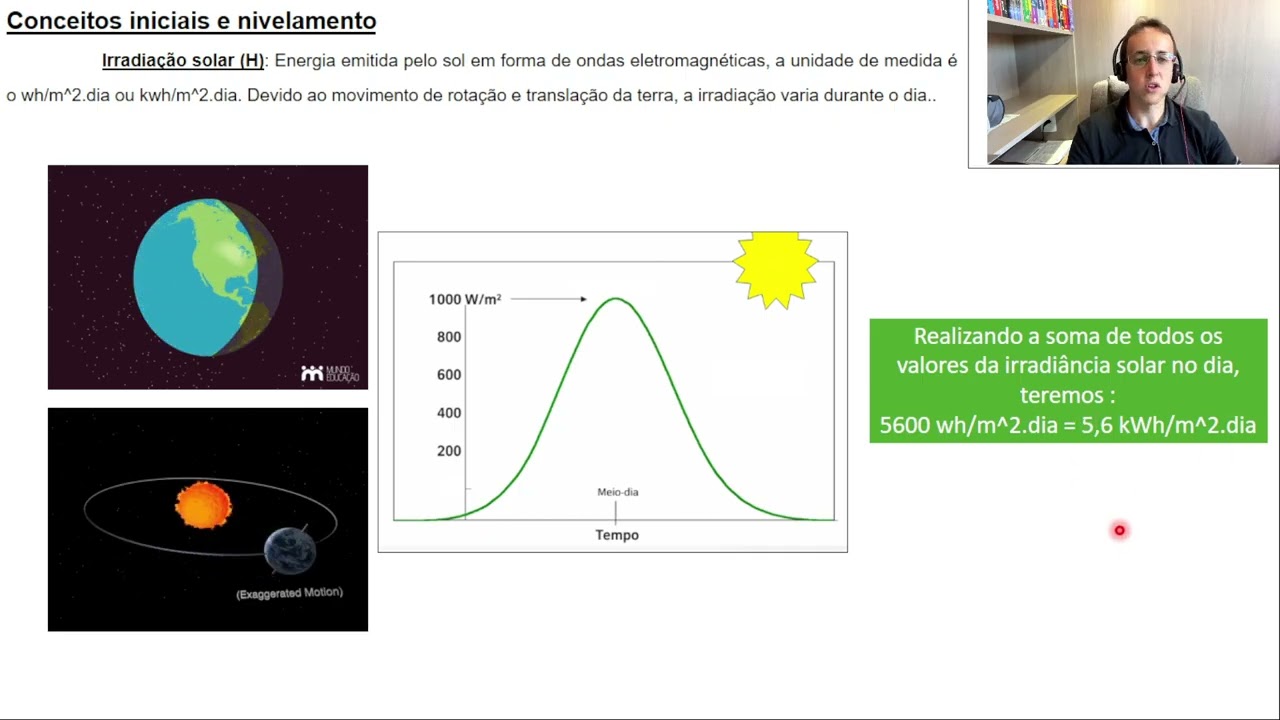
- Definition of solar irradiation and its unit (kWh/m²/day).
- Explanation of Earth's rotation and translation affecting irradiation variation.
- Graph showing daily irradiation curve with peak at noon (1000 W/m²).
- Calculation of daily total irradiation (5.6 kWh/m²/day) by summing hourly values.
- Regional average irradiation values in Brazil (Northeast 5.9, South 5.0).
- Comparison with Germany and Brazil's solar potential.
- Introduction to three PV system types: off-grid, on-grid, and hybrid.
- Detailed explanation of off-grid system components and battery storage.
- Explanation of on-grid system, net metering, and bidirectional meter.
- Discussion of hybrid systems and their advantages for high-tension consumers.
Cited Sources
- Curso Completo de Energia Solar — Mentioned in the video description as the full course offering.
Concurring Sources
- Solar irradiance — Confirms the definition and units of solar irradiation.
- Photovoltaic system — Supports the description of system types and components.
Contribution & Novelties
The video provides a clear and accessible introduction to solar irradiation and PV system types, which is valuable for beginners. It effectively bridges theoretical concepts with practical applications, such as using irradiation data for system sizing. The comparison of Brazilian regions and Germany highlights the country’s solar potential, motivating learners.
Pour aller plus loin :
- Solar irradiance — Provides detailed scientific background on solar radiation and its measurement.
- Photovoltaic system — Overview of PV system components and configurations, including on-grid and off-grid.
- Net metering — Explains the billing mechanism for on-grid systems, relevant to the video’s discussion of energy credits.
- NBR 16690 — Brazilian standard for PV systems, mentioned in the course description but not in the video.
118 words
Radar Profile
The radar profile shows balanced scores across all dimensions, with slightly higher scores in information quality and reliability, indicating a solid educational resource. The lower technical level score reflects the introductory nature of the content, which is appropriate for the target audience.