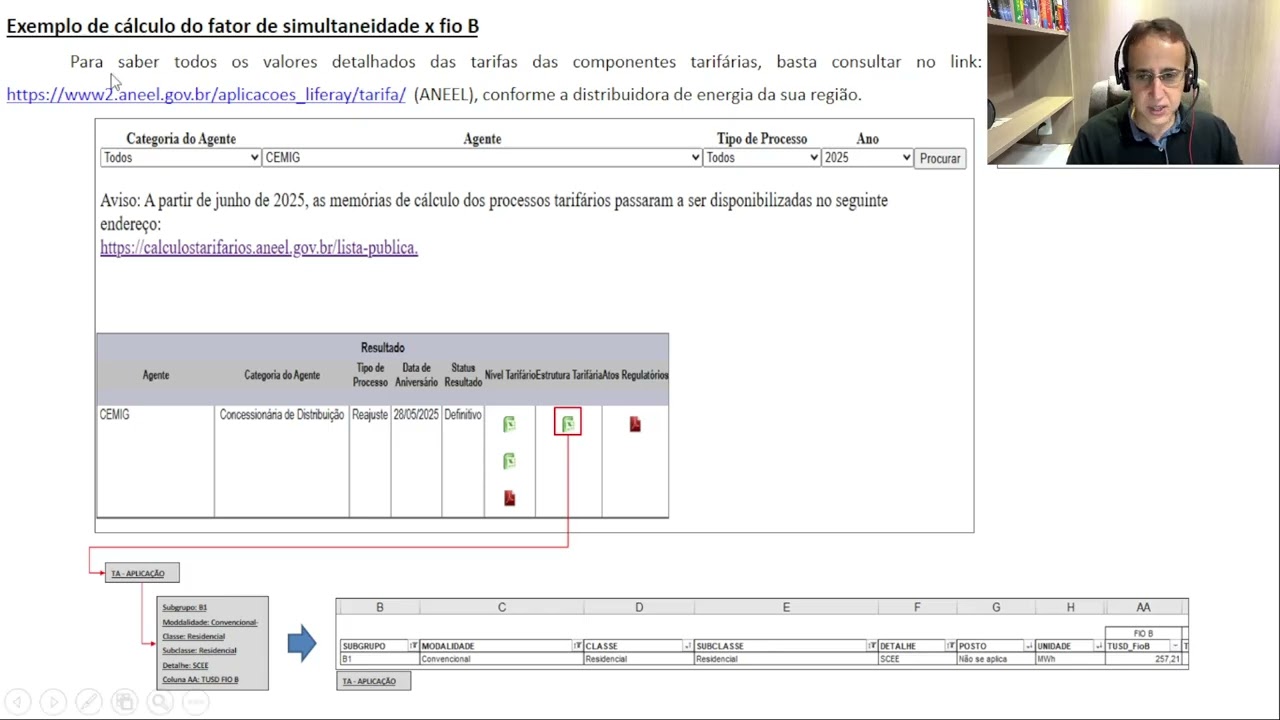
Aula 5_Exemplo de cálculo fio B x fator de simultaneidade
Keywords
Summary
245 words
Critical Evaluation
Value of the Information & Strength of the Argument
The video provides valuable practical information for solar PV designers and installers in Brazil, as it clarifies the calculation of ‘fio B’ and its interaction with the simultaneity factor, which is crucial for accurate economic feasibility analysis. The argumentation is clear and logical, with step-by-step examples that illustrate the concepts. The instructor correctly explains that the ‘fio B’ cost is proportional to the energy injected into the grid, which is inversely related to the simultaneity factor. He also correctly highlights the importance of considering the availability cost and the progressive implementation of the ‘fio B’ charge. However, the video does not delve into the technical derivation of the simultaneity factor or the regulatory details, and it relies on simplified assumptions (e.g., a fixed simultaneity factor from EPE). The presentation is practical and oriented towards application, but it lacks critical discussion of the limitations and uncertainties in the methodology.
Scientific Rigor, Source Quality, Title Accuracy
The video demonstrates scientific rigor by referencing official sources: the ANEEL website for ‘fio B’ tariffs and the EPE website for simultaneity factors, as well as the Brazilian regulation Lei 14.300 and REN 1000. The instructor correctly explains the conversion of units and the progressive application of the ‘fio B’ charge. The title accurately reflects the content, which is a practical calculation example. However, the video does not provide direct links to these sources in the description, and the methodology is presented without a formal citation of the underlying studies or data. The presentation is clear and well-structured, but the reliance on a single example and the lack of sensitivity analysis limit the depth of the scientific discussion.
281 words
Title / Content Match
The title accurately reflects the content, which is a practical calculation example of 'fio B' and simultaneity factor.
Quality & Reliability
7/10
The video provides a clear, step-by-step tutorial on calculating the 'fio B' cost and applying the simultaneity factor, based on official sources (ANEEL, EPE) and Brazilian regulation (Lei 14.300). The methodology is explained with practical examples, but lacks in-depth technical derivation and independent verification of the data.
Key Moments
Markers derived by PSI from the transcript: the creator did not define chapters.
- Introduction to the lesson: objective to calculate 'fio B' and its relation to simultaneity factor.
- Explanation of how to consult the 'fio B' value on the ANEEL website, using CEMIG as an example.
- Demonstration of downloading and filtering the ANEEL spreadsheet to find the 'fio B' tariff for subgrupo B1.
- Conversion of the 'fio B' tariff from MWh to kWh and calculation of the effective cost for 2026 (60% of the full tariff).
- Consultation of the simultaneity factor on the EPE website, using a residential example with 40% factor.
- Explanation of the availability cost (taxa mínima) and its comparison with the 'fio B' cost.
- First calculation example: generation of 168 kWh/month, showing that the availability cost is higher than the 'fio B' cost.
- Second calculation example: generation of 700 kWh/month, showing that the 'fio B' cost becomes higher.
- Conclusion: summary of the methodology and reminder that the spreadsheet automates the calculations.
Cited Sources
- ANEEL - Tarifas e processos — Used to consult the 'fio B' tariff for the distribution concessionaire (CEMIG).
- EPE - Empresa de Pesquisa Energética — Used to consult typical simultaneity factors for different consumer types.
- Lei 14.300/2022 — Legal framework for distributed generation, defining the progressive 'fio B' charge.
- Resolução Normativa ANEEL nº 1000/2021 — Regulation that establishes the availability cost (taxa mínima) for consumers.
Concurring Sources
- Lei 14.300/2022 — The video's explanation of the progressive 'fio B' charge aligns with the law's provisions.
- Resolução Normativa ANEEL nº 1000/2021 — The video's mention of the availability cost is consistent with this regulation.
Contribution & Novelties
The video provides a practical, step-by-step tutorial on calculating the ‘fio B’ cost for solar PV systems in Brazil, integrating the simultaneity factor and the progressive implementation of the charge. It offers a clear methodology that can be directly applied by professionals, and it highlights the importance of considering the availability cost in system sizing. The novelty lies in the practical application of these concepts in a real-world example, which is often missing in academic literature.
Pour aller plus loin :
- Lei 14.300/2022 — Official text of the Brazilian distributed generation law.
- Resolução Normativa ANEEL nº 1000/2021 — Regulation on distribution procedures, including availability cost.
- EPE - Fator de Simultaneidade — Source for typical simultaneity factors in Brazil.
- ANEEL - Tarifas — Official source for ‘fio B’ tariffs.
128 words
Radar Profile
The radar profile shows a balanced performance across all dimensions, with slightly higher scores in information quantity and quality, and lower in technical level, indicating a practical tutorial that is informative but not deeply technical.