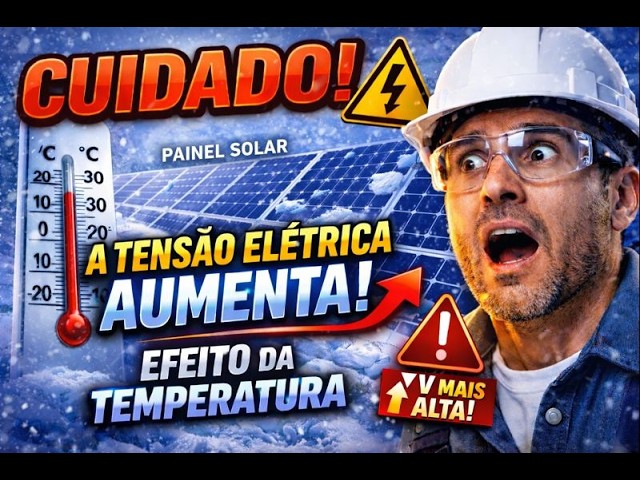
CUIDADO, A TENSÃO ELÉTRICA AUMENTA. Como Calcular o AUMENTO DA TENSÃO devido o Efeito da Temperatura
Keywords
Summary
192 words
Critical Evaluation
Value of the Information & Strength of the Argument
The video provides valuable practical knowledge for PV system designers, explaining the often-overlooked effect of temperature on module electrical characteristics. The argumentation is clear and logically structured: it starts with the datasheet parameters, explains the meaning of temperature coefficients, and then demonstrates their application through worked examples. The presenter correctly identifies that voltage is a concern at low temperatures and current at high temperatures, which is crucial for proper inverter and conductor sizing. The calculations are accurate and follow standard industry formulas. The video’s value lies in its practical approach, making complex concepts accessible to engineers and technicians. However, the argumentation could be strengthened by referencing standards (e.g., IEC 61215) or providing more context on the derivation of the formulas.
Scientific Rigor, Source Quality, Title Accuracy
The video demonstrates scientific rigor in its methodology, correctly applying temperature coefficients and formulas. The presenter uses a real datasheet, which adds credibility. However, no external sources are cited, and the video relies solely on the presenter’s expertise. The title accurately reflects the content, focusing on voltage increase due to temperature, which is the main topic. The video does not include any sponsored content or advertisements. The description includes links to the presenter’s course, but these are promotional and not scientific sources. Overall, the scientific rigor is adequate for a tutorial, but the lack of citations to standards or research limits its depth.
238 words
Title / Content Match
The title accurately reflects the content, focusing on the increase in voltage due to temperature effects, which is the main topic of the video.
Quality & Reliability
7/10
The video provides a clear, step-by-step tutorial on calculating temperature-induced variations in PV module electrical parameters, using datasheet coefficients. The methodology is standard and correctly applied, but the video lacks citations to external sources and the presenter's credentials are not verified. The content is technically sound but limited in depth.
Key Moments
Markers derived by PSI from the transcript: the creator did not define chapters.
- Introduction to the video's topic: calculating temperature-induced variations in PV module electrical parameters.
- Explanation of STC (Standard Test Conditions) and its importance in datasheet values.
- Introduction to temperature coefficients for power, voltage, and current, and their interpretation.
- Presentation of the mathematical equations for correcting Voc and Isc based on temperature and irradiance.
- Explanation of how to estimate cell temperature using ambient temperature, NOCT, and irradiance.
- Worked example for cold conditions: calculating voltage increase at 10°C ambient temperature.
- Worked example for hot conditions: calculating current increase at 38°C ambient temperature.
- Conclusion and reminder to consider worst-case scenarios in PV system design.
Cited Sources
- INMET - Instituto Nacional de Meteorologia — Mentioned as a source for historical temperature data for PV system design.
Concurring Sources
- PV Education.org - Temperature Effects on PV Cells — Provides a general explanation of how temperature affects PV cell voltage and current, consistent with the video's content.
Contribution & Novelties
The video provides a clear, practical tutorial on calculating temperature-induced variations in PV module voltage and current, which is essential for proper system sizing. It emphasizes the importance of considering worst-case conditions, particularly low temperatures for voltage and high temperatures for current. The step-by-step examples make the calculations accessible to practitioners.
Pour aller plus loin :
- IEC 61215: Crystalline silicon terrestrial photovoltaic (PV) modules – Design qualification and type approval — This standard defines the testing conditions and parameters for PV modules, including temperature coefficients.
- Nominal Operating Cell Temperature (NOCT) — Provides background on NOCT and its role in estimating cell temperature.
- Photovoltaic system design and temperature effects — U.S. Department of Energy resource on PV system design, including temperature considerations.
121 words
Radar Profile
The radar profile shows high scores in information quality and reliability, with moderate scores in quantity and technical level. This indicates a focused, accurate tutorial that could benefit from more depth and additional references.