Aula 8_Como verificar a orientação e inclinação do telhado e estimar as perdas
Keywords
Summary
191 words
Critical Evaluation
Value of the Information & Strength of the Argument
The video provides valuable, actionable information for solar PV designers, particularly in Brazil. The explanation of the solar abacus is clear and well-illustrated with examples, enabling viewers to estimate losses due to non-optimal orientation and inclination. The method for calculating the height of ground-mounted structures using trigonometry is straightforward and practical. The argumentation is solid, based on established principles of solar geometry and the presenter’s professional experience. The use of a spreadsheet to automate calculations adds practical value. However, the video does not cite external sources or standards, relying solely on the presenter’s expertise. The promotional segment for the course is clearly separated and does not detract from the technical content.
Scientific Rigor, Source Quality, Title Accuracy
The video demonstrates scientific rigor in its methodology, using standard trigonometric relationships and the solar abacus, which is a recognized tool in solar energy design. The presenter references Brazilian standards (NBR 5410, NBR 16690) in the description, but these are not discussed in the video itself. The sources cited are limited to the course website and the solar abacus for Brazilian states, which are mentioned but not shown in detail. The title accurately reflects the content, and the video delivers on its promise. The description includes a promotional section for a paid course, which is not part of the technical content. No comments were provided for analysis.
233 words
Title / Content Match
The title accurately reflects the content, which focuses on verifying roof orientation and inclination and estimating losses.
Quality & Reliability
8/10
The video provides a practical, step-by-step tutorial on measuring roof orientation and inclination for photovoltaic systems, using the solar abacus for loss estimation. The methodology is clearly explained, and the presenter demonstrates calculations with real examples. The content aligns with standard practices in solar PV design, though it is based on the presenter's experience rather than peer-reviewed sources.
Key Moments
Markers derived by PSI from the transcript: the creator did not define chapters.
- Introduction to the lesson: verifying roof orientation and inclination and estimating losses.
- Explanation of the solar abacus: lines for orientation and inclination, and color scale for utilization factor.
- Example A: orientation 25° NE, inclination 30°, utilization factor 97.7%.
- Example B: orientation 50° NE, inclination 70°, utilization factor 71.8%.
- Example C: orientation 180° S, inclination 90°, utilization factor below 40%.
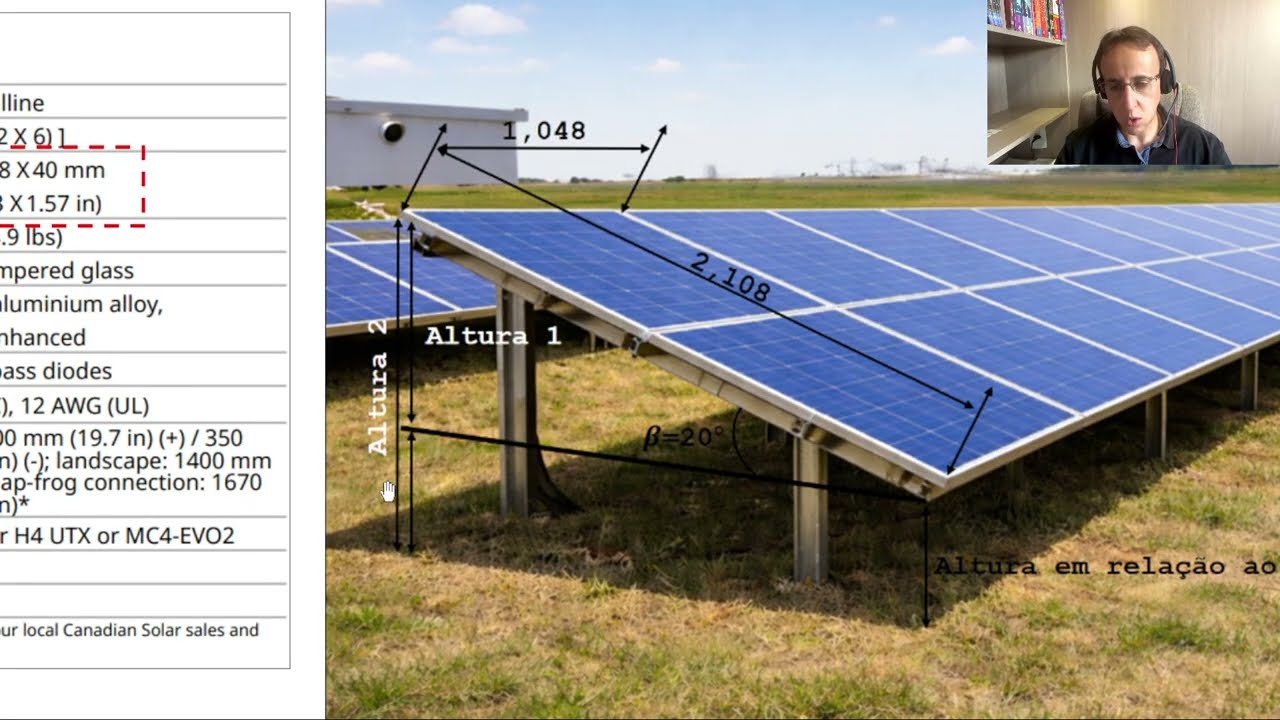
- Calculating height to raise module for ground-mounted systems: height = length * sin(beta).
- Using the spreadsheet to automate calculations for module dimensions and inclination.
- Handling irregular terrains: use a reference module or conduct a topographic survey.
- Measuring roof inclination: draw a horizontal line and a vertical line, measure length and height, then calculate percentage and degrees.
- Calculating the length of the rafter using Pythagorean theorem.
Cited Sources
- Curso Completo de Energia Solar — Promotional link for the instructor's paid course, mentioned in the video description.
Concurring Sources
- NBR 16690 — Brazilian standard for photovoltaic systems, mentioned in the video description as a reference for the course.
Contribution & Novelties
The video offers a practical, step-by-step guide for solar PV installers and designers, focusing on the Brazilian context. It provides a clear methodology for using the solar abacus to estimate losses due to non-optimal orientation and inclination, which is often not covered in basic tutorials. The spreadsheet tool is a valuable resource for automating calculations. The video also addresses the challenge of irregular terrains, offering practical advice.
Pour aller plus loin :
- Solar Abacus — Provides background on the tool used for estimating solar irradiation losses.
- Photovoltaic system — Overview of PV system components and design considerations.
- Solar azimuth angle — Explains the concept of solar orientation, relevant to the video’s discussion of module orientation.
115 words
Radar Profile
The radar profile shows high scores in quantity and quality of information, with a moderate technical level, indicating a practical tutorial that is informative and reliable. The overall high scores suggest the video is a valuable resource for its target audience.