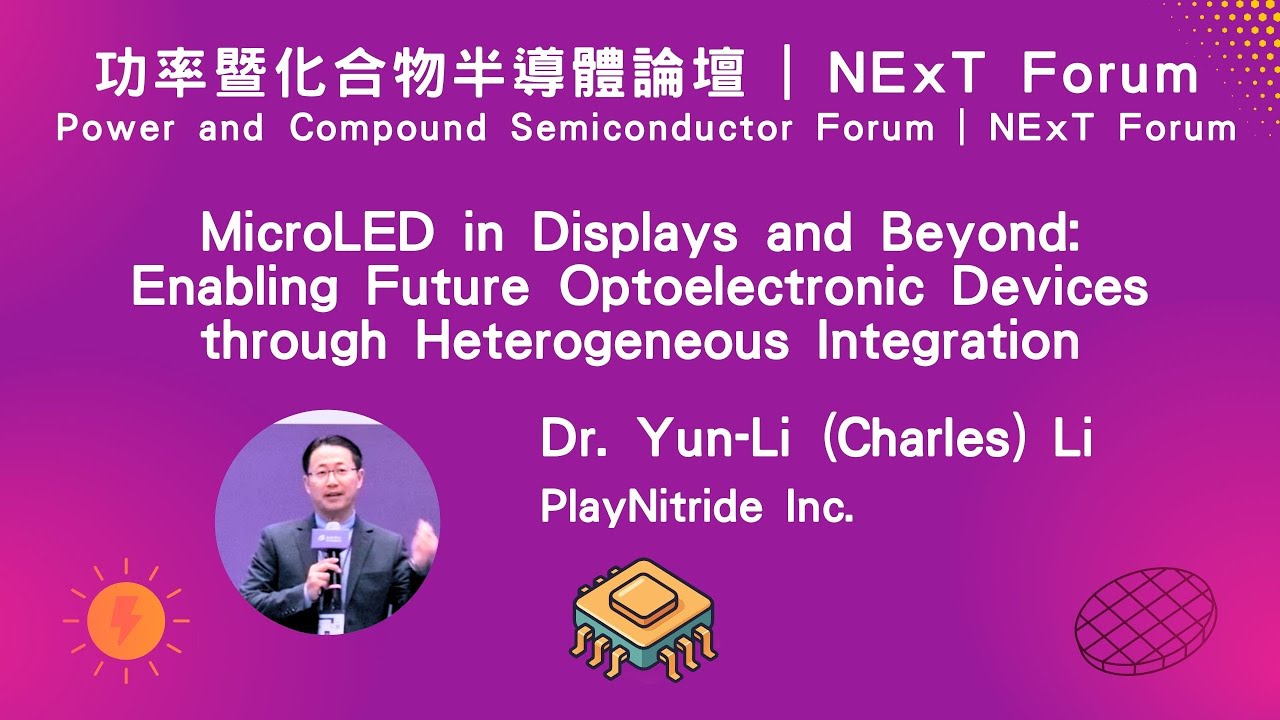
MicroLED in Displays and Beyond: Enabling Future Optoelectronic Devices
Keywords
Summary
113 words
Critical Evaluation
Value of the Information & Strength of the Argument
The talk provides valuable insights into the current state of MicroLED technology from an industry insider. It offers specific technical details on manufacturing processes, such as mass transfer rates and alignment precision, which are not commonly known outside the field. The argumentation is based on the speaker’s direct experience and company achievements, making it credible but also promotional. The discussion of future applications, such as in optical communication and robotics, is speculative but grounded in ongoing research. The speaker effectively argues for the maturity of MicroLED by citing market availability and financial milestones.
Scientific Rigor, Source Quality, Title Accuracy
The talk is based on the speaker’s expertise and company data, but lacks formal citations or references to external studies. The title accurately reflects the content, covering both display and non-display applications. The presentation is consistent with the forum’s theme of power and optoelectronics. The speaker mentions specific products and technical specifications, but these are not independently verified. The talk is more of an industry update than a rigorous scientific presentation, but it provides useful information for those interested in the field.
190 words
Title / Content Match
The title accurately reflects the content, covering MicroLED applications in displays and future optoelectronic devices.
Quality & Reliability
7/10
The speaker is a leading industry expert from PlayNitride, a key player in MicroLED technology. The talk provides specific technical details and market insights, but is promotional in nature and lacks peer-reviewed references.
Key Moments
Markers derived by PSI from the transcript: the creator did not define chapters.
- Introduction to MicroLED as a combination of display and semiconductor industries.
- Launch of MicroLED TV with Samsung and market availability.
- Release of first MicroLED watch by Garmin, priced around $2,000.
- Comparison of MicroLED, OLED, and LCD watches, highlighting performance differences.
- Transparent displays with over 70% transparency and 10,000 nits brightness for automotive applications.
- PlayNitride's financial break-even and growth as a startup.
- Technical challenges: mass transfer, chip on carrier (COC) technology, and precision alignment.
- AR glasses with 0.5 cubic centimeter light engine and 5,000 PPI RGB displays.
- Future applications: optical communication, advanced packaging, and robotics.
- Conclusion: MicroLED is mature, capacity is the main concern, and future possibilities are vast.
Cited Sources
- PlayNitride Inc. — Company website with information on MicroLED technology and products.
- SEMICON Taiwan — Event website for the forum where the talk was presented.
Concurring Sources
- MicroLED - Wikipedia — General information on MicroLED technology, consistent with the talk's claims.
Contribution & Novelties
The talk provides an industry insider’s perspective on the current state and future of MicroLED technology, highlighting recent market launches and technical innovations. It offers specific details on manufacturing processes and applications beyond displays, such as in optical communication and robotics.
Pour aller plus loin :
- MicroLED - Wikipedia — Overview of MicroLED technology and its applications.
- Heterogeneous Integration - IEEE — Academic perspective on heterogeneous integration, relevant to the talk’s theme.
- Augmented Reality - Wikipedia — Background on AR glasses, a key application discussed.
85 words
Radar Profile
The radar profile shows high scores in quantity of information and technical level, reflecting the detailed technical content. The lower score in reliability is due to the lack of formal citations and the promotional nature of the talk.