Laser Physics 3.3 Optical Resonators
Keywords
Summary
140 words
Critical Evaluation
Value of the Information & Strength of the Argument
The video provides a clear and logical progression from the Fabry-Perot interferometer to general laser resonators. The mathematical derivations are straightforward and well-explained, making the resonance conditions and free spectral range formulas easy to follow. The argumentation is solid for the basic physics, but it does not delve into practical stability analysis or advanced topics, which are mentioned only briefly. The value lies in its pedagogical clarity for introductory laser physics, though it lacks depth for advanced learners.
Scientific Rigor, Source Quality, Title Accuracy
The scientific rigor is adequate for an introductory lecture: the mathematics are correct and the concepts are accurately presented. However, no sources are cited, and the lecture relies on established textbook knowledge without referencing specific literature. The title accurately reflects the content, which focuses on optical resonators. The lecture does not include any public comments, so no analysis of audience reception is possible.
156 words
Title / Content Match
The title accurately reflects the content, which focuses on optical resonators in laser physics.
Quality & Reliability
7/10
Clear and mathematically consistent presentation of basic resonator physics, but lacks citations and depth on practical stability issues.
Key Moments
Markers derived by PSI from the transcript: the creator did not define chapters.
- Introduction and motivation for studying optical resonators.
- Review of Fabry-Perot interferometer and resonance condition.
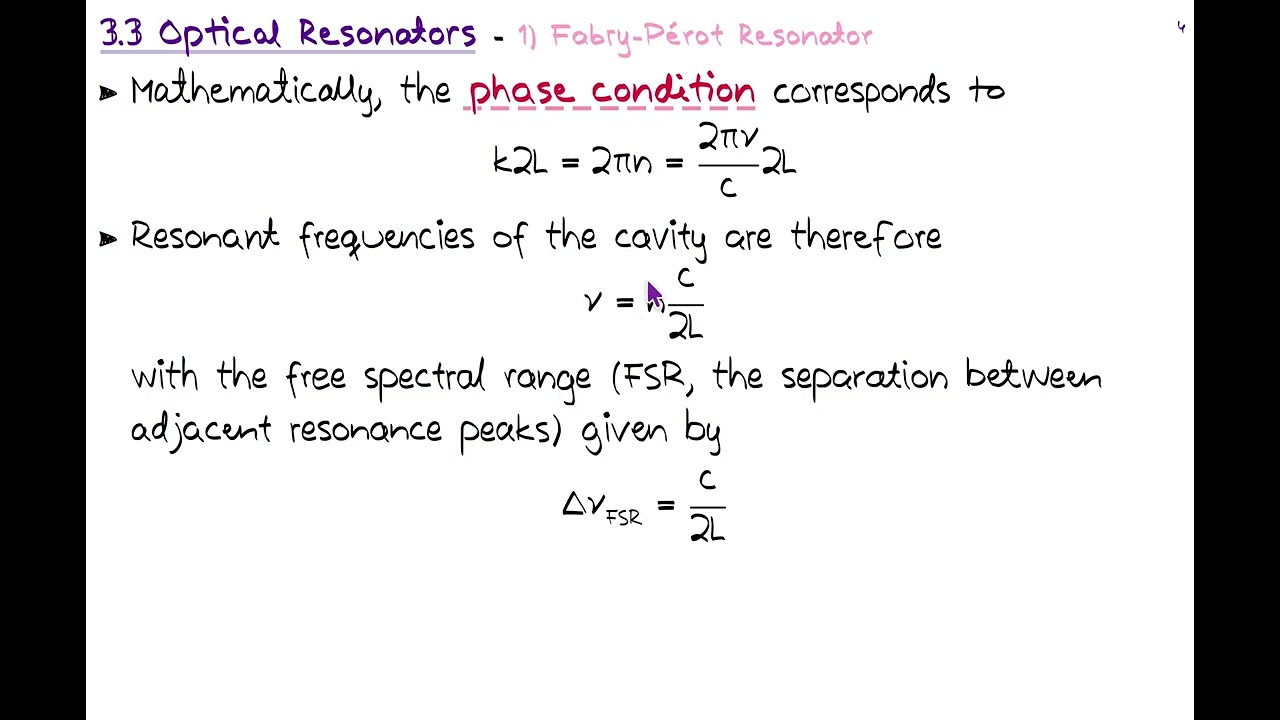
- Derivation of resonance frequencies and free spectral range for Fabry-Perot resonator.
- Introduction of ring resonators and their resonance conditions.
- Discussion of concentric resonators and their free spectral range.
- Comparison of different cavity configurations and their stability.
- Conclusion and preview of next lecture on cavity stability.
Contribution & Novelties
The video provides a clear and concise introduction to optical resonators, focusing on the mathematical derivation of resonance conditions and free spectral ranges for three basic configurations. Its novelty lies in its pedagogical approach, simplifying complex concepts for beginners. However, it does not introduce new research or advanced topics.
Pour aller plus loin :
- Optical cavity - Wikipedia — Provides a comprehensive overview of optical cavities, including stability conditions and applications.
- Fabry–Pérot interferometer - Wikipedia — Details the theory and applications of Fabry-Perot interferometers, which are foundational to this lecture.
- Laser - Wikipedia — Offers background on laser physics, including resonator design and stability.
104 words
Radar Profile
The radar profile shows moderate scores across all dimensions, with slightly higher technical level and reliability, indicating a solid but not exceptional educational video.