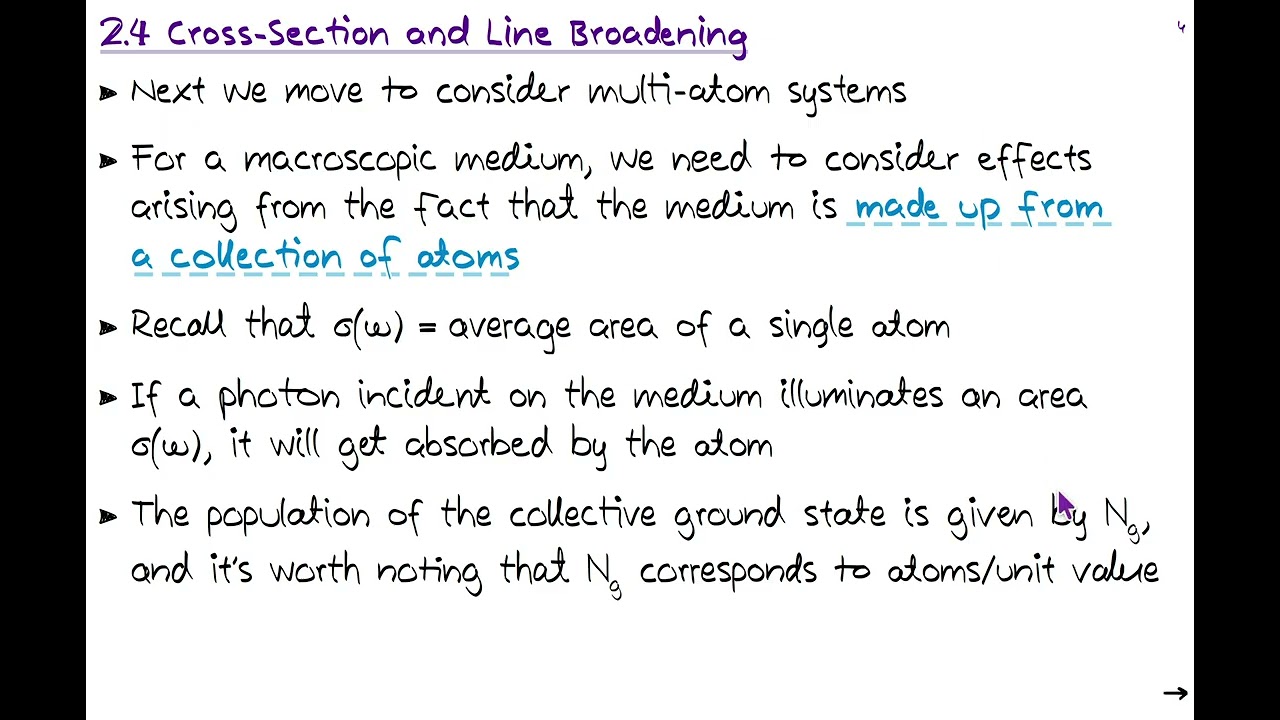
Laser Physics 2.4 Cross-Section and Line Broadering
Keywords
Summary
167 words
Critical Evaluation
Value of the Information & Strength of the Argument
The lecture provides a solid mathematical foundation for understanding absorption cross-sections and the transition to macroscopic media. The argumentation is logical and step-by-step, building from single-atom physics to collective effects. The instructor clearly explains the physical meaning of the cross-section and how it relates to macroscopic quantities like photon flux. The use of the line shape function to generalize the delta function is well-motivated, and the discussion of broadening mechanisms is insightful. However, the presentation could benefit from more explicit connections to experimental observations or practical examples.
Scientific Rigor, Source Quality, Title Accuracy
The lecture is scientifically rigorous, with derivations that follow standard laser physics textbooks. However, no specific sources are cited within the video, and the description provides no references. The title accurately reflects the content, and the lecture is well-structured. The instructor acknowledges minor typos, which slightly detract from the presentation’s polish. Overall, the scientific content is reliable, but the lack of citations limits the ability to verify specific claims.
171 words
Title / Content Match
The title accurately reflects the content, which covers absorption cross-section and line broadening mechanisms in laser physics.
Quality & Reliability
7/10
The lecture is a formal educational presentation with clear mathematical derivations and references to standard physics concepts. The content is consistent with established laser physics theory, though it lacks citations to specific sources and contains minor typos.
Key Moments
Markers derived by PSI from the transcript: the creator did not define chapters.
- Introduction: moving from single emitters to macroscopic media.
- Derivation of absorption cross-section for a two-level system.
- Introduction of photon flux and its relation to intensity.
- Geometrical interpretation of cross-section and thin slab absorption.
- Transition from delta function to line shape function.
- Discussion of homogeneous and inhomogeneous broadening.
- Convolution of line shape functions and total broadening.
- Summary and preview of next lecture.
Contribution & Novelties
The lecture provides a clear pedagogical bridge from single-atom quantum mechanics to macroscopic laser media, emphasizing the role of line shape functions. It offers a conceptual framework for understanding how microscopic properties like cross-sections translate to macroscopic absorption rates. The discussion of homogeneous and inhomogeneous broadening sets the stage for more detailed treatments.
Pour aller plus loin :
- Absorption cross section — Provides a general overview of the concept.
- Doppler broadening — Relevant to the discussion of gaseous media.
- Spectral line shape — Explains different line broadening mechanisms.
88 words
Radar Profile
The radar profile shows high scores in information quality and technical level, indicating a technically dense and reliable lecture. The lower score in information quantity suggests that the lecture is focused and does not cover a wide range of topics. The overall balance is typical for an advanced physics lecture.