Laser Physics 1.4 Properties of Laser Beams
Keywords
Summary
170 words
Critical Evaluation
Value of the Information & Strength of the Argument
The lecture provides a solid foundation in laser physics, clearly explaining each property and its physical origin. The argumentation is logical, building from the basic concept of coherence to explain monochromaticity, directionality, and brightness. The instructor uses intuitive examples and figures to illustrate abstract concepts, making the material accessible. The discussion of coherence times for different laser types and the mention of integrated lasers highlight the practical relevance and current research directions. The treatment is rigorous, with correct formulas and references to standard principles like the uncertainty relation.
Scientific Rigor, Source Quality, Title Accuracy
The lecture is scientifically rigorous, with accurate explanations and formulas. The instructor references standard concepts and provides examples from real-world applications, such as lunar laser ranging. No external sources are cited, but the content aligns with established laser physics textbooks. The title accurately reflects the content, which focuses on the properties of laser beams. The lecture is well-structured and suitable for an introductory course in laser physics.
170 words
Title / Content Match
The title accurately reflects the content, which focuses on the properties of laser beams.
Quality & Reliability
8/10
The lecture is scientifically accurate, covering fundamental concepts of laser physics with correct formulas and examples. It is presented by an expert in the field, likely a university lecturer. The content is well-structured and aligns with standard textbook treatments.
Key Moments
Markers derived by PSI from the transcript: the creator did not define chapters.
- Introduction to the lecture on properties of laser beams.
- Discussion on monochromaticity and linewidth.
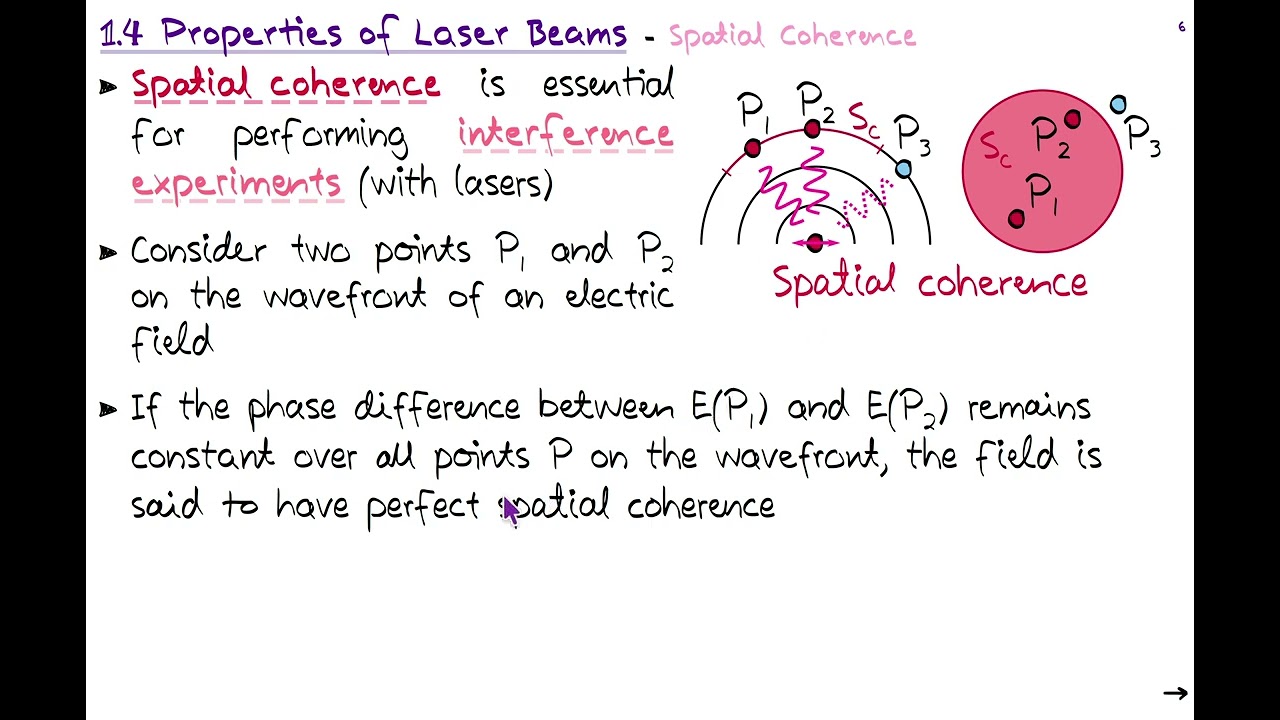
- Explanation of spatial and temporal coherence.
- Examples of coherence times for different laser types.
- Introduction to directionality and divergence angle.
- Derivation of diffraction limit and beam propagation.
- Definition of brightness and its importance.
- Summary and conclusion of the lecture.
Contribution & Novelties
The lecture provides a clear and comprehensive overview of laser beam properties, emphasizing the central role of coherence. It offers practical examples and intuitive explanations that enhance understanding. The discussion of coherence times for various laser types and the mention of integrated lasers highlight current research trends.
Pour aller plus loin :
- Coherence (physics) — Provides a broader context on coherence in wave physics.
- Laser — General overview of laser principles and applications.
- Gaussian beam — Related to beam propagation and divergence.
- Uncertainty principle — Relevant to the coherence time-linewidth relation.
91 words
Radar Profile
The radar profile shows high scores across all dimensions, indicating a well-rounded and reliable educational resource. The lecture excels in information quantity and quality, with a strong technical level and high overall reliability.