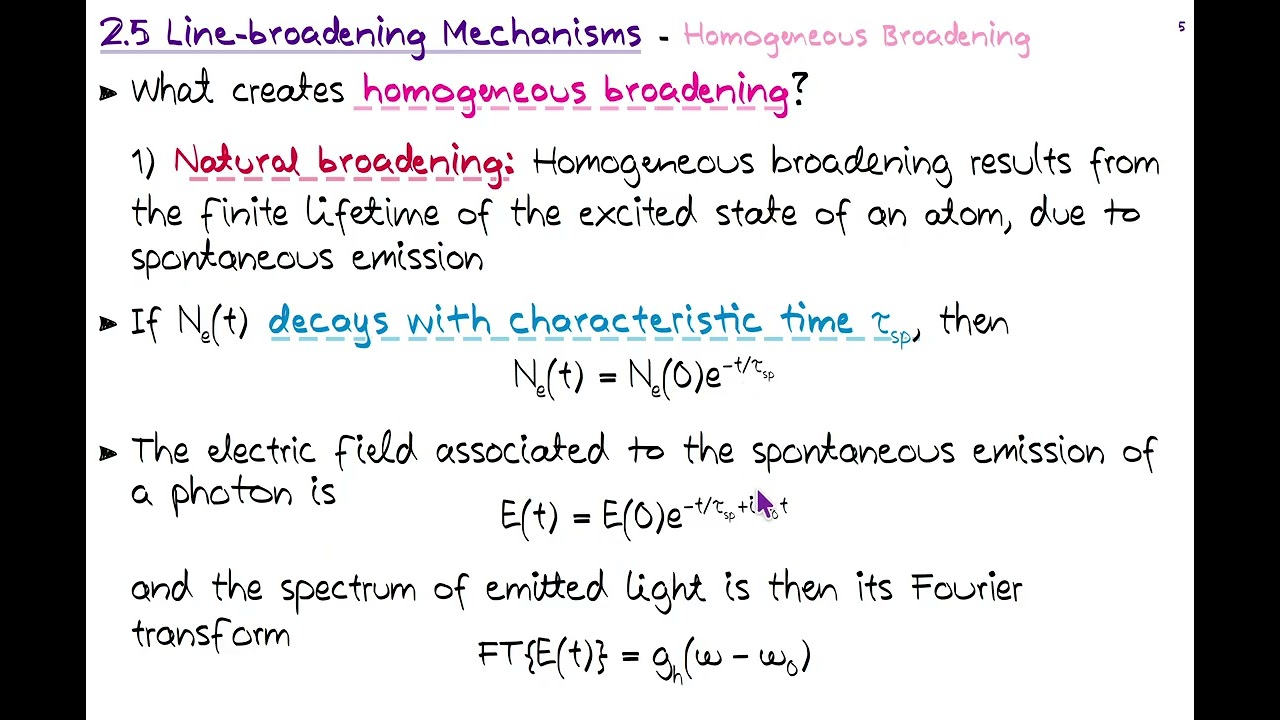
Laser Physics 2.5 Line-broadering Mechanisms
Keywords
Summary
139 words
Critical Evaluation
Value of the Information & Strength of the Argument
The lecture provides a solid conceptual foundation for understanding line broadening in laser media. It clearly distinguishes between homogeneous and inhomogeneous mechanisms, explains their physical origins, and derives the relevant line shape functions. The argumentation is logical and builds on previous knowledge, such as Fermi’s golden rule and the Maxwell-Boltzmann distribution. The use of examples like Ti:sapphire and Doppler broadening helps to illustrate the concepts. However, the lecture is introductory and does not delve into advanced derivations or quantitative comparisons, which limits its depth.
Scientific Rigor, Source Quality, Title Accuracy
The lecture is scientifically accurate and follows standard textbook treatments of line broadening. It references concepts like Fermi’s golden rule and the Maxwell-Boltzmann distribution, but does not cite specific sources. The title accurately reflects the content. The lack of explicit citations is a minor weakness, but the material is well-established physics.
150 words
Title / Content Match
The title accurately reflects the content, which focuses on line broadening mechanisms in laser physics.
Quality & Reliability
7/10
The lecture provides a clear and structured introduction to homogeneous and inhomogeneous line broadening mechanisms, with correct physical formulas and references to standard concepts. However, it lacks citations to specific sources and does not include experimental data or verification.
Key Moments
Markers derived by PSI from the transcript: the creator did not define chapters.
- Introduction to line broadening mechanisms and course context
- Definition of homogeneous broadening and Lorentzian line shape
- Natural broadening due to spontaneous emission and its derivation
- Collision broadening and non-radiative decay mechanisms
- Combining homogeneous broadening contributions and total linewidth
- Introduction to inhomogeneous broadening and its physical origin
- Convolution of homogeneous and inhomogeneous line shapes
- Example: Ti:sapphire lasers and local field effects
- Doppler broadening in gases and Gaussian line shape
- Summary and preview of next lecture on spectral hole burning
Contribution & Novelties
The lecture provides a clear pedagogical introduction to line broadening mechanisms, emphasizing the distinction between homogeneous and inhomogeneous broadening and their physical origins. It connects theoretical concepts to practical examples like Ti:sapphire lasers and Doppler broadening, which helps to solidify understanding. The upcoming lecture on spectral hole burning will build on this foundation.
Pour aller plus loin :
- Lorentzian function — Mathematical background for homogeneous line shapes.
- Gaussian function — Mathematical background for inhomogeneous line shapes.
- Doppler broadening — Detailed explanation of Doppler broadening in gases.
- Ti:sapphire laser — Overview of Ti:sapphire lasers and their broad tuning range.
- Fermi’s golden rule — Quantum mechanical basis for transition rates and natural broadening.
111 words
Radar Profile
The radar profile shows a balanced performance with high scores in quality and technical level, but slightly lower in quantity and reliability. This indicates a well-structured lecture with accurate content, though it could benefit from more detailed examples and explicit citations.