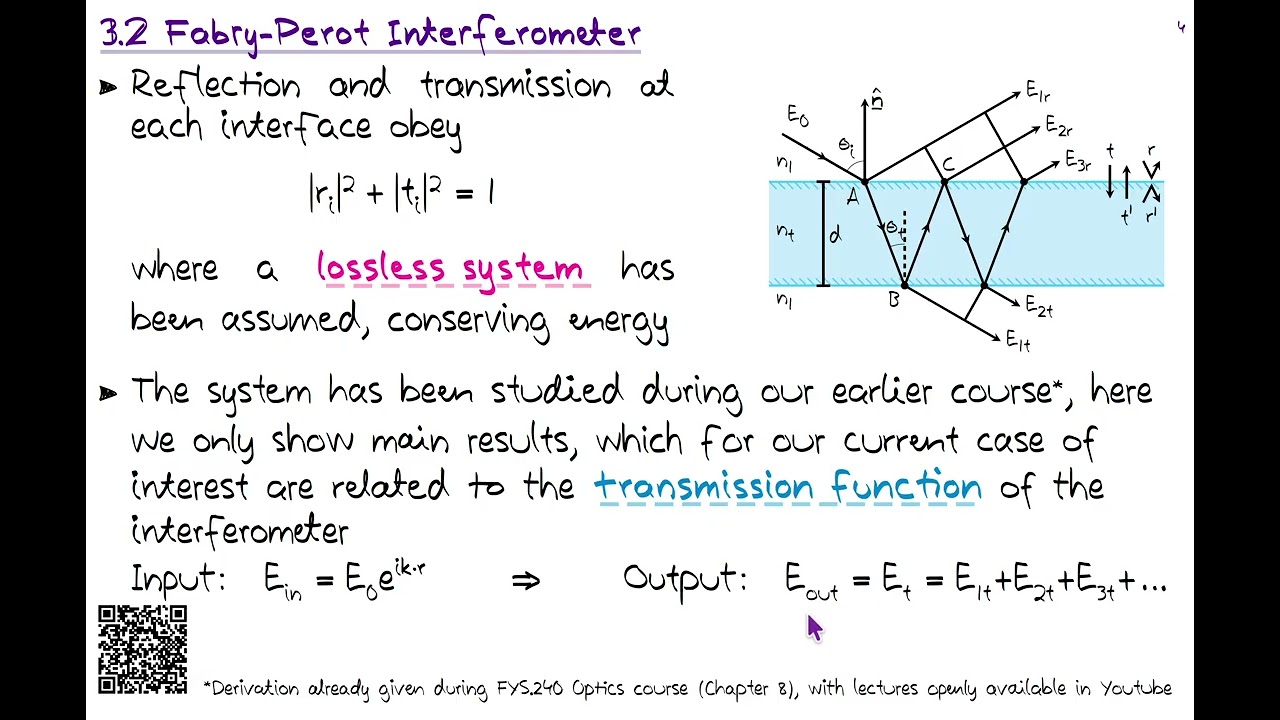
Laser Physics 3.2 Fabry–Pérot Interferometer
Keywords
Summary
129 words
Critical Evaluation
Value of the Information & Strength of the Argument
The video provides a solid, step-by-step derivation of the Fabry–Pérot interferometer’s transmission function, free spectral range, and finesse. The argumentation is logical, starting from basic assumptions (lossless mirrors, plane waves) and building up to the final formulas. The presenter clearly explains the physical meaning of each parameter and the approximations made (e.g., high reflectivity, normal incidence). The value lies in its pedagogical clarity, making complex derivations accessible. However, the presentation is purely theoretical, with no experimental validation or discussion of practical limitations, which limits its practical value.
Scientific Rigor, Source Quality, Title Accuracy
The scientific rigor is moderate: the mathematics is standard and correctly presented, but the video lacks citations to external sources or references. The presenter mentions previous lectures and a QR code for derivation details, but no specific sources are cited. The title accurately reflects the content. The informal tone and occasional verbal slips (e.g., ‘fibroparero’) do not affect the mathematical correctness. Overall, the content is reliable for educational purposes, but the lack of references and the informal style reduce its scientific rigor.
184 words
Title / Content Match
The title accurately reflects the content, which focuses on the Fabry–Pérot interferometer within a laser physics course.
Quality & Reliability
7/10
The video is a clear, structured tutorial on Fabry–Pérot interferometers, deriving key parameters (transmission function, free spectral range, finesse) with explicit assumptions. The mathematical derivations are standard and correct, though the presentation is informal and lacks citations. The content is reliable for educational purposes, but the lack of references and the informal style limit its scientific rigor.
Key Moments
Markers derived by PSI from the transcript: the creator did not define chapters.
- Introduction and motivation for Fabry–Pérot interferometers
- Applications: VCSELs, spectral filters, etalons
- Derivation of transmission function: summing transmitted fields
- Use of geometric series and assumptions of lossless mirrors
- Derivation of Airy function (transmission coefficient)
- Definition of free spectral range (FSR)
- Derivation of finesse: FWHM and approximation
- Final formula for finesse and physical interpretation
- Summary and importance for future lectures
Contribution & Novelties
The video provides a clear, self-contained derivation of the Fabry–Pérot interferometer’s key parameters, making it a useful educational resource. Its novelty lies in its pedagogical approach, breaking down the derivation into manageable steps. However, it does not present new scientific findings.
Pour aller plus loin :
- Fabry–Pérot interferometer - Wikipedia — Comprehensive overview of the interferometer, including applications and theory.
- Airy function - Wikipedia — Mathematical background on the Airy function used in the transmission formula.
- Optical cavity - Wikipedia — General concept of optical resonators, including finesse and Q factor.
91 words
Radar Profile
The radar profile shows balanced scores across all dimensions, with slightly higher scores in technical level and reliability, reflecting the video's solid mathematical content and clear explanations. The lower score in information quantity suggests the video is focused and concise, covering only the essential parameters.