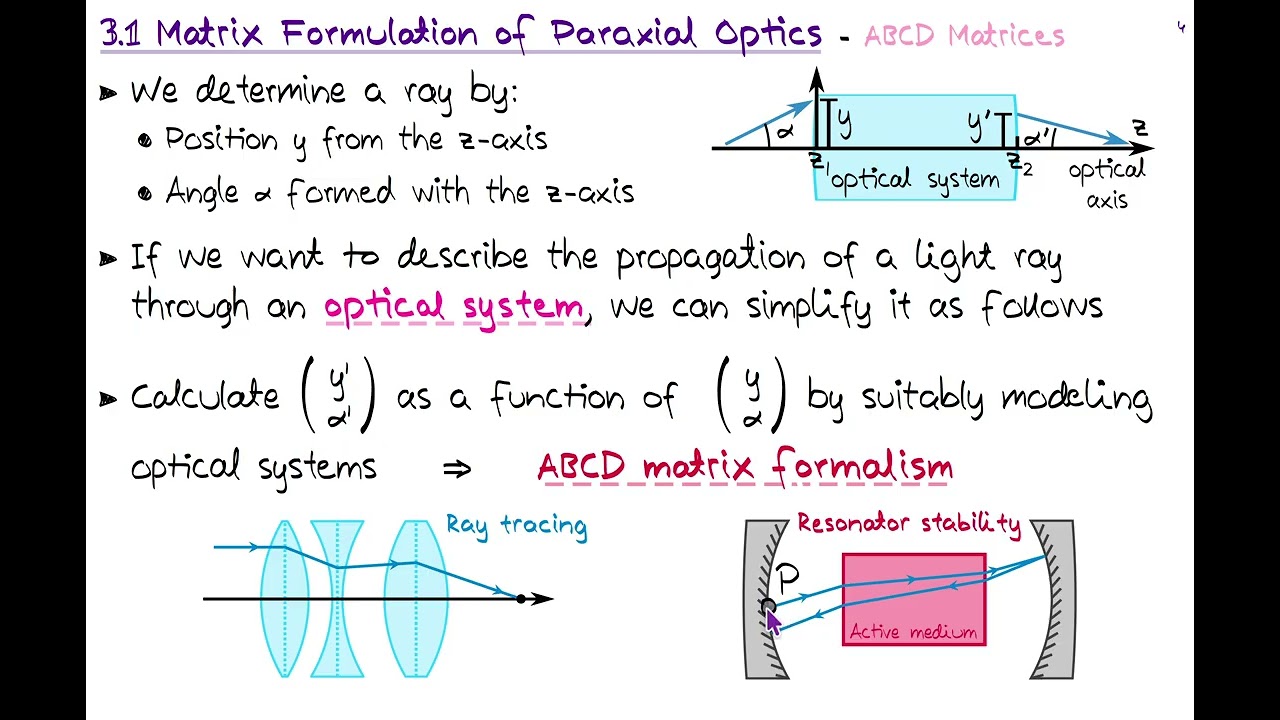
Laser Physics 3.1 Matrix Formulation of Paraxial Optics
Keywords
Summary
142 words
Critical Evaluation
Value of the Information & Strength of the Argument
The video provides a solid introduction to the ABCD matrix formalism, which is essential for laser physics. The instructor explains the concepts clearly, starting from basic principles and building up to more complex systems. The derivations are logical and easy to follow, and the emphasis on conventions and pitfalls (such as sign changes and matrix order) is valuable. The argumentation is coherent and well-structured, with each step justified. However, the presentation is purely verbal with no visual aids, which makes it harder to grasp the geometrical aspects. The content is accurate and aligns with standard textbooks, making it a useful resource for students.
Scientific Rigor, Source Quality, Title Accuracy
The scientific rigor is high; the instructor correctly derives the ABCD matrices and explains the underlying assumptions. He references the book by ’to’s’ (likely a typo for ‘Yariv’ or ‘Siegman’), but no specific sources are cited in the video or description. The title accurately reflects the content. The lack of visual aids and the informal delivery reduce the overall quality, but the technical content is reliable. No comments were provided, so no analysis of public reception is possible.
196 words
Title / Content Match
The title accurately reflects the content, which is a lecture on the matrix formulation of paraxial optics.
Quality & Reliability
7/10
The content is a clear and accurate tutorial on the ABCD matrix formalism, with derivations and explanations of conventions. The instructor demonstrates solid knowledge of the subject. However, the video has very low production values and lacks visual aids, which may hinder comprehension. The scientific content is correct, but the presentation is not polished.
Key Moments
Markers derived by PSI from the transcript: the creator did not define chapters.
- Introduction to chapter 3 on passive optical resonators.
- Motivation for using ABCD matrix formalism in laser physics.
- Definition of ray vector (position and angle) and paraxial approximation.
- Introduction to ABCD matrices and their role in ray propagation.
- Explanation of sign conventions for ray propagation and mirror curvature.
- Derivation of ABCD matrix for free-space propagation.
- Derivation of ABCD matrix for propagation in a medium with refractive index n.
- Derivation of ABCD matrix for a thin lens using the thin lens equation.
- Derivation of ABCD matrix for a spherical mirror, including sign conventions.
- Discussion of planar mirror as a limiting case and the importance of propagation direction.
- Generalization to multiple optical elements and the order of matrix multiplication.
- Introduction of the determinant of the system matrix and its relation to etendue.
- Conclusion and preview of the next lecture on Fabry-Perot interferometers.
Contribution & Novelties
This video provides a clear and concise introduction to the ABCD matrix formalism, which is a fundamental tool in laser physics. It covers the basic matrices for free-space propagation, thin lenses, and mirrors, and explains how to combine them for complex systems. The emphasis on conventions and common pitfalls is particularly useful for students. The lecture is part of a series on laser physics, so it builds on previous material and sets the stage for future topics like resonator stability.
Pour aller plus loin :
- ABCD matrix (Wikipedia) — Provides a comprehensive overview of the ray transfer matrix method, including examples and applications.
- Paraxial approximation (Wikipedia) — Explains the paraxial approximation and its validity in optics.
- Etendue (Wikipedia) — Discusses the concept of etendue, which is related to the determinant of the system matrix and conservation of brightness.
138 words
Radar Profile
The radar profile shows a balanced performance across all dimensions, with slightly lower scores in presentation quality due to the lack of visual aids. The content is technically sound and well-structured, making it a reliable educational resource.